Definition
Voluntary contrast is the deliberate interruption of a chain that already works, long enough to feel what the chain was buying and what its absence costs.
Origin
Adaptation-level work treats happiness and ordinary pleasure as relative to recent peaks. Brickman, Coates, and Janoff-Bulman (1978) reported that lottery winners were not happier than controls and took less pleasure from everyday events — a contrast effect — while accident victims showed a different pattern, idealizing the past rather than boosting minor pleasures. The paper is about peaks that happen to you.
Voluntary contrast uses the same relativity on purpose. You remove one link you already trust — a cue, a first rep, a start ritual — and you watch which downstream behaviours were riding it. The interruption is the instrument. The absence is the measurement.
Adjacent, not the same: hedonic adaptation is what happens when a peak re-anchors you without your choosing the removal. A saboteur skip is an interruption whose payoff stays hidden. Voluntary contrast is chosen, short, and written down.
Mechanism
Repetition hides the dynamic. A chain that runs every morning stops tasting like a chain. The first link looks optional because the later links feel like character.
- Pick a link that works. Not a link you already dodge. The point is to see a function, not to confirm a failure.
- Remove it once, on purpose. Keep the rest of the day. Do not replace it with a speech.
- Weigh both sides. What you gained by not doing it (rest, variety, a walk you never take) and what did not start (the journal, the song, the next rep).
- Put the link back, or change the dose. The experiment ends. A permanent deletion is a different decision.
extreme discipline → extreme freedom is the polarity this serves: freedom inside a discipline includes the right to break it once so you know what you are keeping. Micro-negotiations often pose as this experiment. The tell is whether the skip was decided before the cue, and whether you wrote the cost. Saboteur mechanics is the skip that protects a standard (“exhaustion is normal”) without a measurement.
Epistemic boundary: Brickman et al. (1978) is a small-sample landmark about unchosen peaks, not a protocol for habit interruption. Diener, Lucas, and Scollon (2006) revise how complete and how fixed adaptation is. Crossref confirms both records. This note claims only that a chosen absence can reveal a dependency a running chain conceals. It does not claim that skipping a practice improves it.
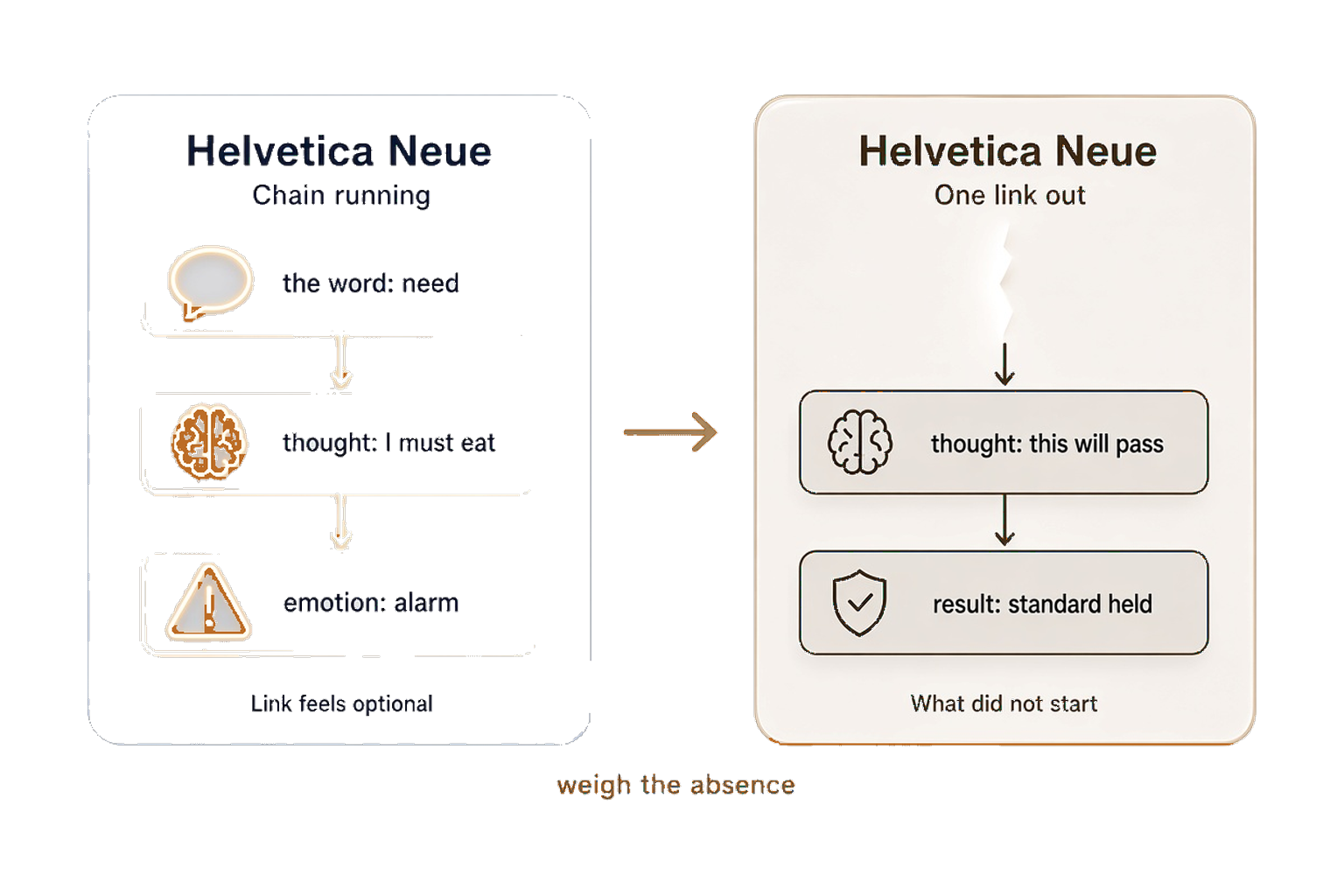
A running chain hides the link. One chosen gap shows what did not start.
Applications
- When a routine has gone numb, skip the first link once and list what failed to start.
- When you are about to automate a chain, run the contrast first: if nothing downstream depends on the link, do not automate it.
- After a peak day, expect ordinary work to feel worse by contrast. That drop is information about the peak, not a verdict on the ordinary work.
Failure modes
- Collector trap: breaking chains as a lifestyle instead of one measured miss.
- Overclaim trap: calling every skipped rep an experiment.
- Test today: skip one working first link, write the gain and the loss, and restore or redesign it the next day.
Sources
Cite
- Brickman, P., Coates, D., & Janoff-Bulman, R. (1978). Lottery winners and accident victims: Is happiness relative?. Journal of Personality and Social Psychology, 36(8), 917–927.
- Diener, E., Lucas, R. E., & Scollon, C. N. (2006). Beyond the hedonic treadmill: Revising the adaptation theory of well-being. American Psychologist, 61(4), 305–314.