Working definition
The member lists every system that runs their life, then picks the one whose evolution forces the others to evolve — the keystone — and ignores the rest until it holds.
How it works
A life is never one system. It is dozens: the morning system, the work system, the food system, the recovery system, the relationship system, the training system. Trying to upgrade all of them at once is what Yann calls trying to eat the elephant whole. The result is overload, drift, and a return to the old pattern.
The doctrine inverts the move:
- List the systems. Write them down: every recurring sequence that already runs the day, well or poorly.
- Find the keystone. Among the list, identify the one system whose progress would pull others forward by gravitational effect. A solid morning system often does this. A solid preparation system often does this. The keystone is rarely glamorous.
- Commit to that one only. Build it, measure it, anchor it. Resist the urge to launch three more. The other systems stay where they are, on purpose.
- Move to the next keystone only when the first one holds without effort.
You trade breadth for depth, and depth produces leverage.
Signature
The image is the keystone inside the arch — one subsystem the whole Personal OS rests on; when it cracks, every Battle feels heavy — 2026-02-16.
More room passes mention this doctrine in replay narrative — search the Codex for System Within the System or start from the latest entry on Weekly Sessions.
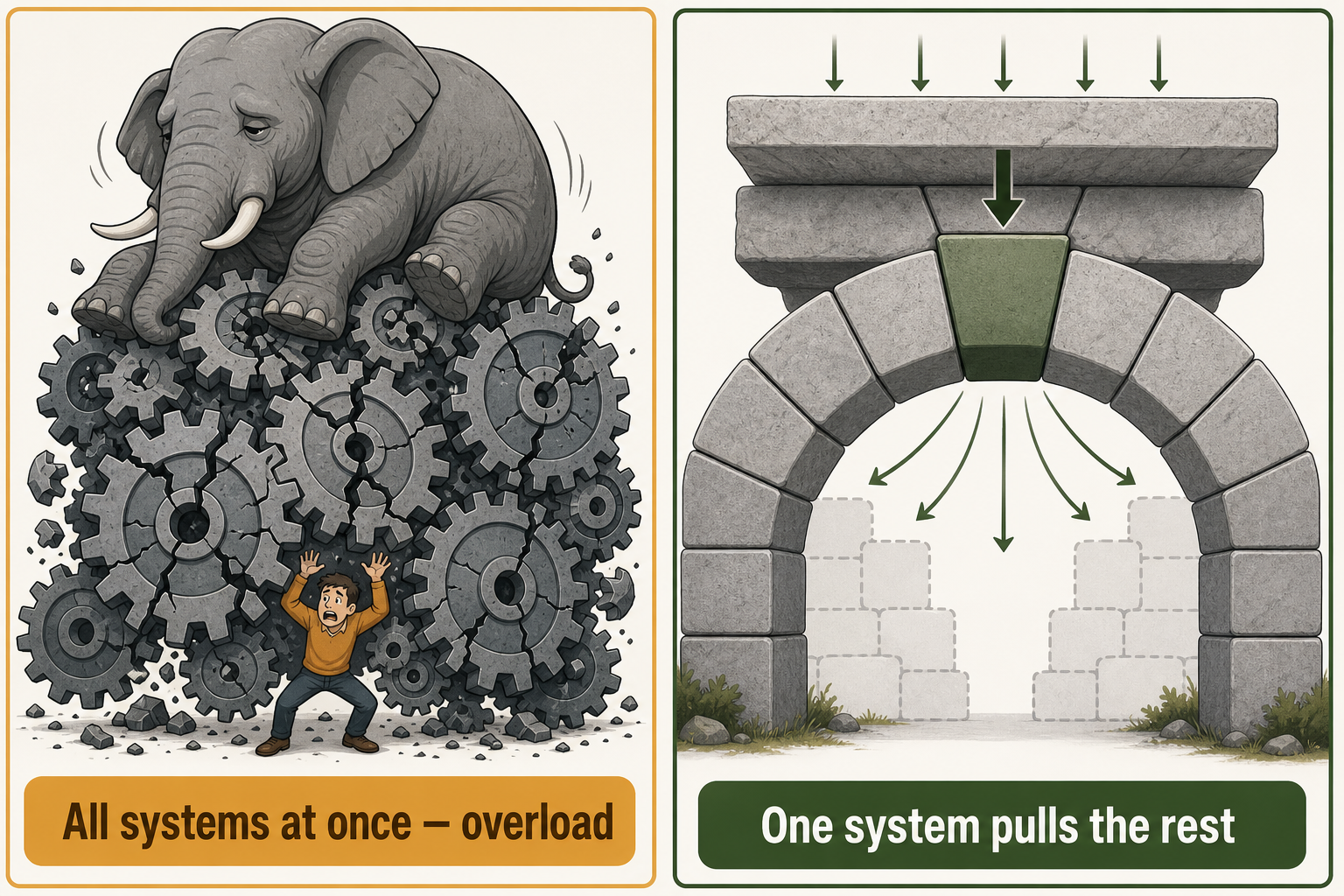
Eat the whole elephant versus one keystone until it holds. Your move: Your move this week.
Your move this week
This week’s micro-action (24–72 hours):
- List every recurring system in your week — five to fifteen rows.
- Mark the one whose stable execution would make at least two others easier.
- Commit to only that one for seven days.
- Calibrate it with the Calibration protocol.