Definition
Pressure is the arousal you feel when stakes, deadlines, or self-demand rise — it can stimulate action or flip into threat mode where the head spins and efficiency collapses.
Origin
The Yerkes–Dodson curve describes performance rising with arousal to a point, then falling — not more pressure equals better results. Challenge versus threat appraisal (biopsychosocial model) maps onto different cardiovascular profiles: challenge tends toward mobilisation; threat toward constriction and impaired execution. The simple inverted-U is only weakly supported as a universal law — discrete psychobiological states matter more than a single arousal dial.
Mechanism
In live coaching calibration, enough pressure to act — not so much that the body locks into threat mode (head loops, tension, lost organisation). The skill is not finding a fixed perfect level but switching self-orchestrated pressure into stimulation when interception says this is the wrong kind.
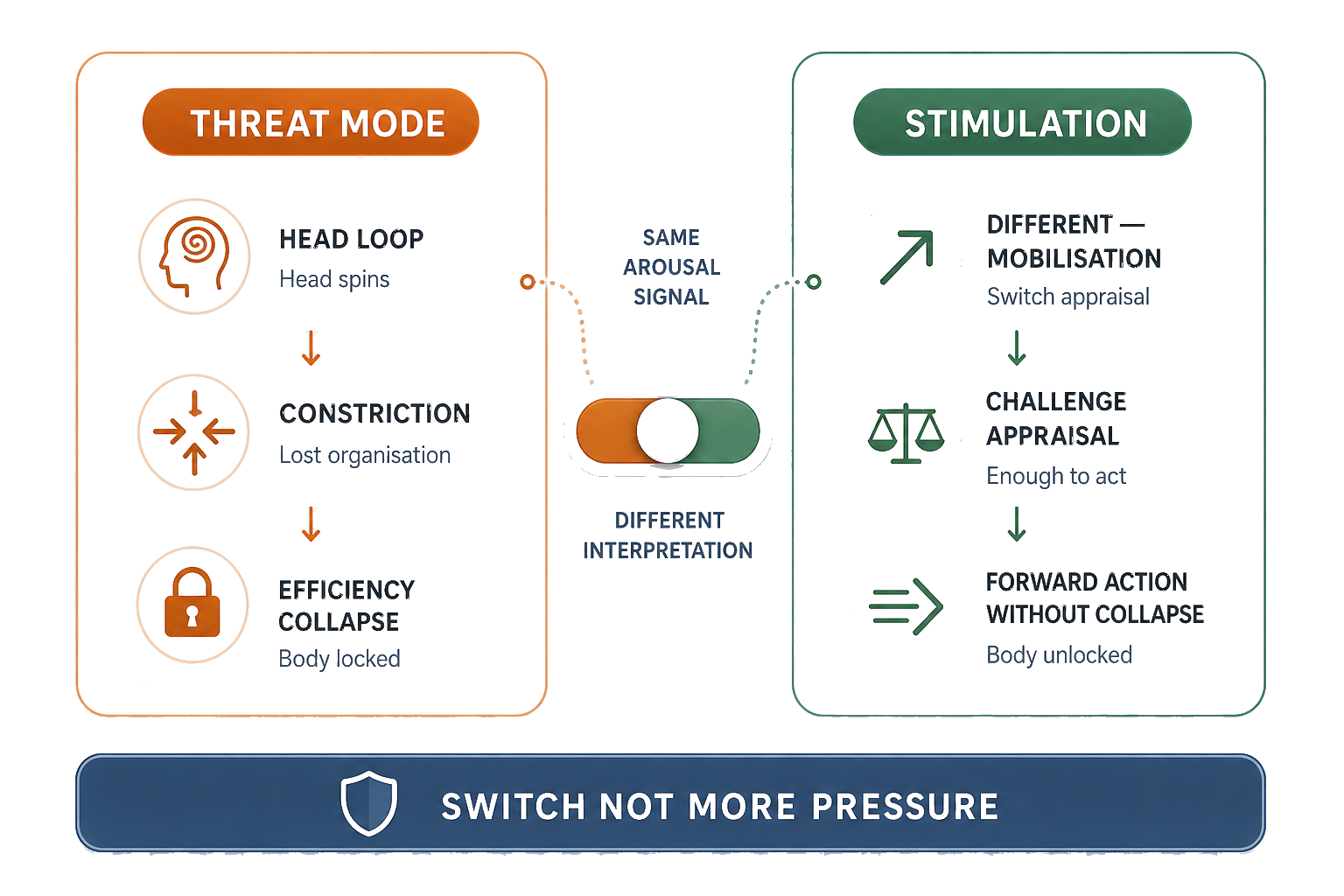
Same arousal signal — threat collapse vs stimulation switch. Not more pressure as default fix. Curated domain trail: Focus.
Journal granularity: intensity, thoughts, body cues, and whether you switched or stopped.
Failure modes
- More pressure as default fix — treating every stall as not enough arousal when the body is already in threat mode.
- Eliminating pressure entirely — lightness without a lead measure produces drift, not balance (Pressure vs lightness).
- Confusing noble intention with trainable edge — intention without a rep.
Applications
- Custom cadence (45-91): train the switch inside the morning block, not only the lag outcome.
- Govern poles with Pressure vs lightness — not eliminate pressure, govern it.
- Avoid confusing pressure with intention — noble direction without a trainable edge.
Related doctrine
Sources
Cite
- Behnke, M., & Kaczmarek, Ł. D. (2018). Successful performance and cardiovascular markers of challenge and threat: A meta-analysis. International Journal of Psychophysiology, 130, 73–79.
- Neiss, R. (1988). Reconceptualizing arousal: Psychobiological states in motor performance. Psychological Bulletin, 103(3), 345–366.