Definition
Where the autonomic system habitually lives — threat vigilance versus accessible safety.
Origin
Stephen Porges developed polyvagal theory to explain how mammalian autonomic states gate social engagement, mobilization, and shutdown — with the vagus as a central regulator, not a single “calm nerve.”
Mechanism
A hierarchical autonomic model: ventral vagal supports social connection and flexible attention; sympathetic mobilizes fight/flight; dorsal vagal supports immobilization under extreme threat. Tone is the chronic bias toward one state — insecurity keeps the system scanning; trained safety cues can shift default state over time through repeated co-regulation and body-based practices (not affirmation alone). Empirical work debates whether heart-rate variability and related indices map cleanly onto this three-state hierarchy — use the frame for state mapping and intervention pacing, not as a standalone diagnostic label.
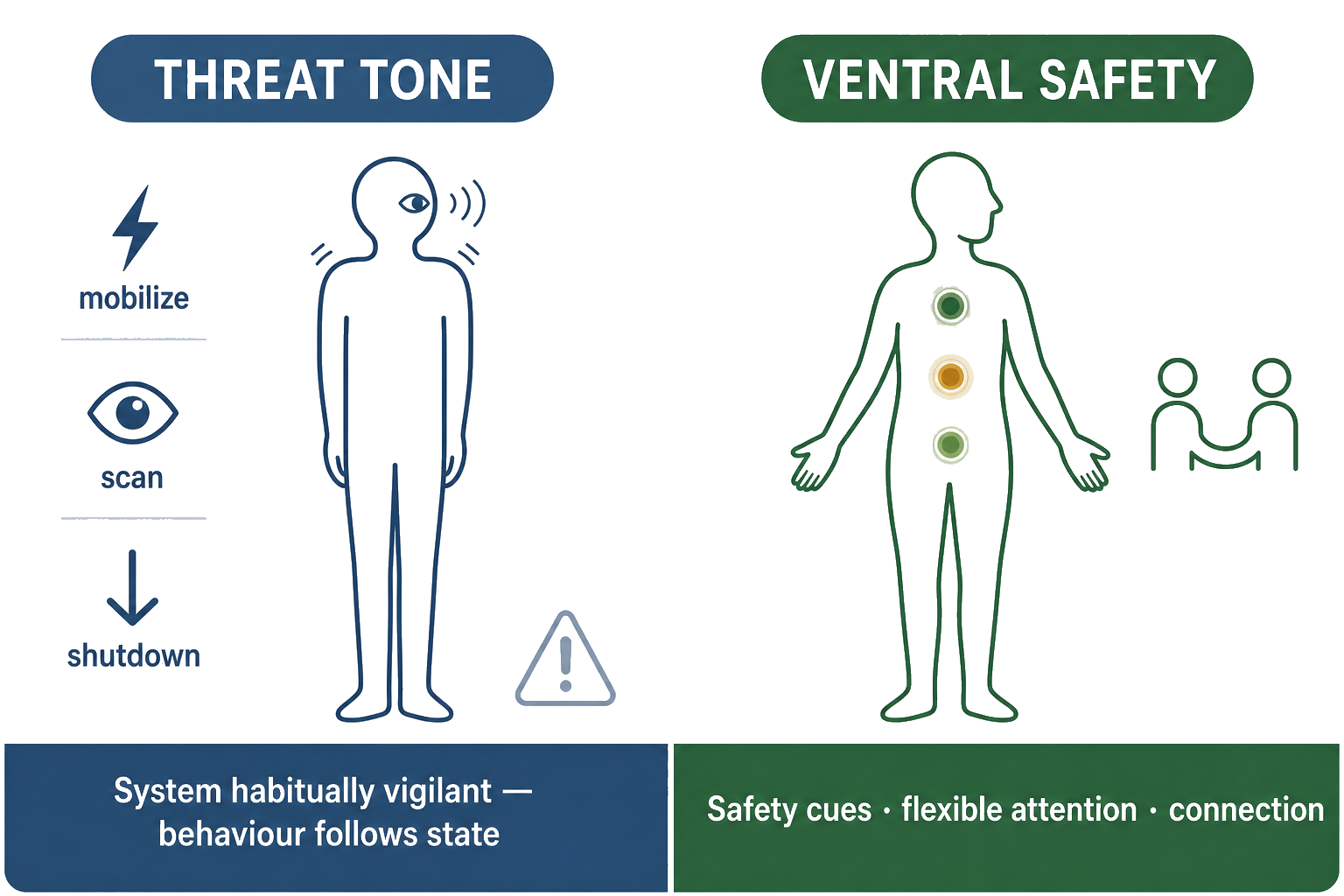
Map behaviour to state before moralizing — threat tone scans and shuts down; ventral safety opens connection. Pair with Interoceptive Markers.
Applications
Map behaviour to state before moralizing it: shutdown is not laziness; hypervigilance is not character flaw. Interventions target state shift (breath, voice, proximity, pacing) then cognition. Pair with owned interoceptive markers (Interoceptive Markers).
Sources
Cite
- Porges, S. W. (2011). The polyvagal theory: Neurophysiological foundations of emotions, attachment, communication, and self-regulation. W. W. Norton
- Porges, S. W. (2007). The polyvagal perspective. Biological Psychology, 74(2), 116–143.