Definition
Microdoing is a small addition to an imperfect system that already runs — one more link, one more cue — so the next instance fires without renegotiation.
Origin
Implementation intentions bind when–where–how so the first act does not wait for a feeling of readiness (Gollwitzer, 1999). Habit research adds the other half: context cues take the behaviour once the association is learned, so the morning vote is no longer required (Wood & Neal, 2007). Club language microdoing names the system dose: you do not wait for a finished automation. You add one imperfect link and let tomorrow prove it.
Mechanism
Two doses get folded that should not be.
- Skill micro-dose. A tiny same-day rep inside a longer deliberate-practice arc (grip today; weeks on the backhand). That is micro dosing.
- System micro-dose. The chain is already there and ugly. You add one link — a tile, a song, a recap — without waiting for the perfect stack. Tomorrow it fires. The morning vote is gone.
- Vote removed. Micro-negotiations is the inner lobby the increment deletes. The deterministic result becomes more probable because the first link no longer asks permission.
Adjacent, not the same: Don’t break the chain is what a streak does once the system is running. Environment cue sculpting is why the cue lives on the bath tile and not in a settings menu. Speed of implementation is the latency to start a chain. Microdoing is the latency to improve an already-started imperfect chain.
Epistemic boundary: this note does not claim that every system should be automated, or that more links are always better. It claims that waiting for a perfect stack and adding one imperfect link are different relations to the same ritual.
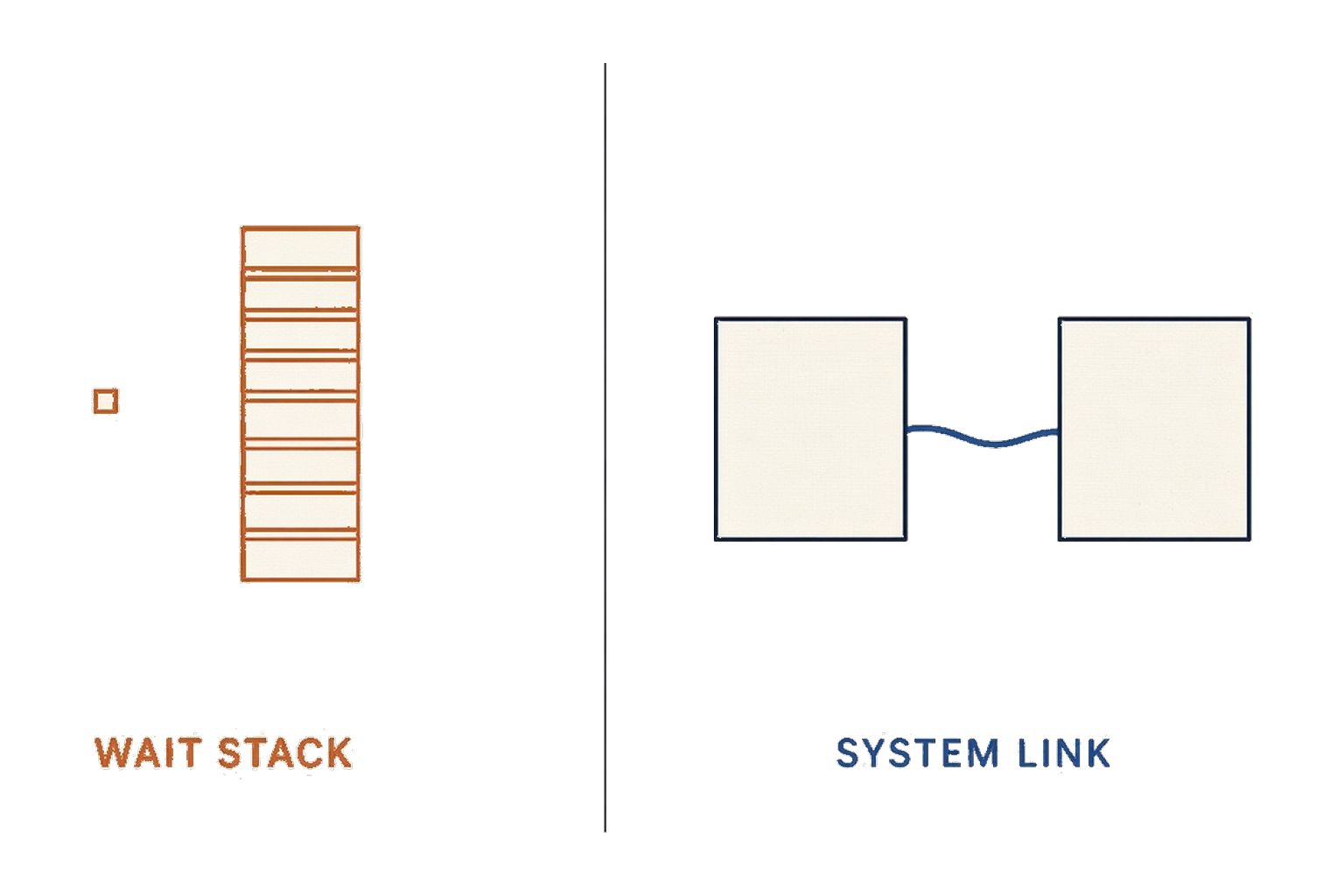
Wait stack vs system link — a skill rep is not a system increment.
Applications
- When an automation is 80% done and the last 20% is being decorated, add the next felt-friction link and ship.
- Pair with Intention–execution gap when the gap is a daily vote, not missing knowledge.
- Pair with Goodhart’s Law when the next increment would be a metric that steals the pleasure of the ritual.
Failure modes
- Collector trap: designing the perfect stack instead of adding one link that fires tomorrow.
- Overclaim trap: calling every gadget a microdoing when no behaviour changed.
- Test today: name one imperfect chain you already run. Add one link. Refuse the vote the next morning.
Sources
Cite
- Gollwitzer, P. M. (1999). Implementation intentions: Strong effects of simple plans. American Psychologist, 54(7), 493–503
- Wood, W., & Neal, D. T. (2007). A new look at habits and the habit-goal interface. Psychological Review, 114(4), 843–863
- Clear, J. (2018). Atomic Habits. Avery