Working definition
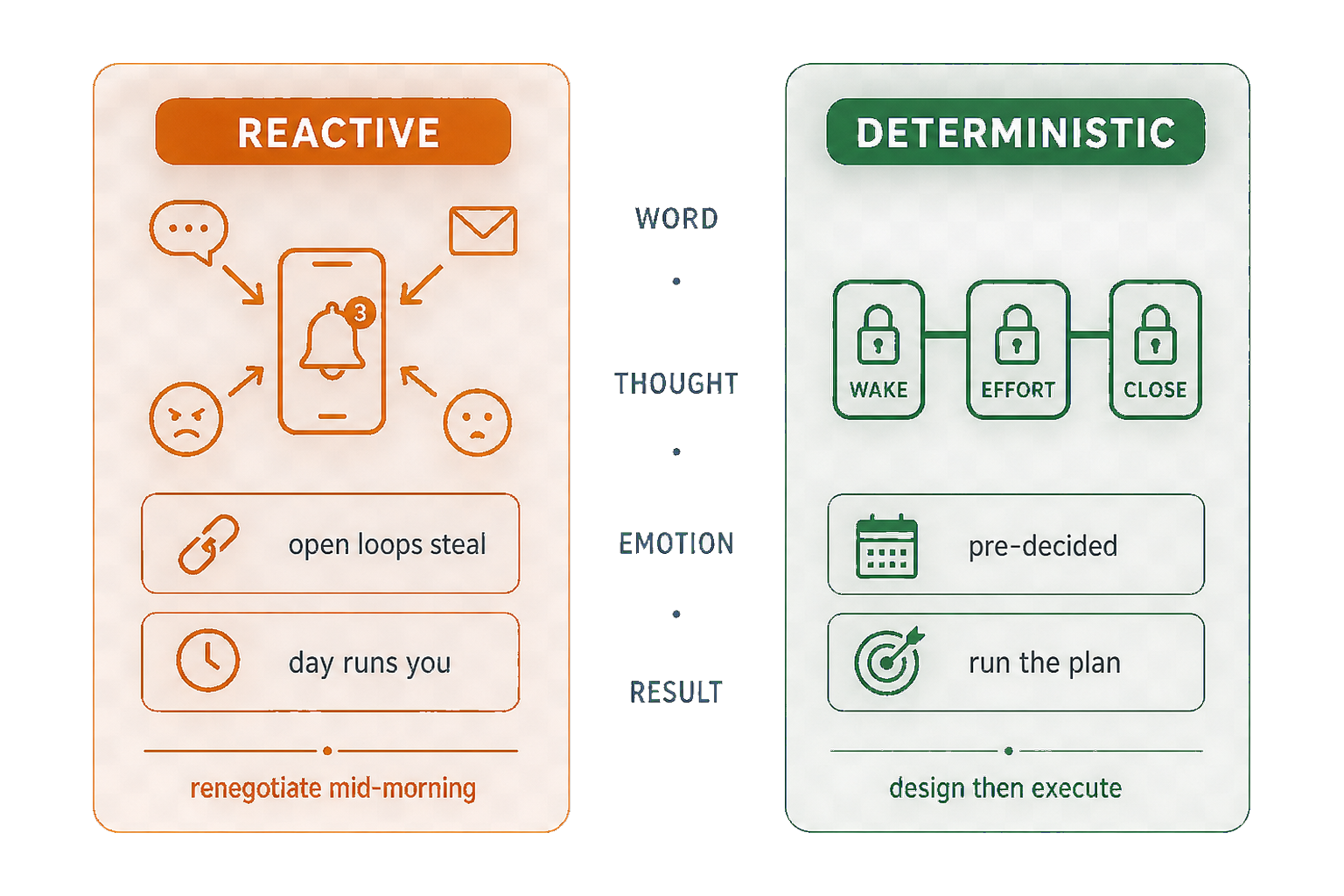
The deterministic day is the day you design and run on purpose — not the day that runs you through reaction, emotion, and unfinished loops.
How it works
Most mornings open on reactive autopilot: notifications, mood, whatever arrives. The deterministic day is the opposite governance: you already decided wake · effort block · recovery · measures — then you execute.
Ideal day is the reference build. The deterministic day is the lived instance — closer or farther from that build. Contrast teaches: sleep past the designed window and you feel what the day was protecting (research space, serendipity, depth).
Pair with extreme discipline → extreme freedom: fixed defaults buy the freedom to stay deterministic when the body wants renegotiation. Pair with Zeigarnik Effect: unfinished tasks steal the day unless structure closes or parks the loops.
Signature
Design the day. Run it. Do not renegotiate mid-morning.
Room: 2026-07-29.
Your move this week
- Write tomorrow’s three non-negotiables (wake · effort · close).
- After the day: one line of contrast — what drifted, what held.
- Adjust the next deterministic day from evidence, not mood.
Scientific grounding
Cite
- Gollwitzer, P. M. (1999). Implementation intentions: Strong effects of simple plans. American Psychologist, 54(7), 493–503.
- Wood, W., Quinn, J. M., & Kashy, D. A. (2002). Habits in everyday life: Thought, emotion, and action. Journal of Personality and Social Psychology, 83(6), 1281–1297.
Pre-decided day structure turns intention into cue-driven habit instead of reactive renegotiation.
Adjacent
Personal Growth Engineering
Daily Adversity Time
Tipping point
Self-governance
Boxing category
execution of self-knowledge