Working definition
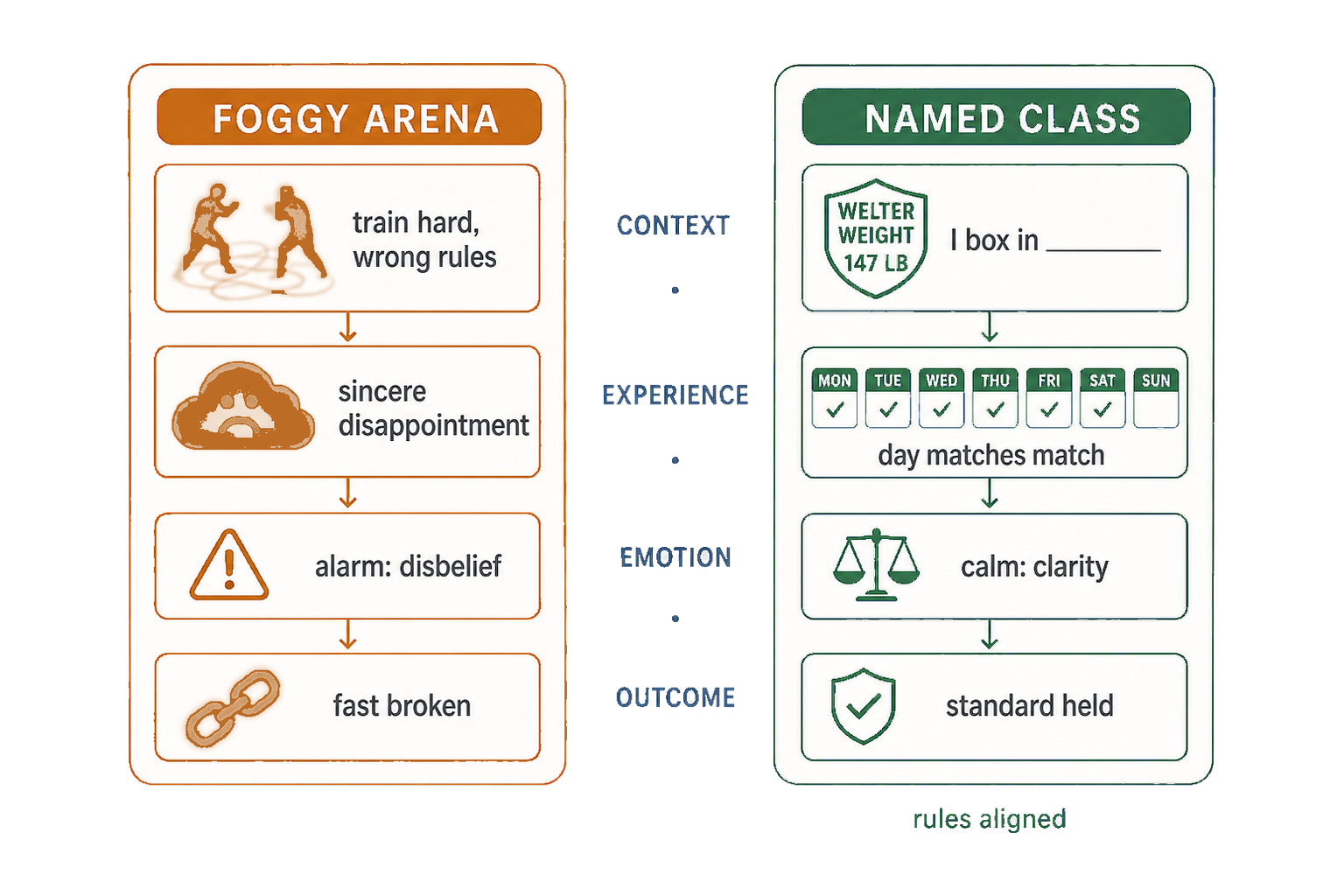
Boxing category is naming the weight class / craft arena you actually compete in — so adversity, standards, and ideal day match the real rules.
How it works
You often train hard inside a foggy arena: “I do martial arts,” “I do cooking,” “I do coaching” — without naming which game’s rules apply. Then you take hits from a different rule-set and call it failure.
Clarity of category precedes the micro-links. If the category is fuzzy, sincere effort still produces disappointment — you trained for karate and walked into capoeira. You may even need to change category after years of assumed identity: I thought I boxed here for ten years — I do not.
Category chooses:
- which adversity belongs in Daily Adversity Time
- which standards and norms you raise
- what ideal day must contain
Pair with Ikigai / Zone of Genius when the arena is purpose-shaped — Boxing category is the competitive frame, not the full purpose map.
Signature
Which category do I box in — and does my day train that match?
Room: 2026-07-29.
Your move this week
- Write one line: I box in ___.
- List what that category’s match day requires (effort block · measures · standards).
- Strike one behaviour that belongs to a category you no longer compete in.
Scientific grounding
Cite
- Locke, E. A., & Latham, G. P. (2002). Building a practically useful theory of goal setting and task motivation. American Psychologist, 57(9), 705–717.
- Duckworth, A., & Gross, J. J. (2014). Self-control and grit. Current Directions in Psychological Science, 23(5), 319–325.
A named arena makes the goal specific; grit without category clarity trains the wrong match.
Adjacent
Personal Growth Engineering
Social performance vs self-authored score
Choosing the right discomfort