Working definition
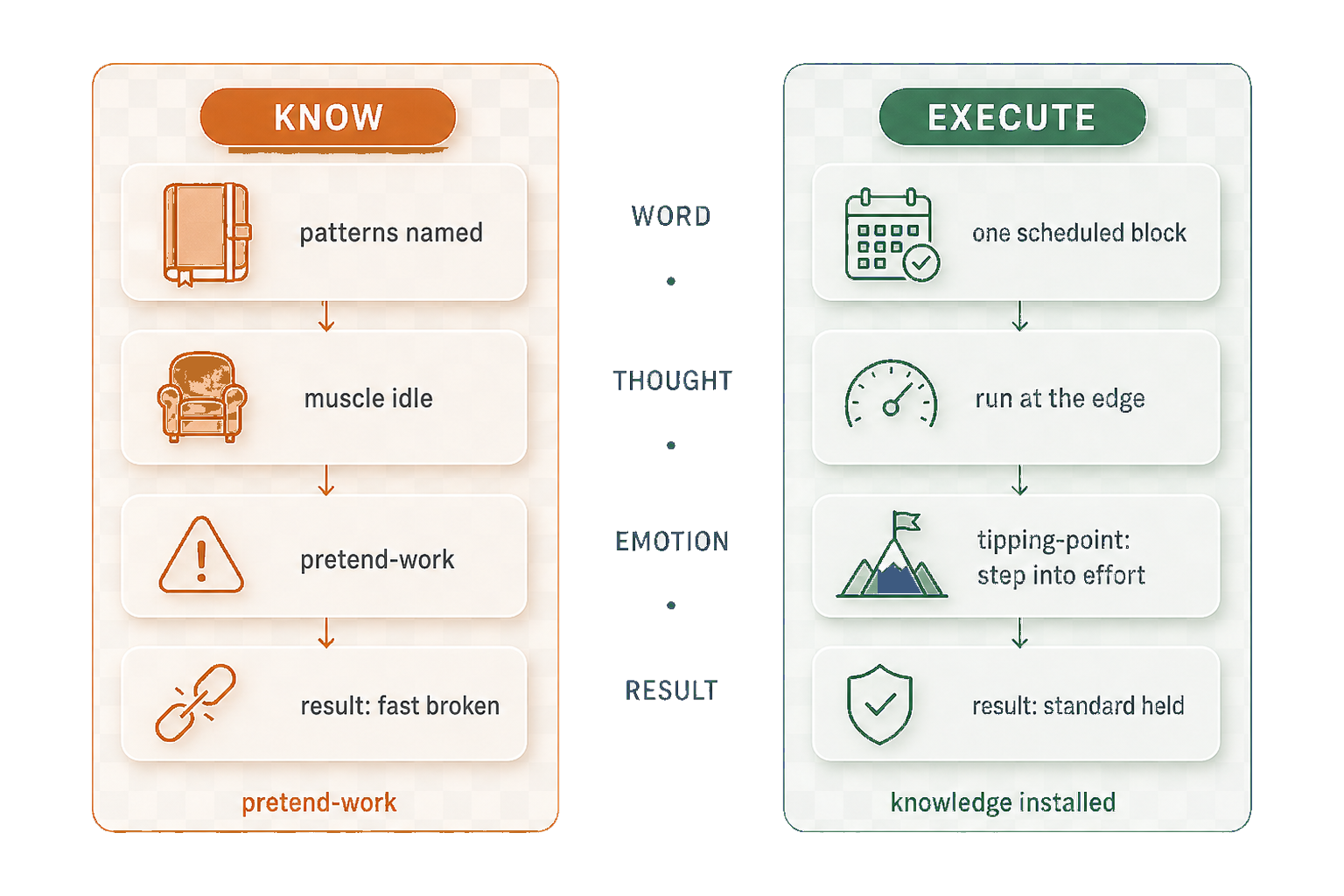
Execution of self-knowledge is the install: you already know enough about yourself — the differentiator is running that knowledge at the tipping point, not collecting more insight.
How it works
You can fill notebooks and still atrophy. Knowledge about yourself — patterns, saboteurs, ideal day — does not grow the muscle. Execution does.
The Club is mental fitness because the room already has knowledge; the gap is reps. Preparation matters — and becomes a flight costume when the match never starts. Pretend-work looks busy while goals stall.
Future self already holds the day and the standards. Execution of self-knowledge is closing the gap between what you know that future self needs and what you actually run today — especially at the moment the body wants exit.
Signature
You already know. Now execute.
Room: 2026-07-29.
Your move this week
- Write one self-insight you already trust (no new research).
- Translate it into one observable block before Friday.
- At the first urge to skip: run the 30-second reset — then continue.
Scientific grounding
Cite
- Ericsson, K. A., Krampe, R. T., & Tesch-Römer, C. (1993). The role of deliberate practice in the acquisition of expert performance. Psychological Review, 100(3), 363–406.
- Duckworth, A., Kirby, T. A., Tsukayama, E., Berstein, H., & Ericsson, K. A. (2011). Deliberate practice spells success: Why grittier competitors triumph at the National Spelling Bee. Social Psychological and Personality Science, 2(2), 174–181.
Knowing the skill is not enough — deliberate execution at the edge builds the performance.
Adjacent
Personal Growth Engineering
Daily Adversity Time
Flight strategies
Deliberate Practice
stereotype excellence
Boxing category