Definition
Speed of implementation is how short the gap is between a direction you have already chosen and the first imperfect chain of actions that can meet reality and be corrected.
Origin
Intention–behaviour research treats the delay between a goal and the first situated act as the usual failure, not a taste problem (Gollwitzer, 1999; Sheeran & Webb, 2016). Implementation intentions bind when–where–how so the first act does not wait for a feeling of readiness. Iterative-correction traditions (massive action, then a check, then a smaller correction) add a second clock: not only did you start, but how fast did the loop close.
Mechanism
Three latencies get confused.
- Direction without a chain. The company, the meeting, the offer exist as intention. The first behaviour that would make the result more probable never starts. The late-life sentence is I always wanted to.
- Chain delayed by a finished surface. A logo, a site, a card is treated as a permission condition. Complexity becomes the reward. The ask stays unfinished.
- Chain started, loop closed. Two hours, ship, raise later. Feedback arrives because something met a room. Correction is possible because there is a sample.
Adjacent, not the same: Implementation is more important than learning is same-day install of a skill you already studied. Speed of implementation is the clock on starting the imperfect chain and taking the check. An Alpha Milestone collapses the maze to one reviewable act. An implementation intention names the cue. Neither requires the surface to look like the identity you will have in ten years.
Epistemic boundary: implementation-intention effects are strongest on specified, cued acts — not on “move faster” as a trait. This note does not claim that haste is quality, or that every unfinished surface should ship. It claims that waiting for ready and closing a feedback loop are different relations to the same unfinished object.
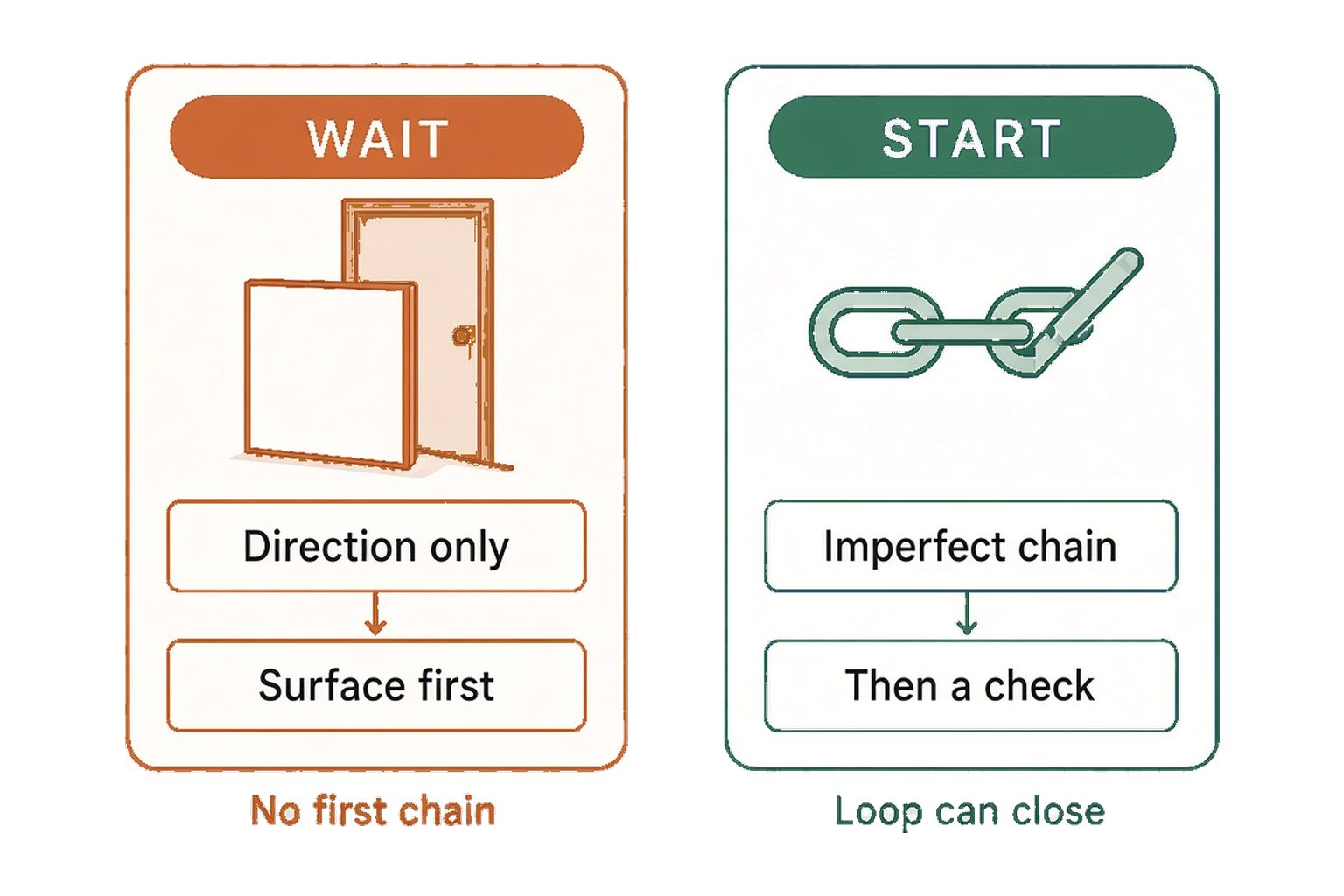
Wait vs first chain — the surface is not the start.
Applications
- When a kit is being decorated (site, mark, cards) and no one has been received, ask which latency is live.
- Pair with Complexity Trap when the pleasure is the unfinished surface itself.
- Pair with Feedback as learning currency when the sample must be taken in the right place — speed without a correct check is just motion.
Failure modes
- Collector trap: more plans for the chain instead of one imperfect meeting this week.
- Overclaim trap: shipping junk and calling every check “learning.”
- Test today: name one unfinished surface you are treating as a permission. Write the first chain that could take a check without it.
Sources
Cite
- Gollwitzer, P. M. (1999). Implementation intentions: Strong effects of simple plans. American Psychologist, 54(7), 493–503
- Sheeran, P., & Webb, T. L. (2016). The theory of planned behaviour and implementation intentions. In M. Fishbein & I. Ajzen (Eds.), Predicting and changing behavior