Definition
Degree of evidence is how true a claim already feels in the body — that you are this person, that this path is the right one, that you can solve this problem — not how complete the notes are on the page.
Origin
Judgment research treats subjective confidence as a feeling that travels with a decision, not as a reliable meter of accuracy (Kahneman, 2011). Metacognition names a close cousin: the feeling of knowing — a graded sense that material is available before you can retrieve it (Koriat, 1993, 2000). A third strand, the illusion of explanatory depth, shows that people rate their understanding as high until they must teach the mechanism; then the rating drops (Rozenblit & Keil, 2002). Club language degree of evidence sits on that stack: felt certainty as a trainable state, not a slogan.
Mechanism
Two layers get confused. Paper evidence is a list — definitions, grids, a weekend of notes. It can be true and still evaporate in two weeks when the old cycle returns. Reflex evidence is the same content available under load: the body does not negotiate, the words are already there, transfer can leave the room. Recording and teaching force the drop from illusion-of-depth to contact: you hear the gap between the sentence and what you actually believe.
Epistemic boundary: subjective confidence is a poor proxy for accuracy — overconfidence is the typical error (Kahneman, 2011). This note does not claim that raising felt evidence makes a forecast true. It claims that low felt evidence blocks action and transfer even when the file is complete. Koriat (1993) is a metacognitive model, not a field RCT of coaching journals. Rozenblit and Keil (2002) used folk-science objects; the drop is from having to explain, not from a Club Voice protocol.
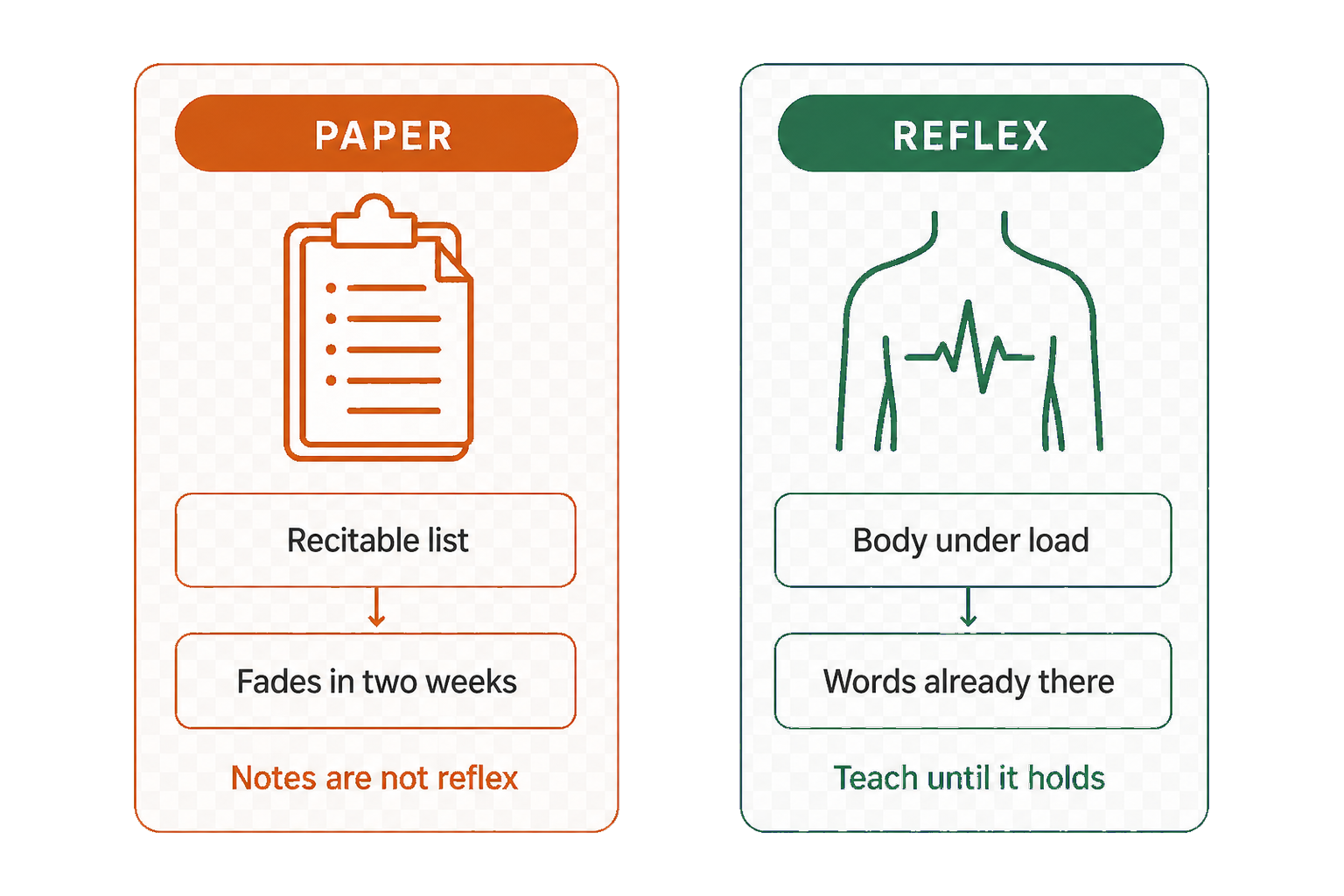
Paper vs reflex — a recitable list fades; under load the words are already there.
Applications
- When a close fails despite a clean script, ask whether the speaker has paper evidence or reflex evidence.
- Pair with Transfer of Certainty when the leak is I have not sold it to myself.
- Pair with Morning Voice when the job is to raise the degree daily, not to add another affirmation.
Failure modes
- Collector trap: more notes about the trait instead of one recorded teaching that you will hear tomorrow.
- Overclaim trap: treating a strong feeling as proof the strategy is right.
- Test today: say the claim out loud; mark where the voice thins — that cell is the work, not a new binder.
Sources
Cite
- Kahneman, D. (2011). Thinking, Fast and Slow. Farrar, Straus and Giroux.
- Koriat, A. (1993). How do we know that we know?. Psychological Review, 100(4), 609–639
- Rozenblit, L., & Keil, F. (2002). The misunderstood limits of folk science. Cognitive Science, 26(5), 521–562