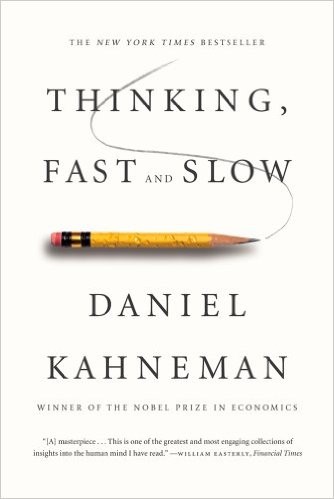
 | The mind runs two systems — fast heuristics (System 1) and effortful analysis (System 2). Most costly errors come from letting System 1 answer questions that needed System 2. Daniel Kahneman First published 2011 - Reprint (2013) · Farrar, Straus and Giroux · ISBN 9780374533557 |
|---|
Key principles
- System 1 / System 2 — Automatic, fast, associative processing vs slow, effortful, rule-based thinking; System 2 is lazy and often rubber-stamps System 1.
- WYSIATI — “What you see is all there is”: the mind builds coherent stories from incomplete evidence and rarely feels the gap.
- Anchoring — First numbers, frames, or reference points skew later estimates even when you know they are arbitrary.
- Loss aversion — Losses weigh roughly twice as much as equivalent gains — risk choices tilt toward avoiding pain over capturing upside.
- Planning fallacy — Inside view optimism wins over base rates; timelines and outcomes are systematically too rosy.
- Peak–end rule — Memory weights the peak moment and the ending, not duration — redesign endings, not only averages.
Core science
Kahneman’s 2011 popular synthesis distills the heuristics-and-biases program he built with Tversky — prospect theory, framing, dual-process architecture, and repeatable judgment errors under uncertainty. It is accessible narrative science, not the primary paper trail (Judgment Under Uncertainty holds the anthology spine). Pair with Rational Choice in an Uncertain World for textbook debiasing structure and with decision hygiene when the failure is who signs after analysis, not missing IQ.
Application
Reach for this volume when a team keeps naming biases but still rubber-stamps System 1 in hires, contracts, and strategy — when metacognition needs a named manual, not a poster. See Behavioral change canon pillar 2 for where this sits in the five-pillar reading map.