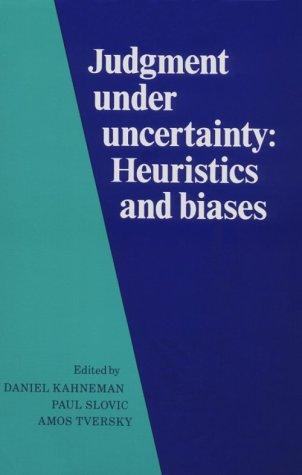
 | Under uncertainty the mind substitutes easy questions for hard ones — availability, representativeness, and anchoring feel like evidence but are often biased. The volume that named the heuristics-and-biases research program before Kahneman’s later popular synthesis. Daniel Kahneman, Paul Slovic, & Amos Tversky (Eds.) (1982) · Cambridge University Press · ISBN 9780521284141 |
|---|
Key principles
- Availability — Events that come to mind easily are judged more frequent or likely — vivid memory substitutes for base rates.
- Representativeness — Stereotypes and prototypes override sample size — the story that “looks right” wins over statistics.
- Anchoring — Initial values, even random ones, pull later estimates — adjustment from an anchor is usually insufficient.
- Conjunction fallacy — Detailed scenarios feel more probable than simpler ones — coherence beats logic (the Linda problem).
- Overconfidence — Narrow confidence intervals and causal stories where data are thin — calibration beats bravado.
- Framing — Equivalent outcomes split by gain vs loss language — the same fact changes choice without changing truth.
Core science
The 1982 edited anthology collects the primary heuristics-and-biases papers — when probability and utility are hard to compute, people use mental shortcuts that are often adaptive but systematically skew judgment in predictable directions. It is the academic spine behind later popular synthesis (Thinking, Fast and Slow narrates the same program for operators). Pair with Rational Choice in an Uncertain World when teams need textbook debiasing structure, not only the original paper names.
Application
Reach for this volume when a room already quotes System 1 and System 2 but cannot name availability, representativeness, or anchoring — when debiasing needs the primary vocabulary, not the poster. See Heuristic on the Atlas shelf for the operational shortcut map in coaching language.