Definition
Identity scaffolding is the set of boxes a person or a group stands in — I am this, we are that — that holds the present structure up while the unfinished building is still being worked. The scaffold is not the building. It is the temporary architecture that makes work on the building possible.
Origin
Social identity research treats the self as category membership as well as personal narrative: people regulate toward being a coherent instance of a group (Tajfel & Turner). Possible-selves work treats the future identity as a motivational scaffold — a working model that organises today’s behaviour before the person “is” that self (Markus & Nurius). Official metrics (GDP, league tables, a national happiness index) add a public scaffold: the number becomes a box the collective tries to stay coherent with.
The construction metaphor is older than the lab. Scaffolding around a building is meant to come off. Leave it up forever and you start living in the poles.
Mechanism
Three layers get confused.
Individual box. I am the reliable one. I am not arrogant. I am someone good. The box reduces decision load. It also hides the behaviours that would update the box. Coherence pressure — the drive to match the label you already wear — is the fastener.
Collective box. We are a country that measures happiness. We are a profession that does not clown. An official indicator or a shared costume is not decoration. It conditions what counts as a coherent day. People then spend energy staying consistent with the metric, not only with the life the metric was supposed to serve.
Future-self box. The useful scaffold is the one that matches the habits you need next, not the biography you already recited. You do not have to be the future self first. You need the behaviours that produce different results. A scaffold that only protects the old building blocks the new one.
Epistemic boundary: social-identity and possible-selves literatures describe regulation toward a category or a future image. They do not prove that any one coaching label (“identity scaffolding”) is a validated construct, and they do not claim that official happiness metrics cause well-being. This note names a mechanism — boxes that hold work, and boxes that freeze it — not a clinical diagnosis.
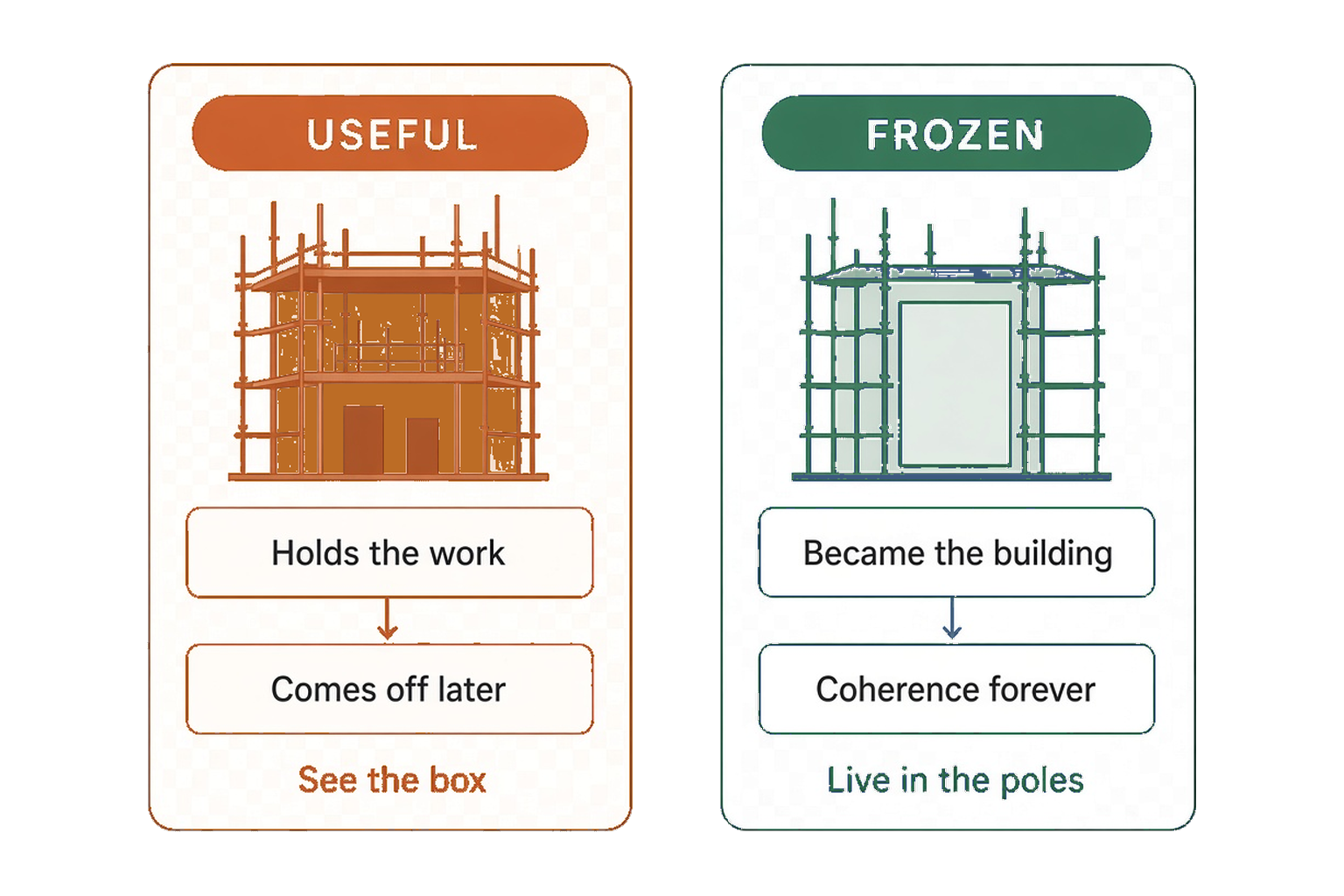
Useful box vs frozen box — the scaffold holds the work, or it becomes the building.
Applications
- When a label is doing more work than the behaviour (I am not that kind of person), ask whether the box is holding unfinished work or preventing it.
- When a group metric is the shared pride, ask what coherence costs the individual who does not fit the number.
- Pair with Future self when the job is habits now, not a costume change later.
Failure modes
- Collector trap: adding more identity labels instead of one behaviour that would update the box.
- Overclaim trap: treating a national or brand metric as proof that the people inside it are well.
- Test today: write the box you stood in this morning (I am X). Write one behaviour that box forbids. That forbidden cell is the work.
Sources
Cite
- Markus, H., & Nurius, P. (1986). Possible selves. American Psychologist, 41(9), 954–969
- Tajfel, H. (1974). Social identity and intergroup behaviour. Social Science Information, 13(2), 65–93