Definition
Use versus suffer is the switch between two relations to a pattern you can already see: condemning yourself for needing it, or putting it in the tank as fuel. The current does not change. The relation does.
Origin
Instrumental-emotion research shows people sometimes choose anger, anxiety, or sadness when that state helps a task — not because they are flooded (Tamir). Acceptance and defusion traditions treat the same current as something you can have without becoming it. Narrative-identity work adds a third strand: adults live inside stories they can see as stories and still inhabit on purpose (McAdams). The folk opposite is moral hygiene: if I can see the need (gaze, dependence, a useful anger), I should be done with it.
Mechanism
Three stances toward an illusion or a charged state:
- Unseen. The pattern runs. You call it personality or fate.
- Seen and suffered. You know you need the gaze, the certainty, the spark of anger — and you condemn the need. The condemnation is a second load. It does not remove the first.
- Seen and used. You know the octane. You put in that fuel when the motor you have actually identified needs it. Arriving at the station and putting in nothing is not neutrality. It is stalling a motor you have already named.
Anger used to capture attention when you are not flooded is the clean example: the state is selected, not suffered. Dependence on being seen as good can sit in the same grid — paid for, known as illusion, still walked toward because it does you good and you refuse to pretend you are already free of it.
Epistemic boundary: instrumental-emotion studies are laboratory and self-report, not a field trial of “using your illusion.” Acceptance work is clinical and heterogeneous. This note does not claim that using a pattern makes it healthy, or that every dependence should be kept. It claims that seeing a pattern and condemning it are not the same as changing the relation — and that a known fuel can be metered.
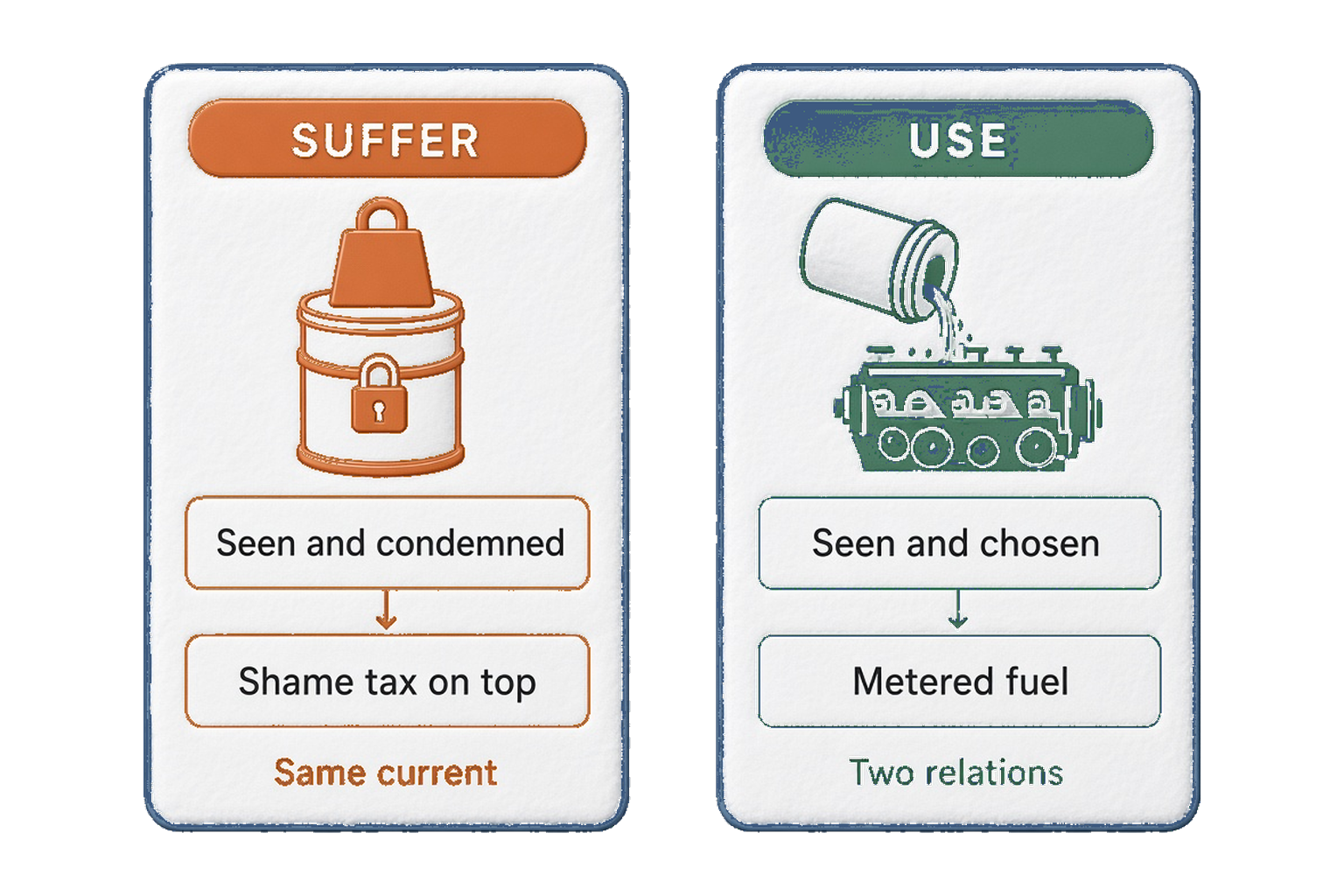
Suffer vs use — same current, two relations.
Applications
- When someone says I know it’s an illusion and I go there anyway, ask whether they are using it or still paying a shame tax on top.
- Pair with Master of Opposites when both poles are already in the room and gluing to one side is the suffer-stance.
- Pair with Evidence as fuel when the job is to put a wanted pattern in the tank, not a pep-talk.
Failure modes
- Collector trap: naming more illusions instead of picking one current and choosing the relation.
- Overclaim trap: “I use my anger” as a licence to flood the room.
- Test today: name one pattern you already see. Write suffer or use next to it. If you wrote suffer, the next move is one metered use — not a purge.
Sources
Cite
- Tamir, M. (2009). What do people want to feel and why?. Current Directions in Psychological Science, 18(2), 101–105
- McAdams, D. P., & McLean, K. C. (2013). Narrative identity. Current Directions in Psychological Science, 22(3), 233–238