Working definition
Identity Shift is clarifying and inhabiting a future identity — how that version thinks, acts, and behaves — so results come from congruence, not from bolting skills onto the old self.
How it works
You can train tactics forever and still negotiate as the person who “isn’t ready.” The shift is definitional: name the identity required for the results, connect to it (visualisation / felt sense), then act as that version under friction.
- Define the identity in operational language (not a slogan).
- Contrast adjacent identities (English-speaker vs learner of English; entrepreneur vs salaried helper of entrepreneurs).
- Connect via visualisation so the body recognises the version.
- Act congruent on the next hard call — including loving the younger part while the adult dials.
Distinction from Identity Gap: Identity Gap is the distance map (current ↔ aspirational); Identity Shift is the operational reframe and inhabit move. Distinction from Narrative identity: narrative identity is the story spine; Identity Shift is the deliberate swap of who is in the chair for a named result.
Signature
Pizza challenge: love the ~5½-year-old who feels it’s him calling — adult takes the phone. Parallel: invent the entrepreneur identity while still employed.
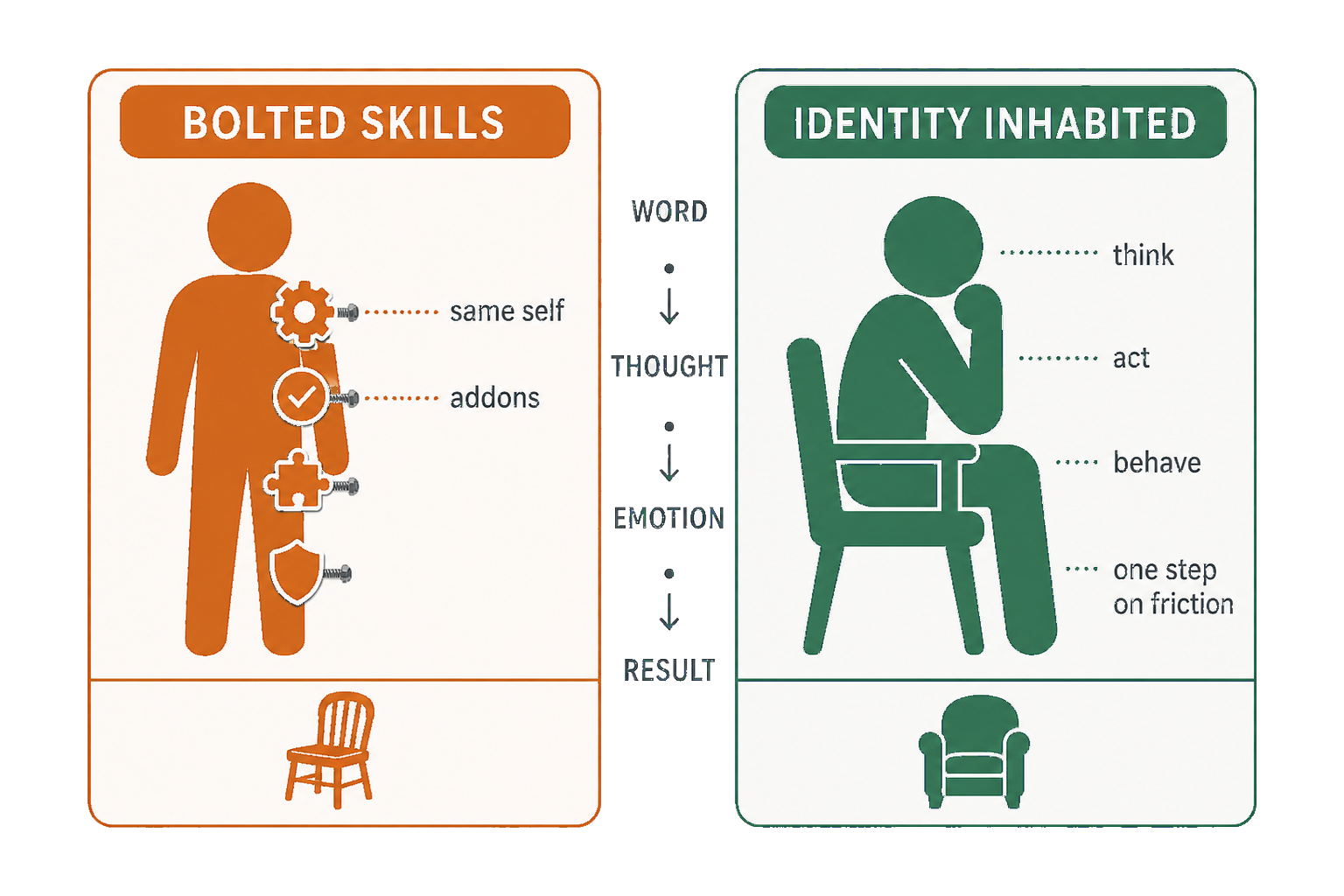
Spatial split — Bolted skills (same self · addons · old chair) versus Identity inhabited (think / act / behave · congruent under friction). Your move: Your move this week.
Your move this week
Write one future-identity paragraph (think / act / behave) for a live Battle — read it once before the next hard rep.
Scientific grounding
Cite
- Ibarra, H., & Petriglieri, J. L. (2010). Identity work and play. Journal of Organizational Change Management, 23(1), 10–25.
- McAdams, D. P., & McLean, K. C. (2013). Narrative identity. Current Directions in Psychological Science, 22(3), 233–238.
Identity work/play lets you try provisional selves before locking them (Ibarra & Petriglieri); narrative identity is the life story that must update when the inhabited self changes (McAdams & McLean).
Adjacent
Identity Gap
Narrative identity
Identity
Personal Definitions
Alter Ego
Be You, The Real You