Definition
Gross National Happiness is Bhutan’s official complement to GDP: a multi-domain index of living conditions and psychological well-being that a state chose to measure, publish, and stay coherent with.
Origin
Bhutan’s monarchy framed development as Gross National Happiness rather than output alone. The Centre for Bhutan Studies later operationalised a GNH Index (domains such as psychological well-being, health, education, time use, cultural diversity, good governance, community vitality, ecological diversity, living standards). Alkire–Foster poverty methodology was adapted so a person can be counted as happy-enough only if they clear sufficiency across enough domains. Other governments borrowed the phrase; few copied the official architecture.
Mechanism
An official indicator is not a mood. It is a collective identity scaffold. Once a country says we measure happiness, two pressures start:
- Coherence. Citizens and institutions try to look like the story the metric tells — the same way a person tries to stay consistent with I am X.
- Attention. What gets counted gets worked. GDP already did this for output. GNH tries to do it for a wider sufficiency set. The risk is the same Goodhart shape: the number becomes the target, and the life the number was meant to protect recedes.
The psychological claim in this note is narrow. A public happiness metric conditions perception of what counts, the way any official box does. It does not prove that Bhutanese people are happier, or that copying the brand raises well-being.
Epistemic boundary: GNH measurement papers are policy-index construction, not RCTs of national mood. Cross-country “happiness” rankings are contested (translation, social-desirability, what a survey can see). Do not treat the existence of the index as evidence that official happiness causes private flourishing.
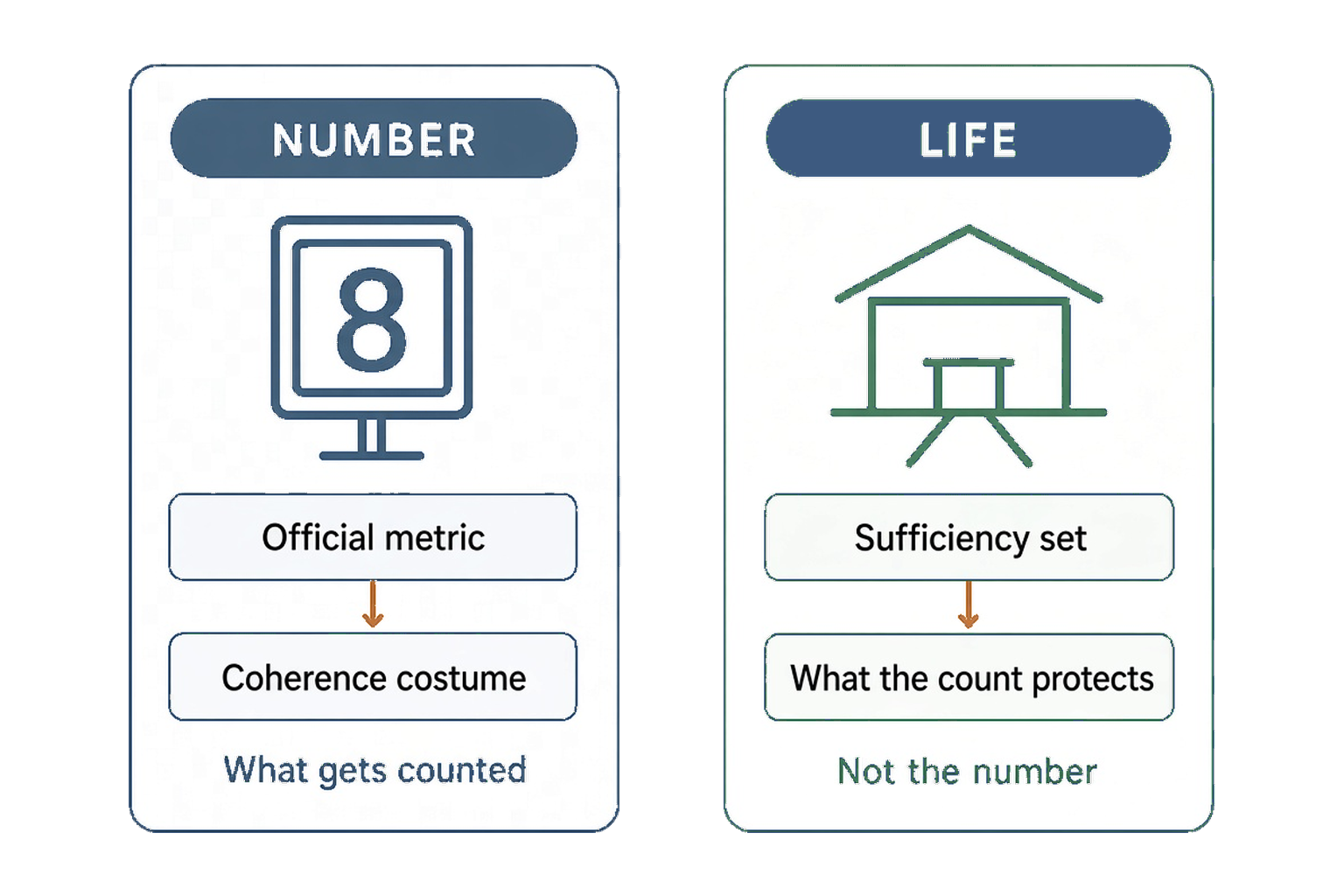
The number vs the life — a metric box is not the well-being it was meant to protect.
Applications
- When a team or a country installs a well-being KPI, ask what identity the number now requires people to wear.
- Pair with Identity scaffolding when the job is to see the box, not to collect another dashboard.
- Pair with Conditioning when the question is what is training my perception of a good day?
Failure modes
- Collector trap: adding well-being metrics without changing a single daily link.
- Overclaim trap: citing Bhutan as proof that measuring happiness produces it.
- Test today: write the official or family metric you already live under. Write one behaviour it silently forbids.
Sources
Cite
- Alkire, S., & Foster, J. (2011). Counting and multidimensional poverty measurement. Journal of Public Economics, 95(7-8), 476–487
- Ura, K. (2005). Gross National Happiness. Sociological Bulletin, 54(3), 603–607