Definition
A cadence of responsibility is the scheduled comparison between a requirement you have already granted a future self and the executions that actually landed. It is not the requirement. It is the rhythm of looking.
Origin
The intention–behaviour gap is an old finding: people intend, and the act does not follow, often because the cue and the response were never tied. Gollwitzer’s implementation intentions (if this cue, then this act) are one repair for a single plan. Neither the gap nor the if-then is a calendar. A cadence is what you add when the requirement is already known and still gets renegotiated each time it comes due. The later self is not abstract. You have already said what that self needs. The question is whether you look, on purpose, at the difference between owed and landed.
Mechanism
Three objects, easy to collapse into “I should be more disciplined.”
- The owed act is already nameable. A block, a conversation, a sitting, a recovery. If you cannot say what the future self was supposed to receive, you do not have a cadence. You have a wish.
- Today either executes or opens a vote. The vote sounds like taste, timing, or a better question. The cadence does not argue with the vote in the minute. It records whether the owed act landed.
- The look is on a rhythm. Once a day, or at the end of a defined block. Without the rhythm, one miss becomes a story about capacity, and the next miss never meets an account. With the rhythm, the miss stays a miss. You can then choose a smaller dose, a different cue, or a real no. You cannot honestly call the skip an accident.
Epistemic boundary. No paper in the neighbouring sources invented this phrase or measured a “cadence of responsibility.” Implementation-intention research shows that an if-then link raises follow-through for a specified act. It does not prove that a nightly audit creates a new personality, and it does not say every unscheduled hour is a failure. Rest you planned, a gate you cannot open, and a requirement you have not yet defined are not failed cadences. The claim is narrower: when the future self’s requirement is already clear, the danger is not ignorance. It is a vote that never meets a scheduled comparison.
A lead measure is a different object. The lead measure is the count you can run (conversations, sittings). The cadence is whether you look at owed versus landed. You can count perfectly and still never ask whether the future self received the thing. You can also feel guilty with no count at all.
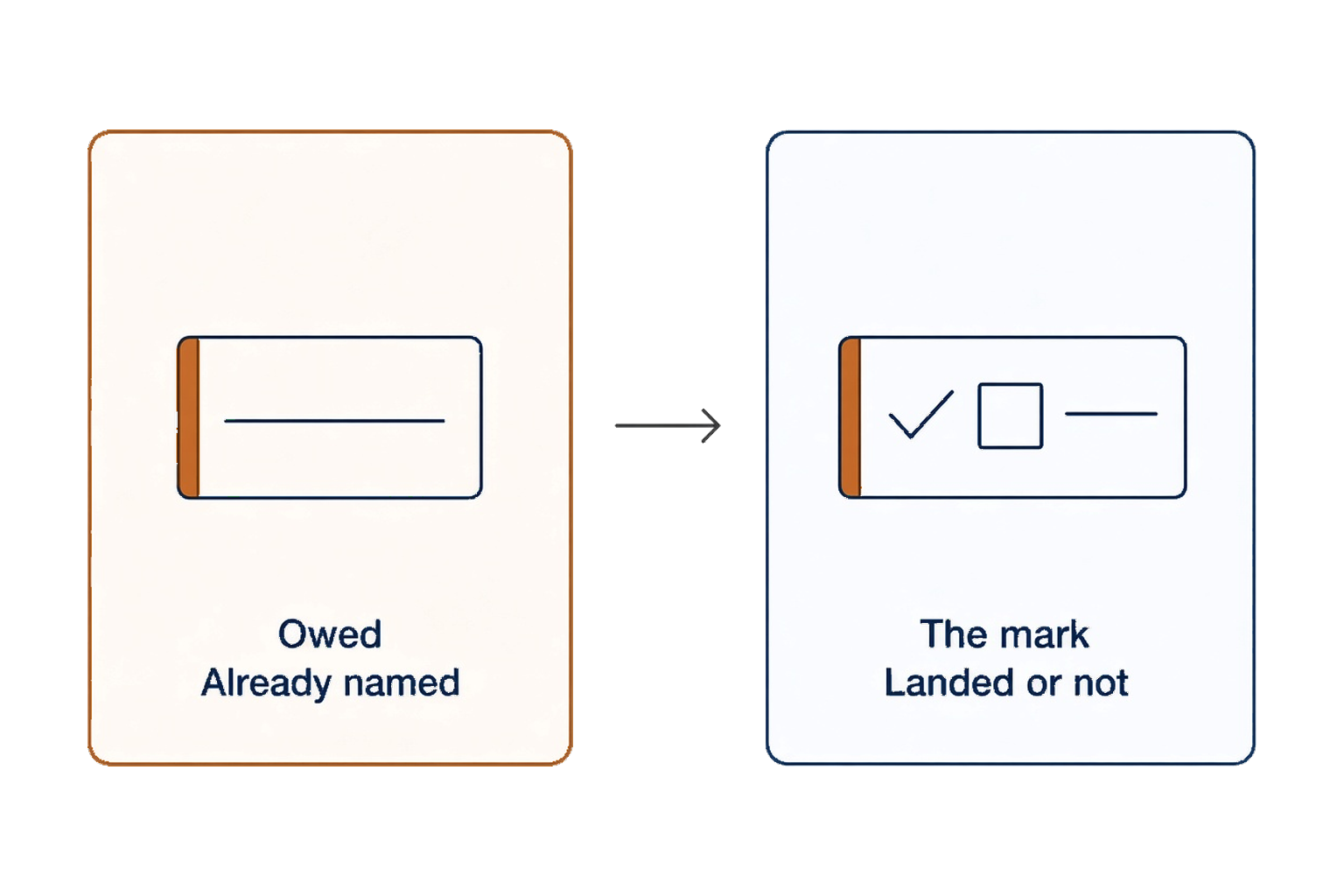
The owed act is already named. The mark records whether it landed.
Applications
- Write one sentence the future self is already owed this week. At the close of the day, mark landed or not. Do not add a second sentence until the first has a mark.
- If the mark is “not” three times, shrink the owed act or change the cue. Do not add a speech about standards.
- Keep the lead count beside the cadence when the result depends on other people. The cadence tracks your execution. It does not track their yes.
Failure modes
- Collector trap: a diary of intentions with no mark for what landed.
- Overclaim trap: treating the phrase as a published law, or treating rest and an undefined wish as moral failures.
- Test today: one owed act, one line, one mark before you sleep. Landed, or not.
Sources
Cite
- Gollwitzer, P. M. (1999). Implementation intentions: Strong effects of simple plans. American Psychologist, 54(7), 493–503.
- Sheeran, P., & Webb, T. L. (2016). The theory of planned behaviour and implementation intentions. In M. Fishbein & I. Ajzen (Eds.), Predicting and changing behavior (2nd ed., pp. 271–305). Psychology Press.
The 1999 paper is the neighbouring evidence for tying a cue to an act. Sheeran and Webb place that if-then inside planned behaviour and the intention–behaviour gap. Neither source tests a daily owed-versus-landed audit. That audit is the operational frame of this note.