Working definition
Prefer the price of fears is the signal sentence: pay the cost of fear-in-action now rather than the unpaid invoice of regret when the window has closed.
How it works
You already know there is a price either way — freeze costs, and so does move. The default Inner Voice narrates the fear price as intolerable and hides the regret bill until it is too late. This doctrine flips the accounting: I prefer the price of my fears now to the price of regrets later.
The power is not motivational wallpaper. Words shape chemistry, imagery, and behaviour (Inner Voice · Power Over Thought Mechanics · The Words We Use to Define a Need). Among the noise of self-talk, this line is a signal you can reuse until the consequence (the ship, the publish, the ask) becomes repeatable. Pair with Master of Opposites: you are choosing your pair of opposites with more consciousness — fear-now vs regret-later — toward the Future self you claim.
Wire to Cut the victory: the sentence is often the reinforced link upstream of the public win. Keep it as a checklist ingredient inside your imperfect checklist for the next exposure.
Distinction from Choosing the right discomfort: right discomfort selects the arena; prefer the price of fears is the billing language that lets you enter it today.
Signature
The phrase is the Signature: I prefer the price of my fears now to the price of regrets later. Room: 2026-08-05 — Facecam imperfect, posted before Club, Seoul month on the clock.
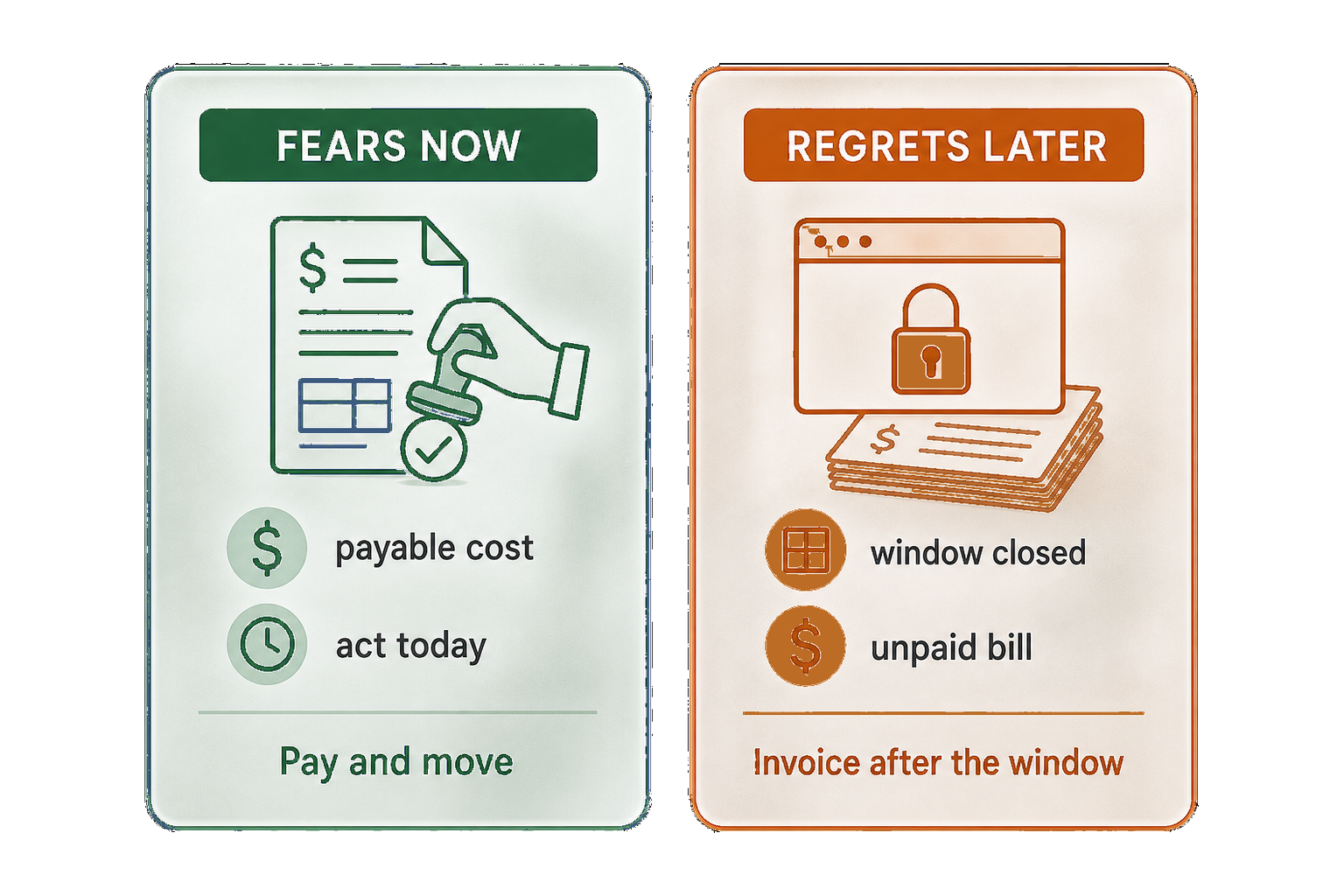
Spatial split — fears now (payable cost · act today) versus regrets later (window closed · unpaid bill). Your move: Your move this week.
Your move this week
- Write your version in one sentence: I prefer the price of ___ now to the price of ___ later.
- Put it where you decide (mirror · lock screen · Morning Journal).
- Run one fear-priced move in 24–72h — then cut the victory to name the link the sentence unlocked.
Scientific grounding
Cite
- Zeelenberg, M. (1999). Anticipated regret, expected feedback and behavioral decision making. Journal of Behavioral Decision Making, 12(2), 93–106.
- Gilbert, D. T., & Wilson, T. D. (2007). Prospection: Experiencing the future. Science, 317(5843), 1351–1354.
Anticipated regret shapes choices before outcomes — forecasting future self-blame can freeze the move or, when flipped, become the billing language that funds action today (Projected regret). Prospection pre-lives hedonic futures with systematic bias (impact · durability) — the fear price feels louder in simulation than the lived cost, while the regret bill is under-weighted until the window closes (Gilbert & Wilson).