Definition
De-occult is the decision to take the veil off unfinished work — and off the stories you tell yourself about that work — so other people, and you, can see the chain that actually runs.
Origin
Hidden personal information stays unavailable for correction: what stays occult cannot take a check. Adjacent, the illusion of explanatory depth shows that people rate their understanding as high until they must show the mechanism (Rozenblit & Keil, 2002). The feeling that you already know is not the same as a sample that can be seen (Koriat, 1993). Club language de-occult sits on that stack: visibility as a trainable relation to unfinished infrastructure, not as a product launch.
Mechanism
Hide has two faces that get glued together.
- Protective hide. You do not show the unfinished stack because a reference class might say you talk and do not understand. The costume is professionalism.
- Self-occult. The same veil hides the stories you tell yourself — not enough, not ready, they would see the mess. No sample reaches the room. No check is possible.
- Unveil. You show one live cell. Evidence rises because something met a gaze. The aura is a side-effect of infrastructure seen, not a speech about readiness.
Adjacent, not the same: Building in public is the practice name for repeated unveil. Proof of work is the felt aura when the chain is visible. Degree of evidence is the inner certainty that changes when filters drop. De-occult is the decision to remove the veil, including the veil aimed at yourself.
Epistemic boundary: this note does not claim that every private draft should be public, or that exhibition is the same as evidence. It claims that waiting for ready and showing the imperfect chain are different relations to the same unfinished object.
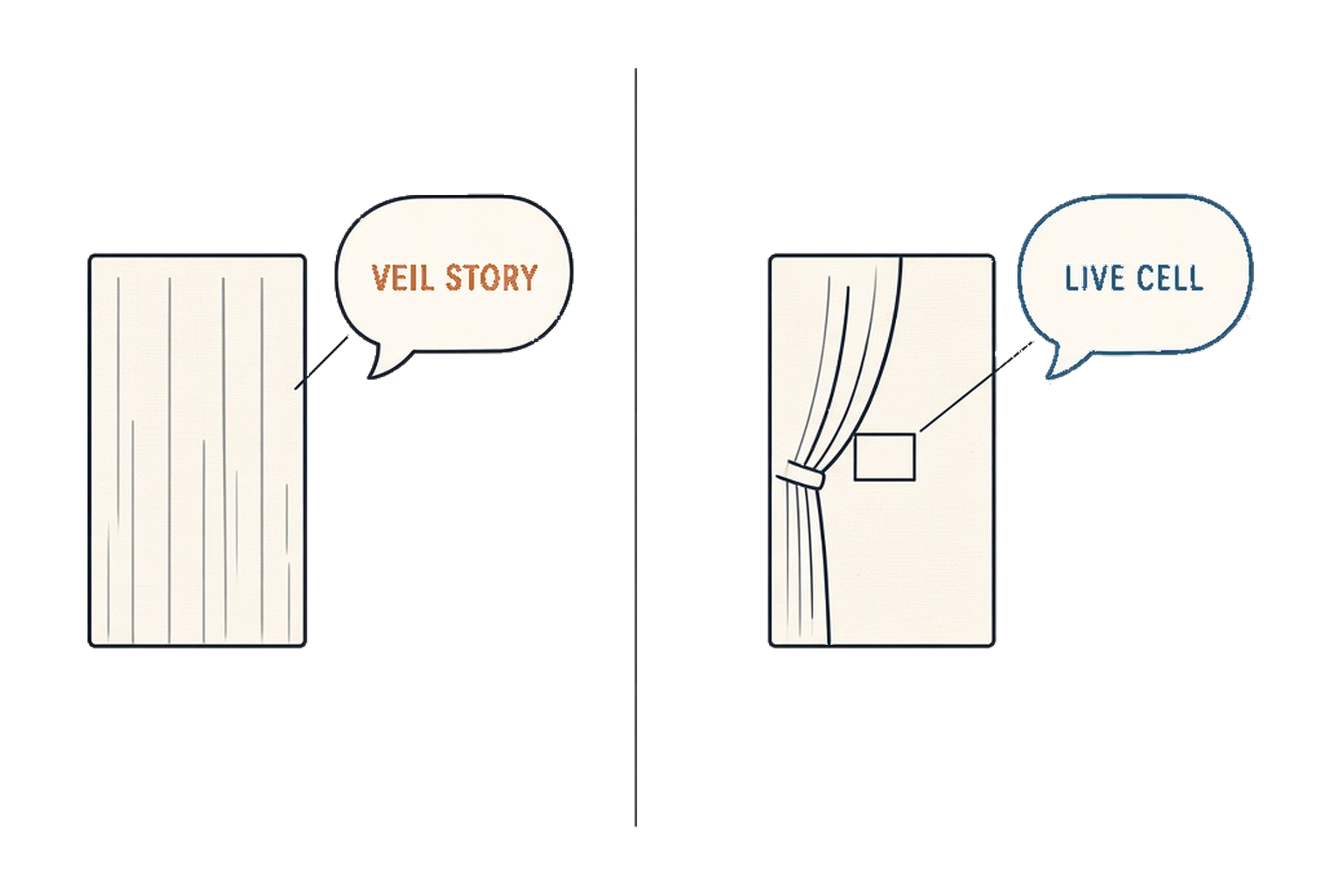
Veil story vs live cell — hide is not the standard.
Applications
- When a second brain, a map, or a company kit is being decorated and no one has been shown a live cell, ask which face of hide is running.
- Pair with Complexity Trap when the pleasure is needing the system to look finished before it may be seen.
- Pair with Speed of implementation when the clock is the first imperfect chain, not the finished surface.
Failure modes
- Collector trap: more notes about the unveil instead of one cell shown this week.
- Overclaim trap: dumping the whole stack and calling every dump “transparency.”
- Test today: name one veil you put on the work and one veil you put on yourself. Show one cell without the first. Write the story the second was protecting.
Sources
Cite
- Rozenblit, L., & Keil, F. (2002). The misunderstood limits of folk science: An illusion of explanatory depth. Cognitive Science, 26(5), 521–562
- Koriat, A. (1993). How do we know that we know? The accessibility model of the feeling of knowing. Psychological Review, 100(4), 609–639