Definition
Building in public is the habit of showing an unfinished chain — a draft, a map, a live cell — on a cadence, so the work can take feedback before it looks finished.
Origin
Intention–behaviour research treats the delay between a direction and the first situated act as the usual failure (Gollwitzer, 1999; Sheeran & Webb, 2016). Open-work and “build in public” traditions add a social clock: the first act is also a shown act, so the sample is not only private. Club language keeps the practice name and refuses the startup-theatre reading: this is not a growth hack. It is a feedback design.
Mechanism
- Private finish-then-show. The kit must look like the identity. The meeting, the share, the check wait. Complexity becomes the reward.
- Public unfinished. One cell is visible. Feedback can arrive because there is a sample. Correction is possible because someone else, or a future you, can see the chain.
- Cadence, not dump. Repeated small unveils beat a single confession of the whole stack.
Adjacent, not the same: De-occult is the decision to remove the veil (including from yourself). Proof of work is the aura that can follow. Speed of implementation is the latency to the first imperfect chain. Building in public is the repeated shown chain.
Epistemic boundary: this note does not claim that every process should be livestreamed, or that audience size is the metric. It claims that hiding until ready and showing on a cadence are different relations to feedback.
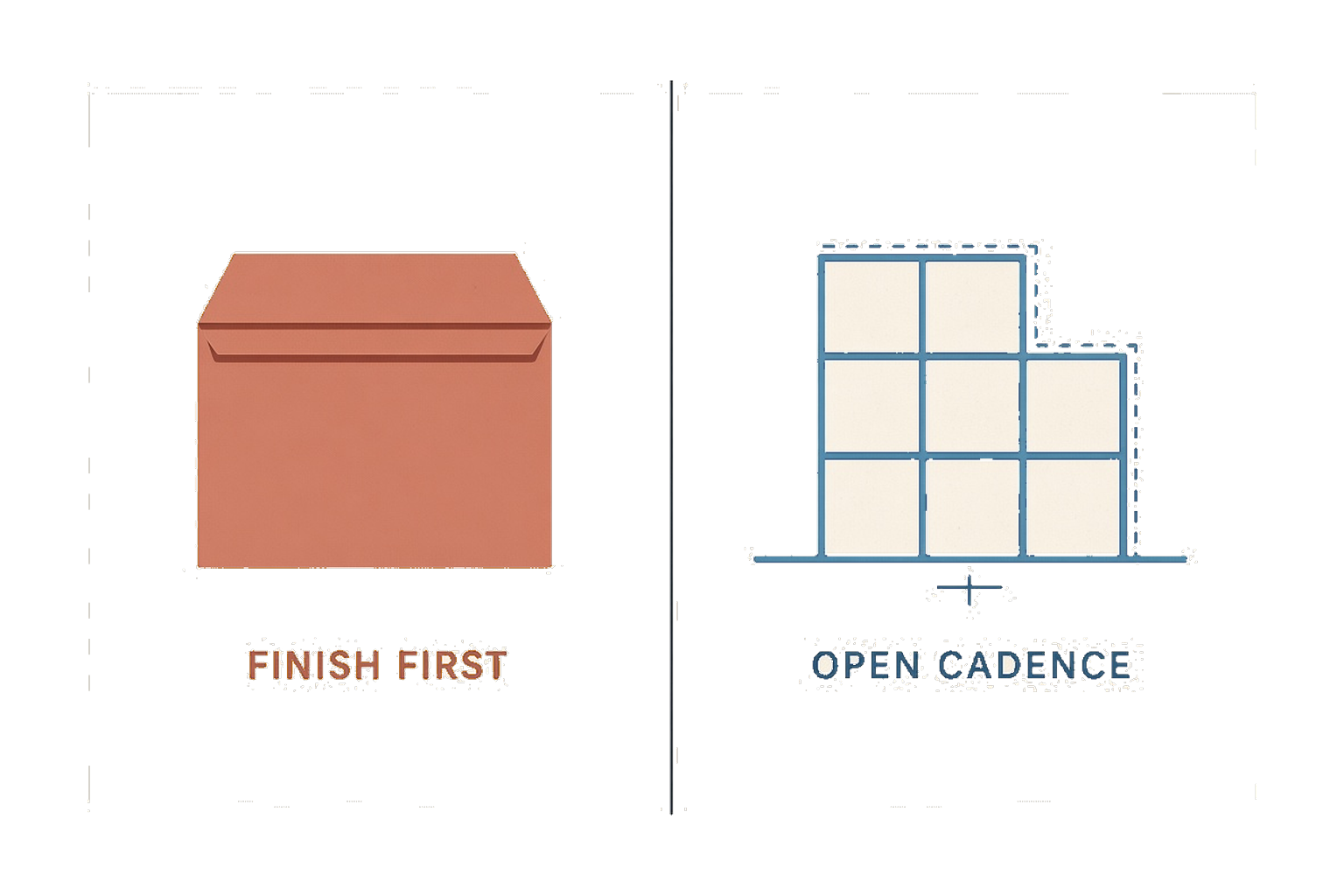
Finish first vs open cadence — the kit is not the sample.
Applications
- When a second brain or a company surface is being decorated, ask which cell could be shown this week without the finished kit.
- Pair with Feedback as learning currency when the sample must be taken in the right place — a tour is not a check.
- Pair with Complexity Trap when the pleasure is the unfinished private cathedral.
Failure modes
- Collector trap: more plans for the public cadence instead of one cell shown.
- Overclaim trap: performing transparency for an audience and calling every post “feedback.”
- Test today: show one unfinished cell to one real gaze. Write the check that became possible.
Sources
Cite
- Gollwitzer, P. M. (1999). Implementation intentions: Strong effects of simple plans. American Psychologist, 54(7), 493–503
- Sheeran, P., & Webb, T. L. (2016). The theory of planned behaviour and implementation intentions. In M. Fishbein & I. Ajzen (Eds.), Predicting and changing behavior