Definition
Proof of work, in this library, is the personal aura that appears when someone can see the chain that actually runs — not a cryptographic token, and not a claim that you are ready.
Origin
Judgment research treats subjective confidence as a feeling that travels with a decision (Kahneman, 2011). Metacognition names a cousin: the feeling of knowing before full retrieval (Koriat, 1993). Club language proof of work borrows the engineering phrase and points it at visible infrastructure: the room feels authority when the unfinished system is shown, because a sample exists.
Mechanism
Three substitutes get confused.
- Speech about the stack. Philosophy, future architecture, the number of notes. No chain is visible. Confidence may be high. Evidence is low.
- Finished surface as proof. Logo, site, dashboard theme. The object looks like competence. The running chain is still occult.
- Unveiled chain. Someone sees the map, the automation, the written scale. The aura is a side-effect: proof that work happened, and that it can take a check.
Adjacent, not the same: Degree of evidence is the inner felt certainty. Proof of work is the social and personal receipt of a visible chain. De-occult is the decision that makes the receipt possible. Building in public is the repeated practice.
Epistemic boundary: this note does not claim that more tools equal more authority, or that crypto “proof of work” is the construct. It claims that describing a system and showing a live cell produce different evidence.
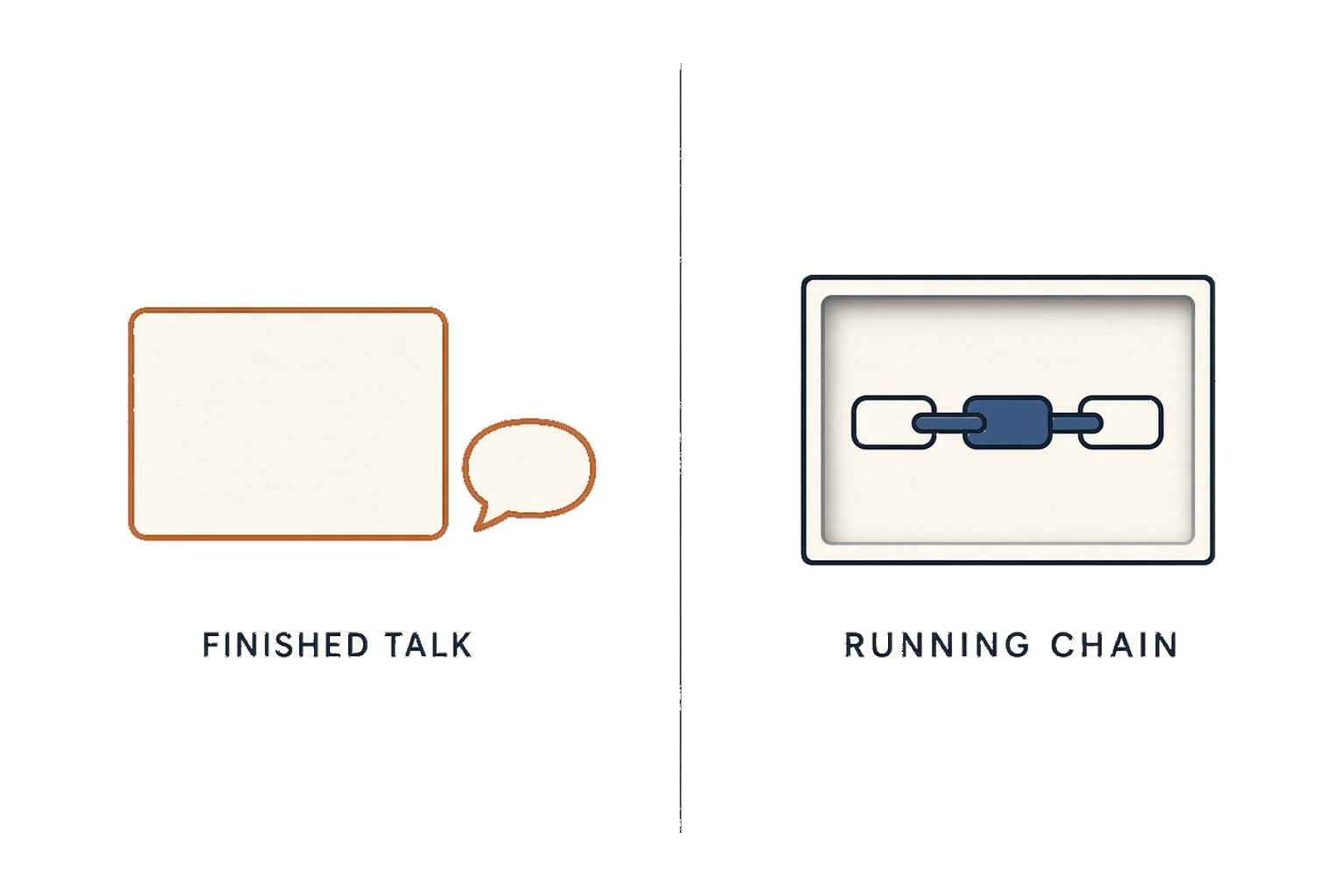
Finished talk vs running chain — a speech is not a receipt.
Applications
- When influence is being asked of an unfinished environment (second brain, company kit, personal instrument), ask whether a chain is visible or only described.
- Pair with Transfer of Certainty when the room must buy a path that does not yet have a brochure.
- Pair with Be Your Real Boss when the standard of professionalism is “they must not see the mess.”
Failure modes
- Collector trap: more infrastructure so the aura will be deserved later.
- Overclaim trap: a tour of tools presented as proof of understanding.
- Test today: show one running cell. Write what the room can now see that a speech could not prove.
Sources
Cite
- Kahneman, D. (2011). Thinking, Fast and Slow. Farrar, Straus and Giroux
- Koriat, A. (1993). How do we know that we know? The accessibility model of the feeling of knowing. Psychological Review, 100(4), 609–639