Working definition
Feedback as learning currency means the quality of the feedback you capture is what buys learning — without inspectable signal you cannot reproduce what worked or stop what sabotaged.
How it works
Life will improve you by accident — enough bike falls and you stop falling. That is unpaid learning. Currency is when you choose what to get better at, measure it, and store the cause: what produced this efficiency? If you only feel “better” without naming the origin, next week you cannot buy the same result (Observability).
Stages stack: take time to improve → take time to understand what improved you → raise data quality (journal, second brain, decision ledger) so patterns of success and auto-sabotage are retrievable. Choosing an expertise in advance (I will become excellent at X) makes the feedback voluntary and precise — you know what to watch (Weekly Review · Lag vs Lead Measure).
Distinction from Observability: Observability is the engineering metaphor of seeing the system; this note is Club currency — feedback quality as the unit that buys replayable skill. Distinction from Weekly Review: Review is the ritual container; currency is what you put in the till.
Signature
The image is a till of clean coins — each logged decision is spendable next week. Room: 2026-08-17 — the currency of learning is the quality of the feedback.
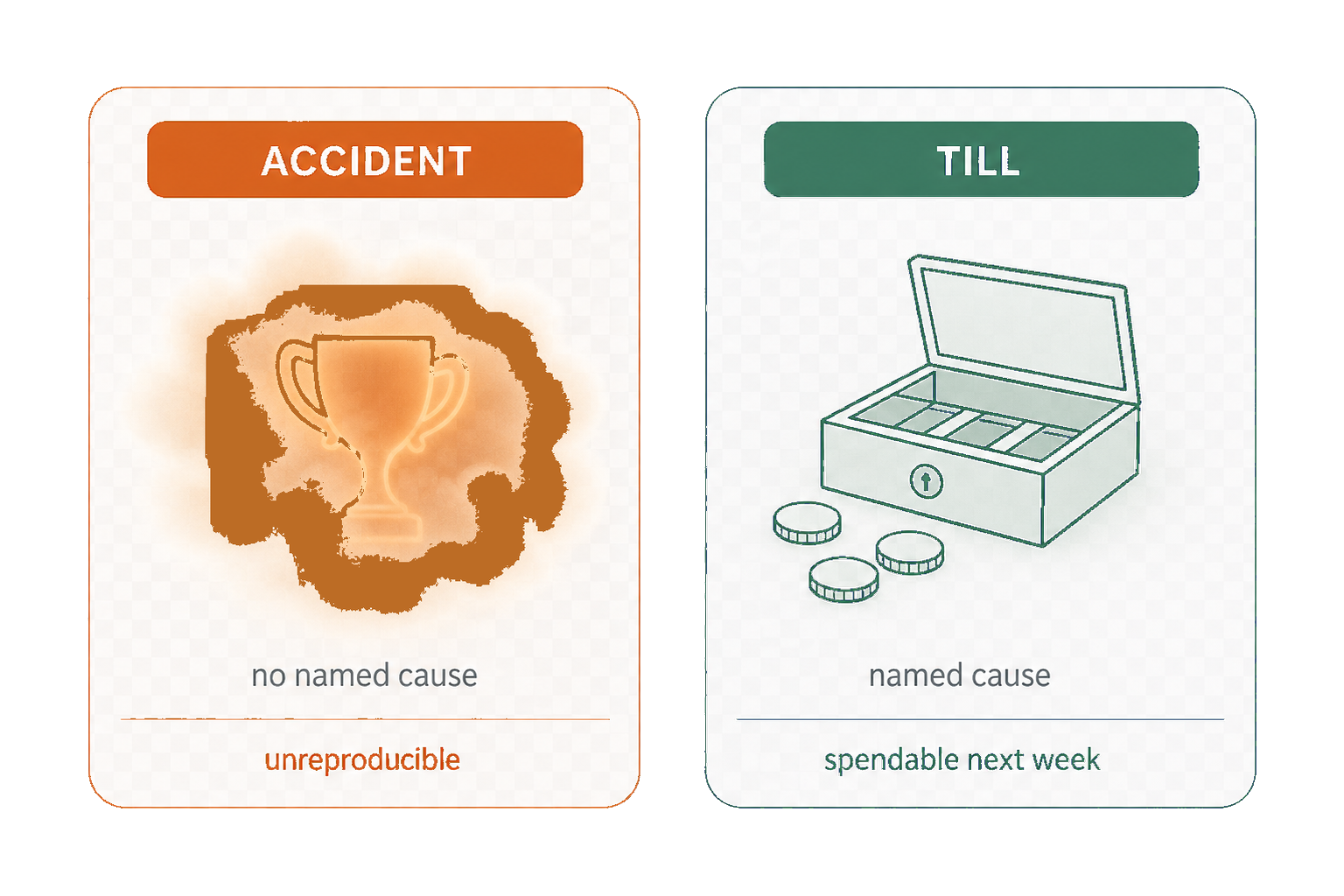
Spatial split — Accident (fog win · unreproducible) versus Till (named cause · spendable next week). Your move: Your move this week.
The WOW: If you cannot name what caused the win, you cannot buy it again.
Your move this week
- Pick one competence you want to get expert at (one sentence).
- After the next deep block, write: what worked · what caused it · replay next.
- Store those three lines where your second brain can find them.
Scientific grounding
Cite
- Kluger, A. N., & DeNisi, A. (1996). The effects of feedback interventions on performance. Psychological Bulletin, 119(2), 254–284.
- Ericsson, K. A., Krampe, R. T., & Tesch-Römer, C. (1993). The role of deliberate practice in the acquisition of expert performance. Psychological Review, 100(3), 363–406.
Feedback quality is not automatically helpful — sign, focus, and task-level targeting decide lift vs backfire (Kluger & DeNisi). Deliberate practice is effortful activity designed to improve with feedback-rich error focus, not mere hours (Ericsson et al.). Learning currency is the Club name for choosing what to measure so feedback becomes spendable next week.