Definition
A conversion system is the repeatable sequence that turns visibility into revenue — offers, follow-up, and proof — rather than isolated content spikes.
Origin
Cialdini’s influence principles and Godin’s permission-marketing frame both stress sequenced trust — attention alone does not convert; proof, consistency, and follow-up do.
Mechanism
Evidence level: primary-folk (persuasion / marketing literature) — levers are field-tested principles, not RCTs of your funnel.
A system has stages: attention → trust → offer → commitment → delivery → proof loop. Lag clients = Traffic × conversion rate through those stages. Single viral posts spike attention without moving later stages; the gap is usually missing follow-up, objection handling, or credible case evidence. Continuity and decision hygiene on outreach are part of the system, not soft extras.
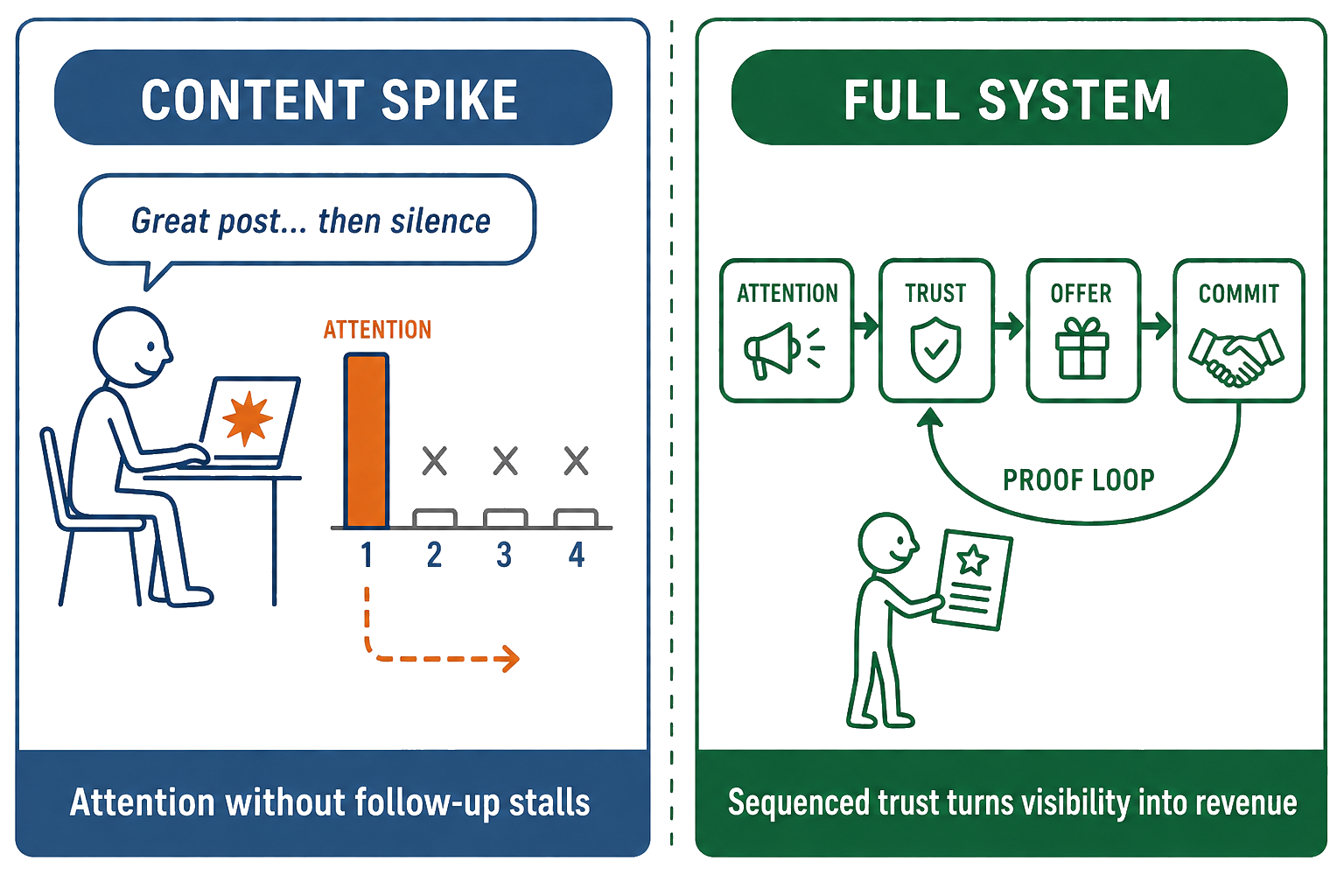
Content spike versus full system — sequenced trust, not isolated posts. Pair Influence · Be Your Real Boss.
Applications
Map one full path on one page — where prospects enter, where they stall, and which proof asset closes the gap this month. Name the Cialdini lever in play (social proof, scarcity, commitment) before redesigning the funnel — see Influence for principle depth. When the weak link is volume, raise traffic first; when it is rate, inspect offer, proof, and follow-up windows.
Failure modes
- Traffic = clients — treating conversation volume as closed revenue.
- Content spike as system — one post without follow-up, objection handling, or proof loop.
- Lever without path — naming reciprocity or scarcity while stages after attention stay undesigned.
Sources
Cite
- Cialdini, R. B. (2021). Influence (New and expanded ed.). Harper Business
- Godin, S. (2018). This is marketing. Portfolio