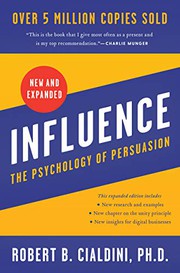
 | Commitment, reciprocity, social proof, authority, liking, scarcity, and unity shape how people say yes — the expanded edition adds unity and reframes influence as ethical alignment when you know which lever you are pulling. Cialdini, R. B. First published 1984 - Expanded (2021) · Harper Business · ISBN 9780062937650 |
|---|
Key principles
- Commitment and consistency — Small aligned actions lock identity — people follow through to stay coherent with prior choices.
- Reciprocity — Unearned value creates obligation — give first with intent, not manipulation.
- Social proof — Uncertainty defaults to the crowd — show evidence others like them already moved.
- Authority — Credible experts and symbols compress doubt — earn authority, do not cosplay it.
- Liking — Rapport and similarity lower resistance — warmth is mechanics, not charm alone.
- Scarcity and unity — Real limits on access focus decision; shared identity (“we”) outpulls transactional pitch — never fake either lever.
Core science
Cialdini’s expanded edition synthesizes experimental social psychology and decades of field observation into seven automatic influence levers — shortcuts the mind uses when attention is scarce. It is persuasion architecture, not a full funnel playbook; pair with Godin’s permission-marketing frame on the conversion system shelf when sequenced trust matters more than a single clever post.
Application
Reach for this volume when a yes feels pulled rather than chosen — when you need to name which lever ran (reciprocity, social proof, scarcity) before copying the tactic. Open Traffic when the weak link is conversation volume before rate, and Conversion system when the job is the full path from attention to committed client, not one isolated principle.