Definition
Automatic influence levers are the mental shortcuts — Cialdini’s “click, whirr” fixed-action patterns — that let people decide without full analysis, and that persuasion is engineered to trigger.
Origin
Robert Cialdini’s Influence describes how, faced with too much information, people rely on reliable rules of thumb that usually serve them well but can be triggered out of context. He likened them to fixed-action patterns in animals — a single cue (“click”) releases a whole pre-set sequence (“whirr”) — and catalogued the principles compliance professionals exploit: reciprocity, commitment and consistency, social proof, liking, authority, and scarcity (later, unity).
Mechanism
Each lever is a heuristic that compresses a complex judgment into a single trigger:
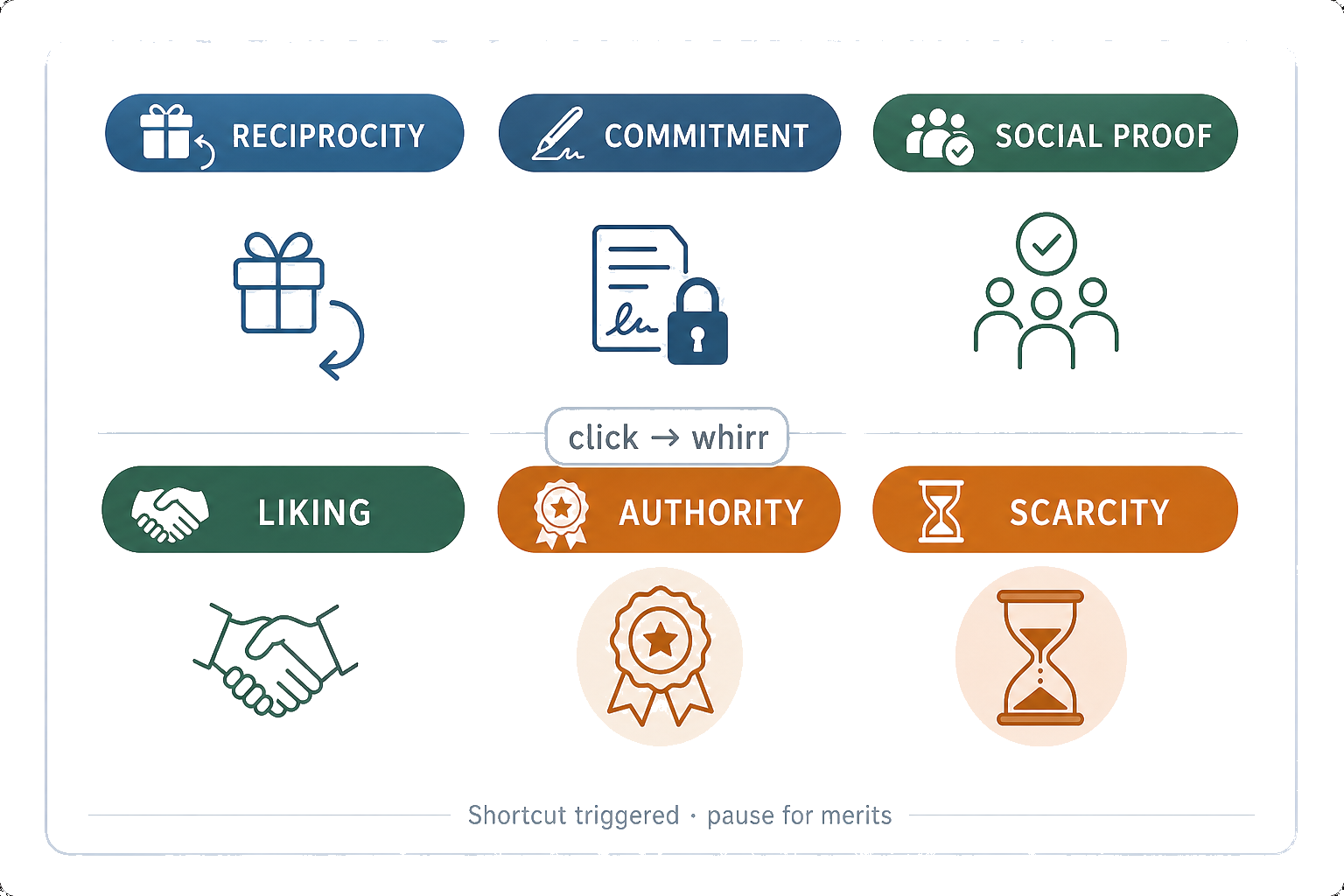
Six click-whirr shortcuts — name the lever, pause for merits. Pair Influence.
It’s free, so I owe (reciprocity); others are doing it, so it’s right (social proof); an expert said so (authority); it’s running out (scarcity). The architecture of a persuasive message arranges these triggers so the target’s shortcuts do the deciding. Awareness of the levers restores the analytic step the shortcut skips, converting an automatic compliance into a deliberate choice.
Applications
- Naming which lever a message is pulling, to decide on merits rather than reflex.
- Ethical use: aligning genuine value with the trigger (real scarcity, true social proof).
- Spotting engineered triggers (manufactured scarcity, borrowed authority) and pausing.
Sources
Cite
- Cialdini, R. B. (2006). Influence: The Psychology of Persuasion. Harper Business.
- Gouldner, A. W. (1960). The norm of reciprocity. American Sociological Review, 25(2), 161–178.