Definition
A standing tension between fidelity to one’s own values and fidelity to the expectations of others — neither pole is wholly separate, since others can be part of how the self is constituted.
Origin
Humanistic and psychodynamic traditions both name this split. Donald Winnicott contrasted the true self, which acts from authentic feeling, with the false self, organised around compliance with others. Carl Rogers tied psychological health to congruence between experience and expressed self. Self-determination theory (Deci & Ryan) frames the same axis as autonomy versus externally controlled behaviour. The sociometer account (Mark Leary) explains why fidelity to others has such pull: self-esteem tracks perceived social acceptance, so disappointing others registers as threat.
Mechanism
Much of the felt “charge” of obligation comes from staying faithful to what others expect rather than to one’s own standards.
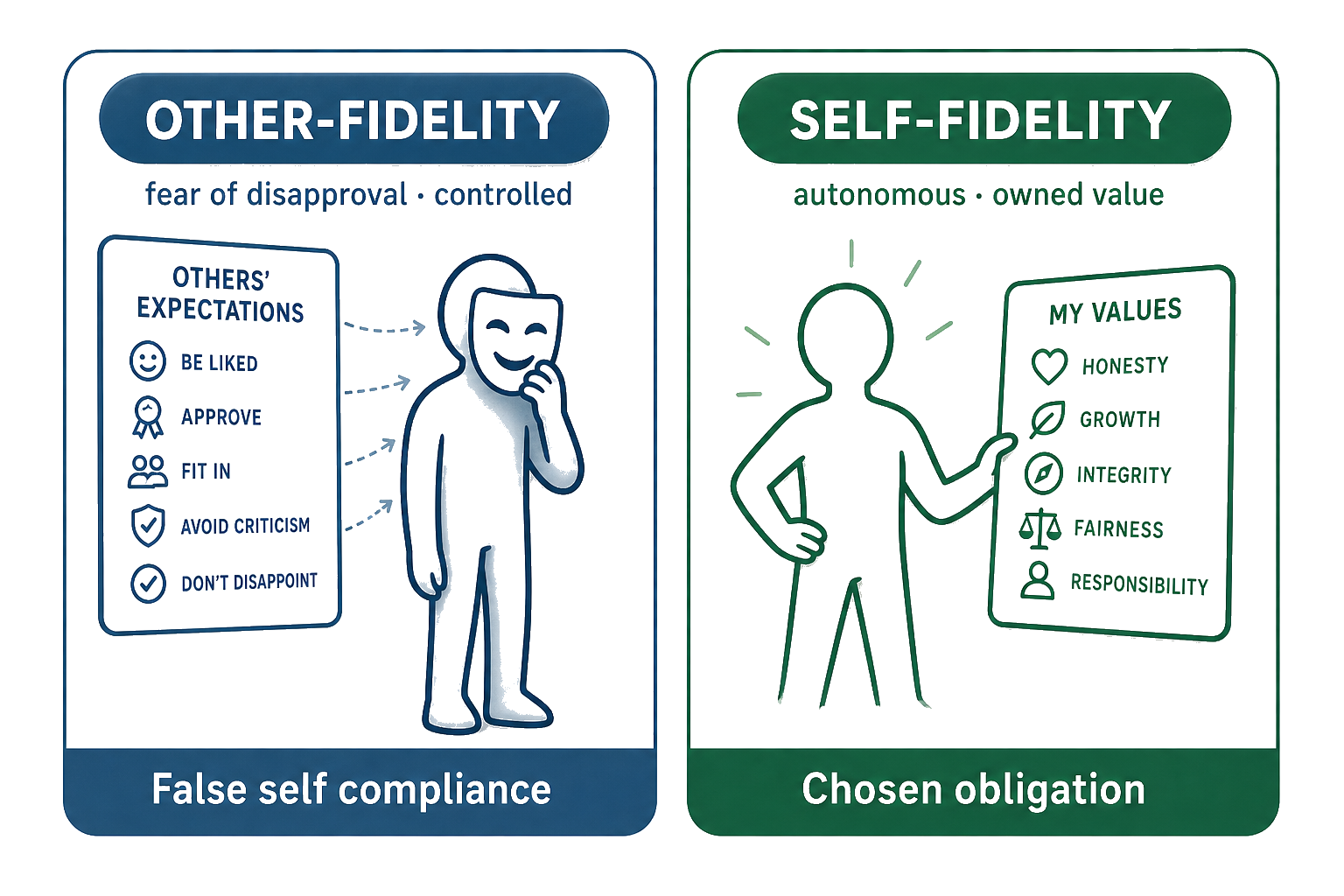
Other-fidelity versus self-fidelity — autonomous choice versus fear of disapproval. Pair Be You, The Real You · People-pleasing.
Yet the two poles are not cleanly opposed: significant others can be internalised as part of the self, so honouring a relationship can itself be an authentic value rather than mere compliance. The distinction that matters is the source of the act — chosen from one’s own values (autonomous) versus driven by fear of disapproval (controlled). Naming the source converts diffuse obligation into a deliberate choice and tends to reduce the weight carried.
Applications
- Locating the source of an obligation (chosen value vs feared disapproval) before acting on it.
- Reducing approval-driven over-commitment without collapsing genuine relational duties.
- Distinguishing healthy loyalty (an owned value) from people-pleasing (a defence).
Sources
Cite
- Winnicott, D. W. (1965). The Maturational Processes and the Facilitating Environment. Hogarth Press.
- Rogers, C. R. (1961). On Becoming a Person. Houghton Mifflin.
- Ryan, R. M., & Deci, E. L. (2000). Self-determination theory and intrinsic motivation. American Psychologist, 55(1), 68–78.
- Deci, E. L., & Ryan, R. M. (2000). The what and why of goal pursuits. Psychological Inquiry, 11(4), 227–268.
- Leary, M. R., & Baumeister, R. F. (2000). Sociometer theory. Advances in Experimental Social Psychology, 32, 1–62.