Working definition
Effectivité is the result at the finish line. Efficience is how much energy you burned to reach it. The Club tracks both.
How it works
Two members can hit the same result and live two different lives. One arrives exhausted; the other arrives composed and could go again tomorrow. The result is identical. The cost is not. The doctrine treats the cost as data worth measuring.
The distinction is operational, not academic:
- Effectivité — the binary or the score. Did you do the thing? Did the Battle exposure happen? Yes / no, or 1 to 10. The outcome lens.
- Efficience — the cost-to-result ratio. Mental cost, time cost, emotional cost, recovery cost, opportunity cost. The system lens.
A high-effectivité, low-efficience pattern is the classic Club anti-pattern: you hits the result by burning yourself. It works for one cycle. It does not scale to fifty-two cycles. A high-effectivité, high-efficience pattern is the goal: same result, less drag, freed attention for the next move.
The implication for Calibration is direct: two scores, not one. Did I do the Battle? and what did it cost me to do it?
Signature
The image is busy week, same outputs — you can execute every task and end the week where you started; effectivity asks which move changed the lag measure — 2026-02-25.
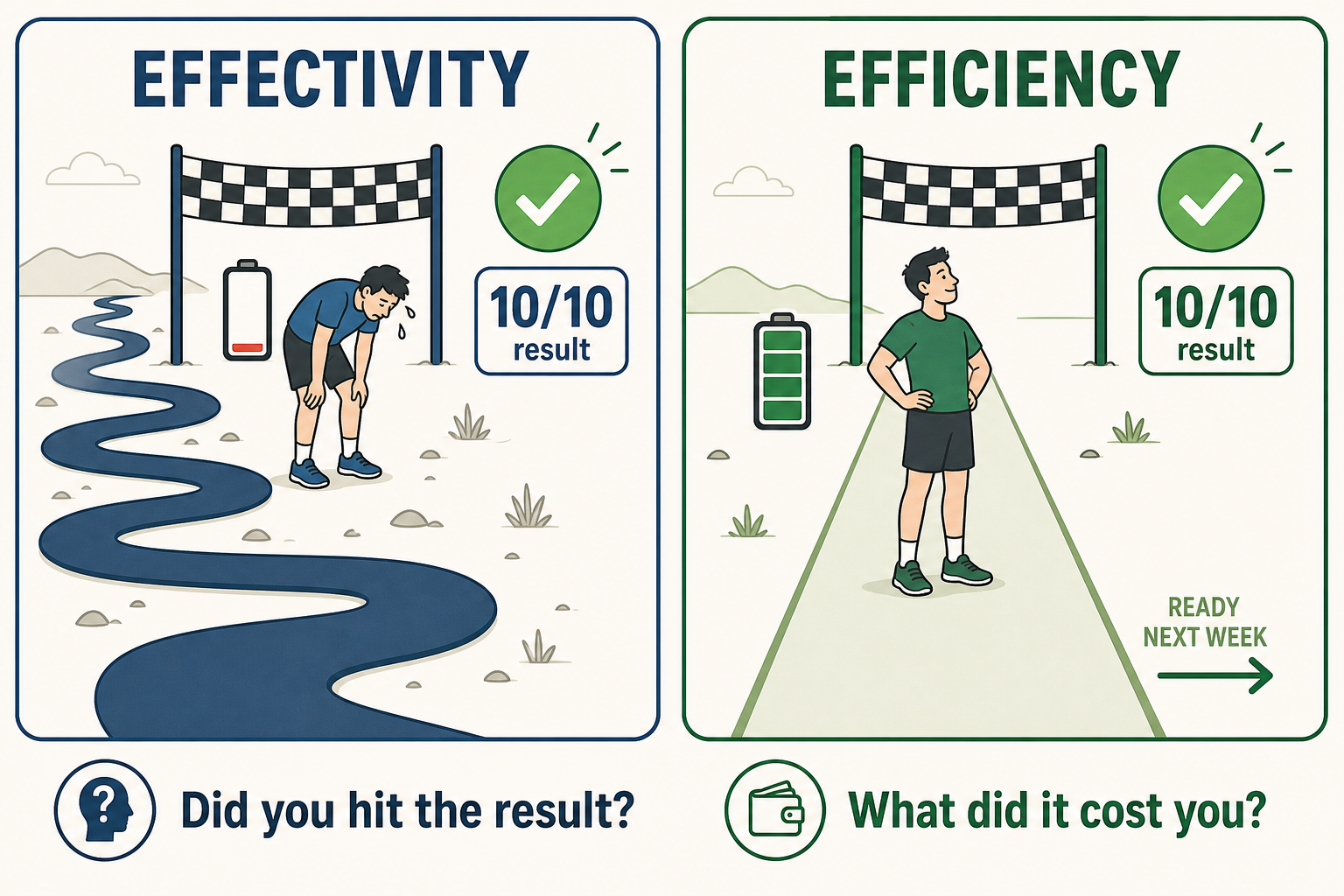
Spatial split — effectivity (result at the line) versus efficiency (same result, cost tracked — can you play next week?). Your move: Your move this week.
More room passes mention this doctrine in replay narrative — search the Codex for Efficiency vs Effectivity or start from the latest entry on Weekly Sessions.
Your move this week
This week’s micro-action (24–72 hours):
- For each Battle attempt, log two numbers: 1–10 for the act itself (effectivité), 1–10 for how much it cost you (efficience).
- The second number is often more informative than the first.