Working definition
Anti-vision is the written list of what you refuse — with a non-negotiability score — so the path you claim still matches the life you will not live.
How it works
Vivid Vision pulls you forward. Anti-vision blocks the exits you keep reopening under pressure.
- Refuse rows — not vague discomfort; concrete futures you will not inhabit (role, trade, relationship pattern, revenue trap).
- Non-negotiability 1–10 — when “no” becomes maybe later, the score drops. That drop is the signal, not the shame.
- Path forks, not only end-states — the refuse includes every intermediate route that leads to the forbidden end (Branka’s point on 2026-08-21).
Worked Club example: high revenue per hour from an old trade can still be a 10/10 never-again — money does not cancel Anti-vision.
Company vs person: in a One Person Business, ask what the enterprise needs, not only what the individual wants — Anti-vision can protect the moral person from the fragile ego’s bargains.
Distinction from Non-negotiable backup: backup is operational continuity for a named asset; Anti-vision is identity/path refuse for the life you are directing.
Signature
The matrix: what I refuse × non-negotiability 1–10 × where I already negotiate. Stallone holding Rocky’s script is the twin image on the positive side — see Scenario of life.
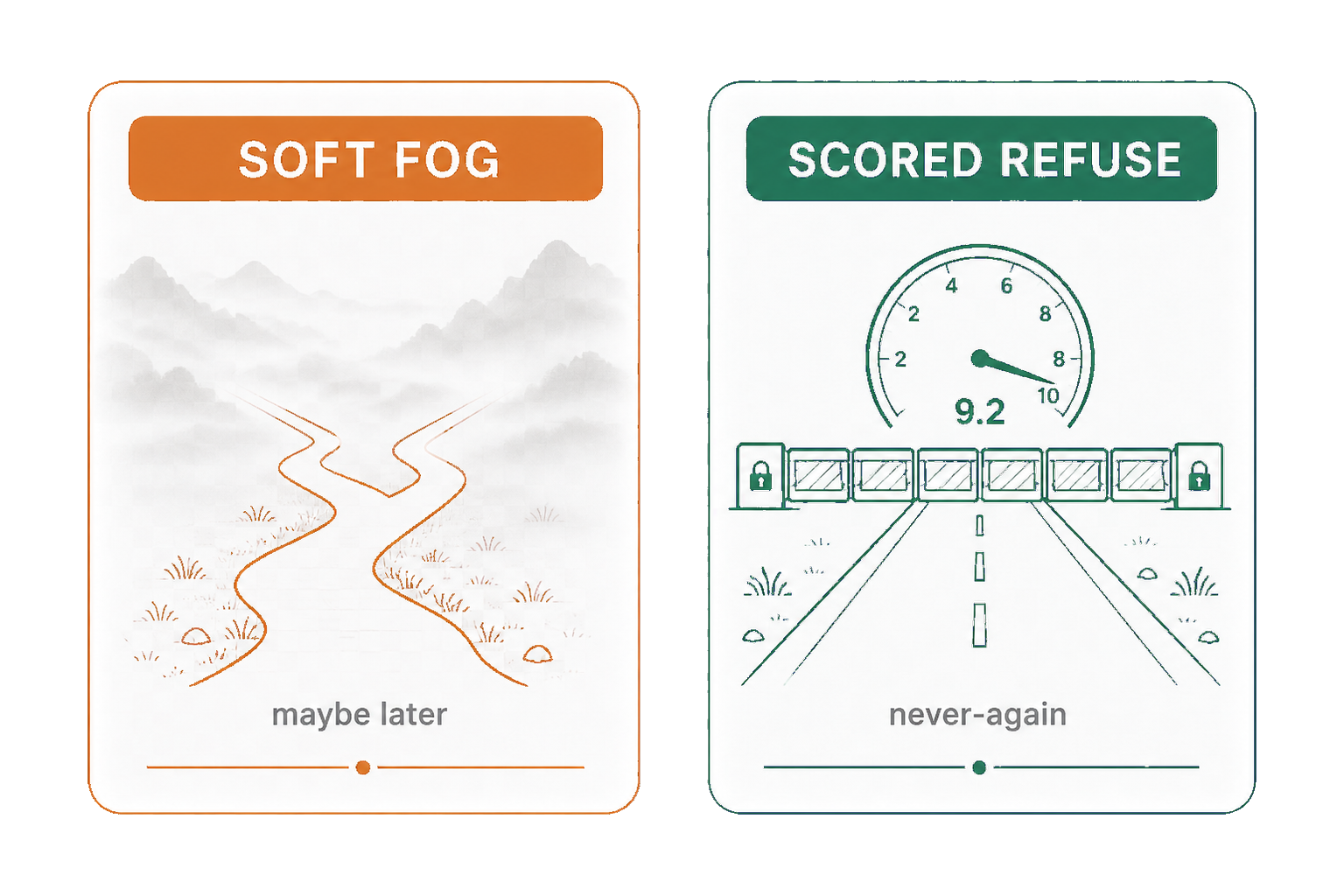
Spatial split — Soft fog (maybe later · exits reopen) versus Scored refuse (dial · never-again). Your move: Your move this week.
Your move this week
Playcard — run it: Anti-vision
- Write three Anti-vision rows.
- Score each 1–10.
- Circle every row you already bargain with — those are this week’s observation targets (Morning Voice).
Scientific grounding
Cite
- Higgins, E. T. (1987). Self-discrepancy: A theory relating self and affect. Psychological Review, 94(3), 319–340.
- Elliot, A. J., & Thrash, T. M. (2002). Approach-avoidance motivation in personality. Journal of Personality and Social Psychology, 82(5), 804–818.
Self-discrepancy separates ideal vs ought gaps — Anti-vision makes the ought/refuse side writable so soft “maybe later” shows as agitation, not vague fog (Higgins). Approach–avoidance temperaments show that avoidance goals are real motivational systems, not weak will — scoring non-negotiability keeps avoidance honest instead of smuggling it as delayed approach (Elliot & Thrash).
Adjacent
Power of anticipation
Personal Definitions
Problems at the Height of Ambitions