Definition
White-coat authority is the shortcut that treats a cue of role or setting — a coat, a hall, a title — as proof that what happens there is worth more attention, more compliance, or more money.
Origin
Cialdini catalogues authority as one of the click-whirr levers: an expert cue releases a pre-set sequence of deference (Influence). Classic compliance work (Milgram) showed how far a lab coat and a room can carry an instruction. A neighbouring medical fact — white-coat hypertension — is a measurement artifact (blood pressure rises in clinic). The teaching use here is the social cue, not the cuff.
Mechanism
Perception of authority is not the same as demonstrated competence in the moment. The coat, the amphitheatre, the five-star room arrive first. They dress the later sentence. Context of value is what happens to price when that dress changes. Automatic influence levers is the family; white-coat is the authority member.
Two mistakes travel together:
- Unseen cue. You pay or comply and call it taste or merit.
- Seen and condemned. You notice the coat and decide all authority is fake — including the competence that might be real.
The useful third: see the cue, keep the analytic step, decide on merits. Influence, in this narrow sense, is being in the frame from which you can radiate — not becoming a louder person.
Epistemic boundary: do not fold this note into white-coat hypertension. That literature is about clinic BP. Authority-heuristic literature is about compliance and judged expertise. This note does not claim that titles are empty, or that every high-status room is a trick. It claims that frame and sentence are separable, and that the frame often decides first.
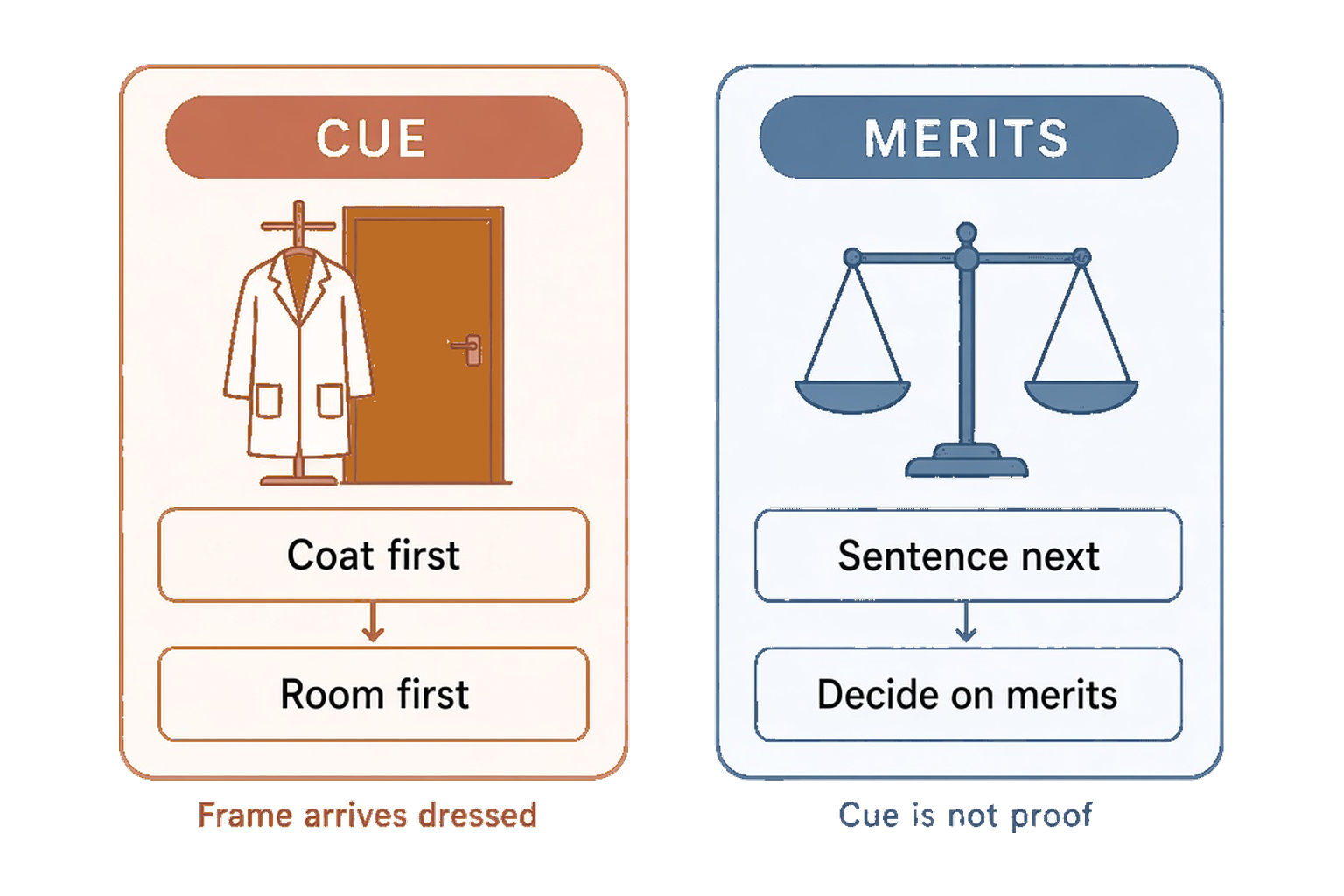
Cue first vs merits next — the coat arrives dressed.
Applications
- When a message lands harder in one room than another, name the coat before you rewrite the script.
- Pair with Pre-Suasion when the work is what is salient before the ask.
- Pair with Transfer of Certainty when the speaker has not yet authorised their own frame.
Failure modes
- Collector trap: listing more status props instead of choosing one honest frame.
- Overclaim trap: “I put on the coat” as a substitute for competence.
- Test today: name one cue that already raises your price or your compliance. Write whether you are using it or still pretending the object did the work alone.
Sources
Cite
- Cialdini, R. B. (2006). Influence: The Psychology of Persuasion. Harper Business.
- Milgram, S. (1963). Behavioral Study of Obedience. Journal of Abnormal and Social Psychology, 67(4), 371–378
- Cialdini, R. B. (2016). Pre-Suasion. Simon & Schuster.