Definition
Context of value is the claim that the same object changes price and felt worth when the frame changes — room, ritual, authority, and the identity the buyer is keeping coherent.
Origin
Judgment research treats value as constructed, not read off labour or material (Ariely, Loewenstein, and Prelec on coherent arbitrariness; Tversky and Kahneman on framing). Field demonstration: a world-class violinist, paid concert rates in a hall, collected coins on a station platform when the setting offered no authority cue (Weingarten, 2007). Retail and hospitality price the same water, the same egg, at different magnitudes because the experience that travels with the object is part of what is sold.
Mechanism
Folk accounting says worth = hours + material + innovation. The room that does not match that equation is not a scandal. It is a different function:
- Setting. Hall versus platform; five-star versus corner shop. Attention and ceremony are already in the price.
- Identity coherence. A buyer at a given stratum may need the tag to stay coherent with who they believe they are. Cheap cloth in a luxury window is not a math error.
- Designed experience. Unboxing, service, the way a juice arrives — the offer is not identical to the product. The conditioning that travels with the object is part of the object as lived.
White-coat authority is the authority-click inside this frame. Automatic influence levers is the wider catalogue. Context of value is the pricing claim: you are not only selling the thing. You are selling the situation in which the thing can be seen as worth the number.
Epistemic boundary: constructed-value studies are laboratory and field observation, not a licence to invent prices without a buyer. The metro-violin demonstration is journalism plus a natural experiment, not an RCT of “always raise the frame.” This note does not claim that labour never matters. It claims that hours are a poor sole meter when the frame is doing the deciding.
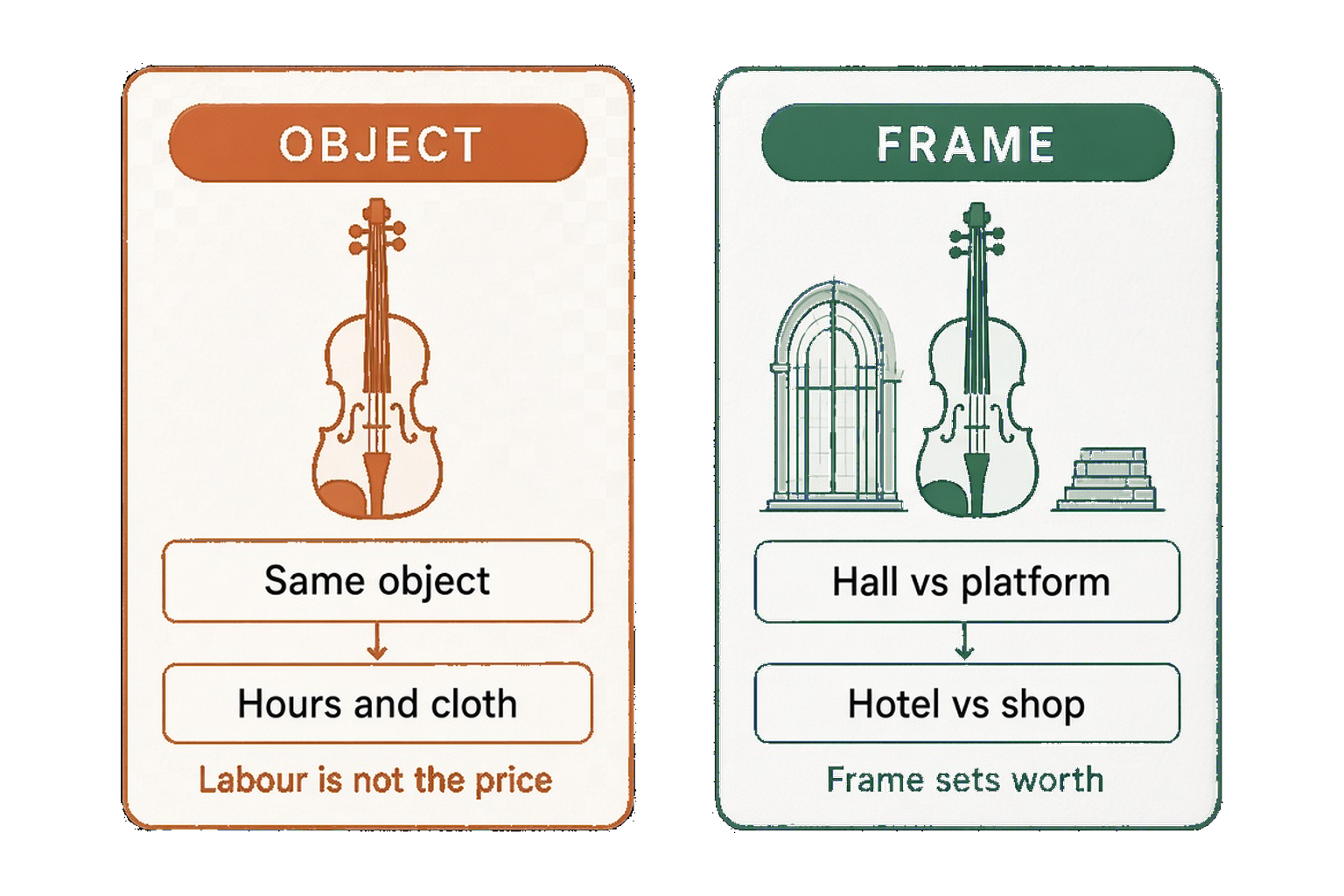
Same object, two frames — the frame sets the worth.
Applications
- When someone cannot price an intangible (time, presence, a conversation), ask which frame would make the same transmission obvious.
- Pair with Transfer of Certainty when the leak is I have not sold the frame to myself.
- Pair with Conditioning when a childhood rule still says worth = effort.
Failure modes
- Collector trap: more décor around the object instead of naming the one frame you are actually selling.
- Overclaim trap: treating every high price as proof of a well-designed frame.
- Test today: pick one object. Write the price you would pay in frame A and refuse in frame B. The difference is the work, not the object.
Sources
Cite
- Ariely, D., Loewenstein, G., & Prelec, D. (2003). “Coherent Arbitrariness”: Stable Demand Curves Without Stable Preferences. Quarterly Journal of Economics, 118(1), 73–106
- Tversky, A., & Kahneman, D. (1981). The framing of decisions and the psychology of choice. Science, 211(4481), 453–458