Definition
Troublemaker levels grade how hard you train one character edge — from level zero (I inconvenience a little) to high intensity — using the same gesture family at rising dose, like martial-arts belts.
Origin
Skill acquisition and exposure therapy both rely on graded dose: same behaviour family, rising intensity until capacity expands. Belt metaphors from martial arts compress that axis into a single readable scale.
Mechanism
Overshooting level collapses the loop — failure imagery feels unbearable, mood craters, practice stops. Undershooting produces no new circuit. Foa and Kozak’s emotional-processing frame adds that exposure must update the fear structure — graded dose without completion can re-traumatise; pick one level down from the fantasy.
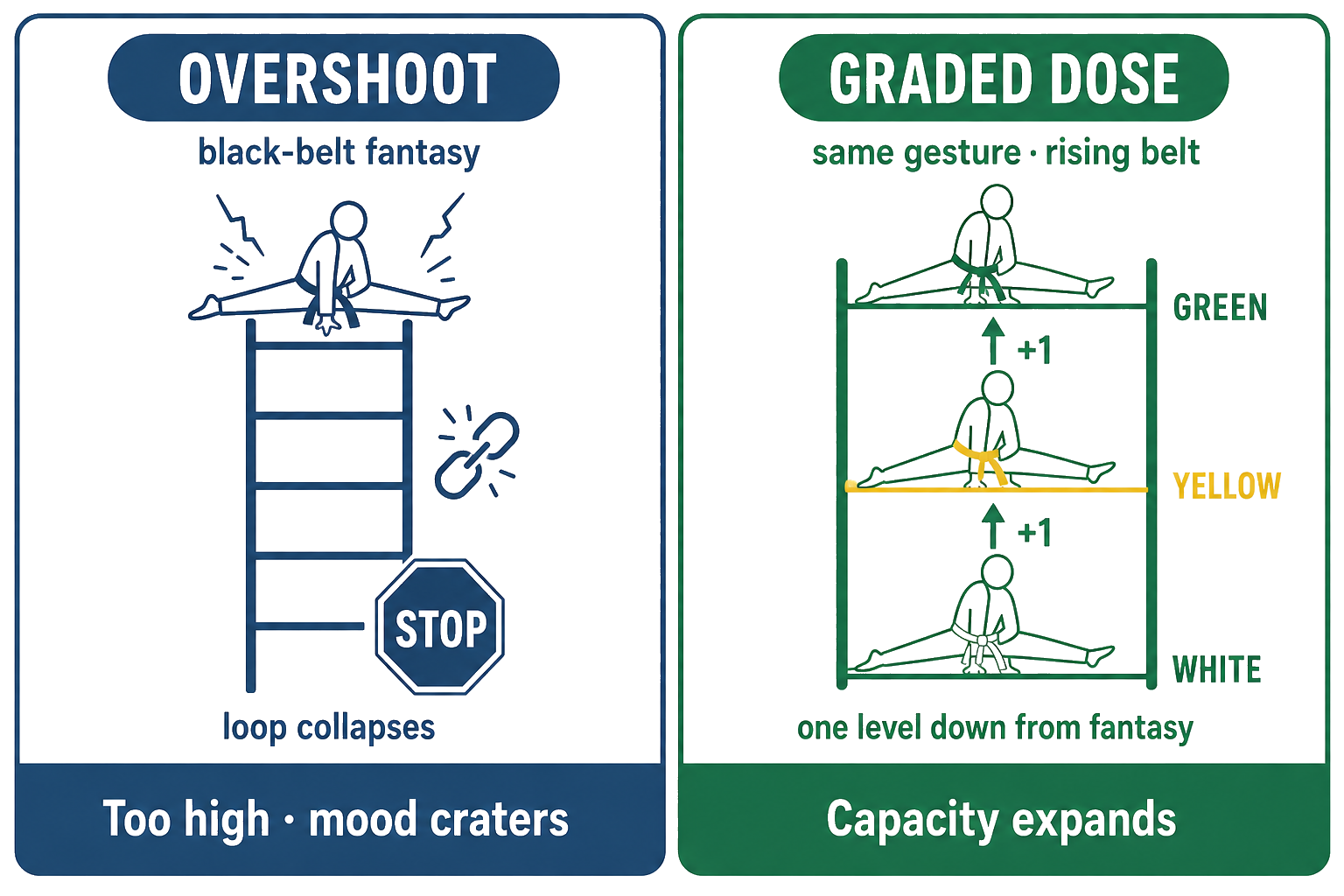
Overshoot collapses the loop — graded belt dose expands capacity. Pair with Reading Grid harvest and one level down from fantasy.
Levels pair with Tipping point (the one new behaviour) and Battle (the week’s container) — three different granularities.
Applications
Before a Battle week, write your current belt for that edge. Harvest hourly per Reading Grid. When failure imagery craters mood, step down one level instead of abandoning visualization entirely.
Sources
Cite
- Ericsson, K. A., Krampe, R. T., & Tesch-Römer, C. (1993). The role of deliberate practice in the acquisition of expert performance. Psychological Review, 100(3), 363–406.
- Foa, E. B., & Kozak, M. J. (1986). Emotional processing of fear: Exposure to…. Psychological Bulletin, 99(1), 20–35
- Bandura, A. (1977). Self-efficacy: Toward a unifying theory of…. Psychological Review, 84(2), 191–215
Related doctrine
Reading Grid · Being Perceived as a Troublemaker · Tipping point