Definition
Permission to live is the authorization to occupy the life that remains after a version has died — not the technique of how to start, the yes that the remaining life may be inhabited.
Origin
Mortality-contrast work (cemetery walks, bounded dying stages, hospice-adjacent formation) changes what a later inconvenience is allowed to cost. Experiential-avoidance research treats the cost of escaping a private state as a longer restriction of the remaining life (Hayes, Wilson, Gifford, Follette, & Strosahl, 1996). Acceptance literature names the same refusal as a war on the part you will not inhabit (Brach, 2003). Club language permission to live sits on that stack. Adjacent, not the same: Permission withheld names the acts still refused. Permission to live names the life still uninhabited after the death.
Mechanism
Three invoices get glued together.
- The death. A real decision expires a protective layer. Without naming that death, authorization stays theatrical.
- The withheld acts. Scripts and how-to arrive before the refused behaviours are listed. The block stays upstream of technique.
- The uninhabited life. After the deaths — other people’s, or a version of your own — the remaining day is still treated as not-yet-authorized. The question at the end of the day is not what did I finish but where did I still refuse to live.
The price is dual. You can pay the consequence of having authorized yourself. You can also pay the price of not giving the right. Only the first is a decision. A more complete version can also be lighter: complete because the heavy layer is gone.
Epistemic boundary: this note does not claim that every mortality reminder licenses risk, or that grief should be used as a productivity hack. It claims that refusing specific acts and refusing to inhabit the remaining life are different relations to the same unauthorized day.
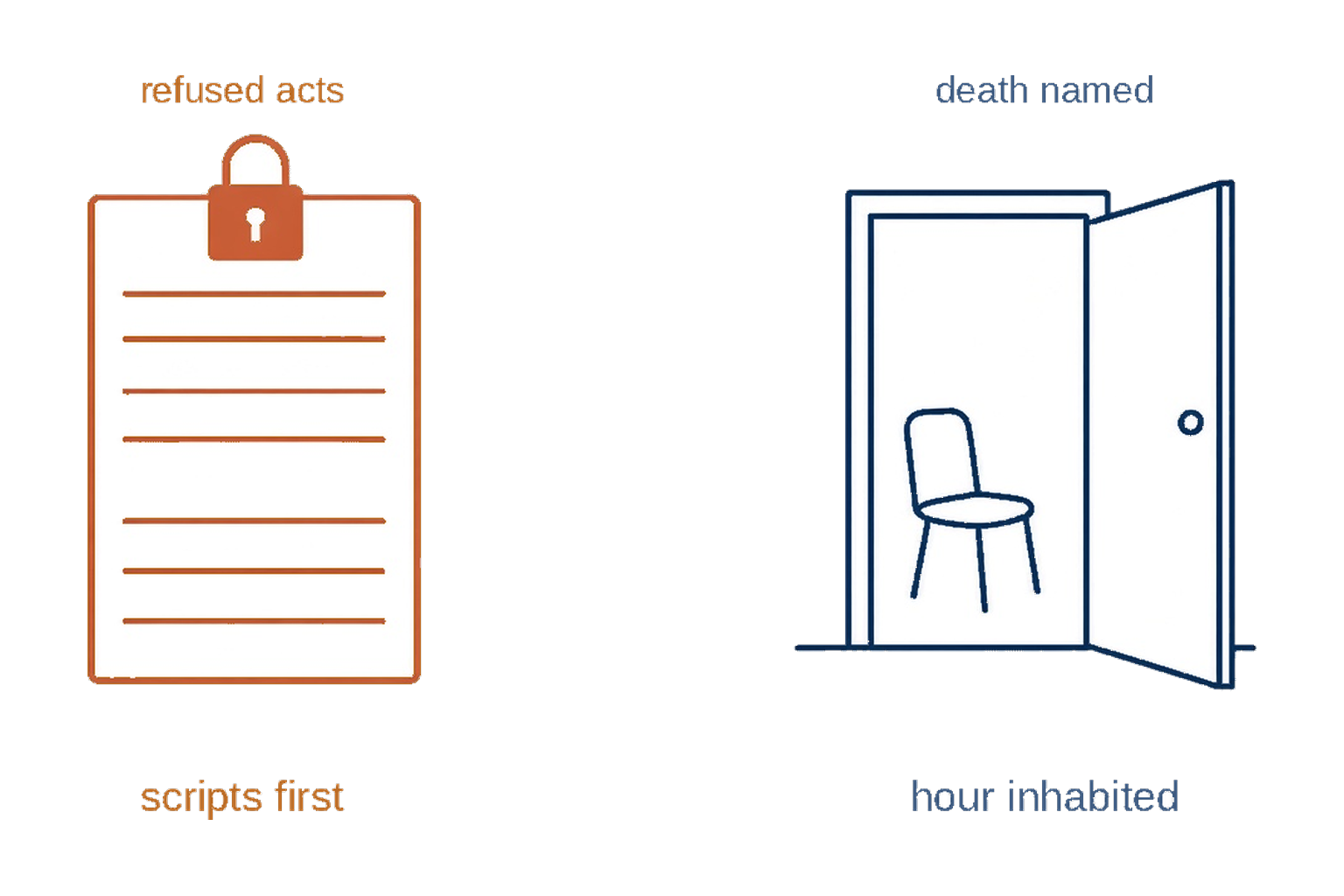
Refused list vs inhabited hour — the inventory is not inhabit.
Applications
- When a decision has been named and the body still will not occupy the next hour, ask which invoice is unpaid — the act, or the life.
- Pair with Decide is a death when the missing move is naming the version that ends.
- Pair with Radical Acceptance when refusal of the remaining life is running as quiet self-hate.
Failure modes
- Collector trap: more sentences about permission instead of one inhabited hour this week.
- Overclaim trap: using other people’s deaths as a license to skip discernment.
- Test today: write one line — where did I not give myself permission to live. Inhabit that line once without adding a plan.
Sources
Cite
- Hayes, S. C., Wilson, K. G., Gifford, E. V., Follette, V. M., & Strosahl, K. (1996). Experiential avoidance and behavioral disorders: A functional dimensional approach to diagnosis and treatment. Journal of Consulting and Clinical Psychology, 64(6), 1152–1168
- Brach, T. (2003). Radical Acceptance. Bantam.