Definition
Decision architecture is the system that makes a consequential choice still true after the emotion of the signing — the hold, not the poster, not the log line alone.
Origin
Implementation-intention research treats the gap between a stated choice and later behaviour as the usual failure, not a taste problem: if-then plans automate the when-where-how of holding a fork (Gollwitzer, 1999). Planned-behaviour work then places those plans as the bridge across the intention–behaviour gap (Sheeran & Webb, 2016). Software teams log architecture forks so the reason for a choice can be reviewed. Club language decision architecture sits on that stack: a personal system that filters past decisions by relevance and result, names the next fork, and anticipates what will make the choice hold. Adjacent, not the same: Architecture Decision Record (ADR) is the four-line log; Decision hygiene is who is allowed to sign; A decision is two acts is choose then maintain. Architecture is the hold.
Mechanism
Three objects get confused.
- The January gym card. A year of membership on the first of January, gone on the 28th. Emotion signed. No system asked what would make the choice still true in week four. The hidden clause was already in the first signing.
- The log without a hold. Four lines exist. The next kilometre still renegotiates. The record is archaeology, not architecture.
- The stack. Context, decision, expected impact, review date — plus a filter on past forks, plus an anticipation of the condition that will break or keep the choice. If tomorrow is the leak: a part already does not believe the scene can happen, so the structure stays large enough that the first chain never has to start.
Sure-sure-sure loops (more arguments, more models, no fork) are a failure of architecture, not a lack of data. Seeing big can be lucid. It becomes a trap when the size of the structure is what protects you from a decision that could hold.
Epistemic boundary: this note does not claim that every choice should be irrevocable, or that changing your mind is a character failure. It claims that a poster decision and a decision with a hold system are different relations to the same fork.
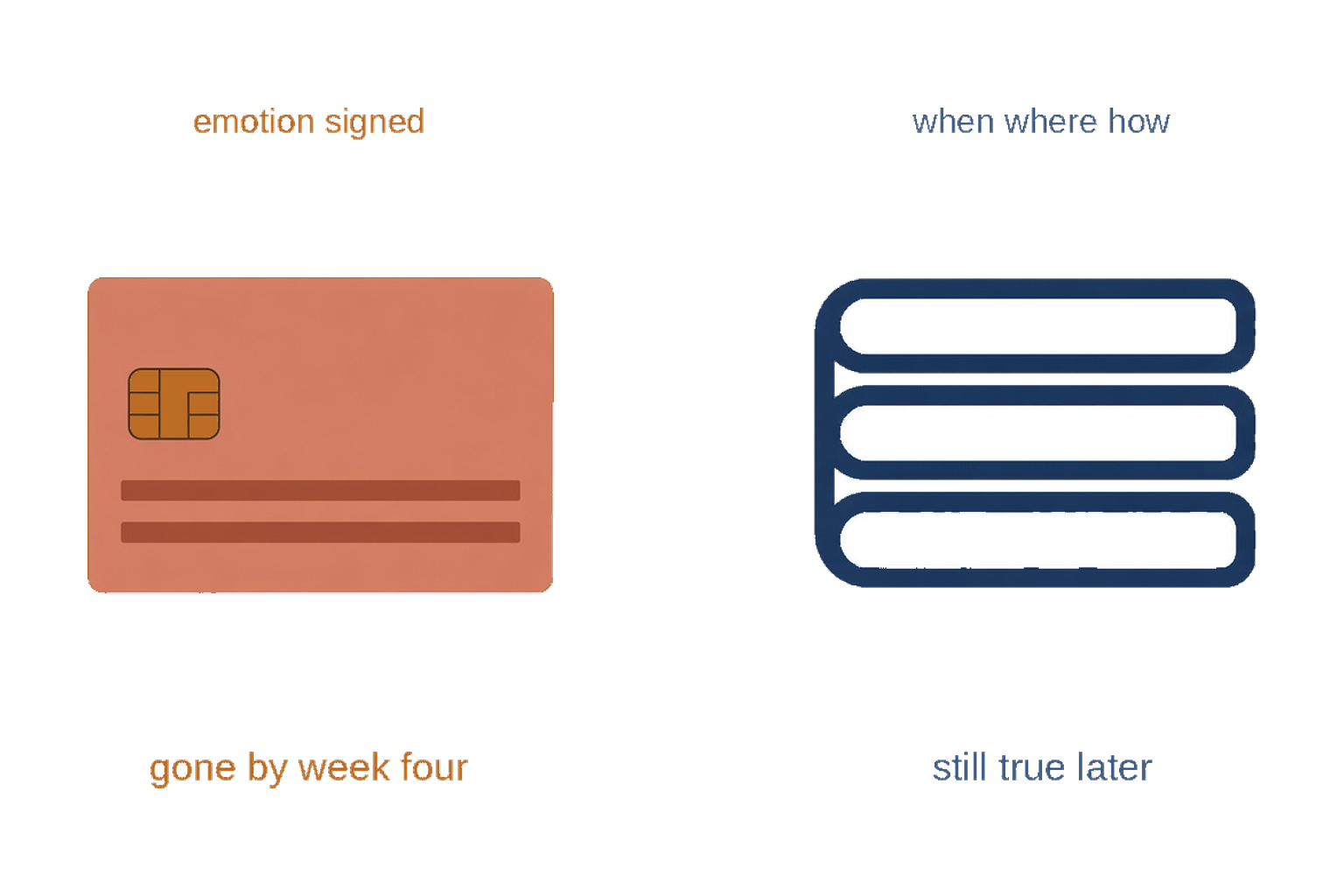
January card vs hold stack — the poster is not architecture.
Applications
- When a stop or a start is being outsourced to more certainty, ask what would make the choice still true after January.
- Pair with Decision chain when the next kilometre is already renegotiating.
- Pair with Failure Strategy when the hidden clause was in the first signing.
Failure modes
- Collector trap: more ADRs instead of one hold condition named this week.
- Overclaim trap: treating every logged line as a life sentence.
- Test today: write one four-line ADR and one sentence: what would make this still true after January.
Sources
Cite
- Gollwitzer, P. M. (1999). Implementation intentions: Strong effects of simple plans. American Psychologist, 54(7), 493–503
- Sheeran, P., & Webb, T. L. (2016). The theory of planned behaviour and implementation intentions. In M. Fishbein & I. Ajzen (Eds.), Predicting and changing behavior (2nd ed., pp. 271–305)