Definition
A decision is two acts: the choice itself — always a “no” to the alternatives — and the separate, repeated act of maintaining that choice over time.
Origin
Decision research distinguishes forming an intention from enacting and sustaining it. William James located the difficulty of the will not in choosing but in staying with the chosen object of attention. Peter Gollwitzer’s work on implementation intentions shows that pre-deciding when, where, and how a choice will be carried out sharply increases follow-through, precisely because it addresses the second act rather than the first. Commitment devices (Thaler, Ariely) work the same seam — they protect the maintenance phase from a future, weaker self.
Mechanism
The initial choice closes options; this is necessary but not sufficient, because the conditions that motivated it fade and competing pulls return.
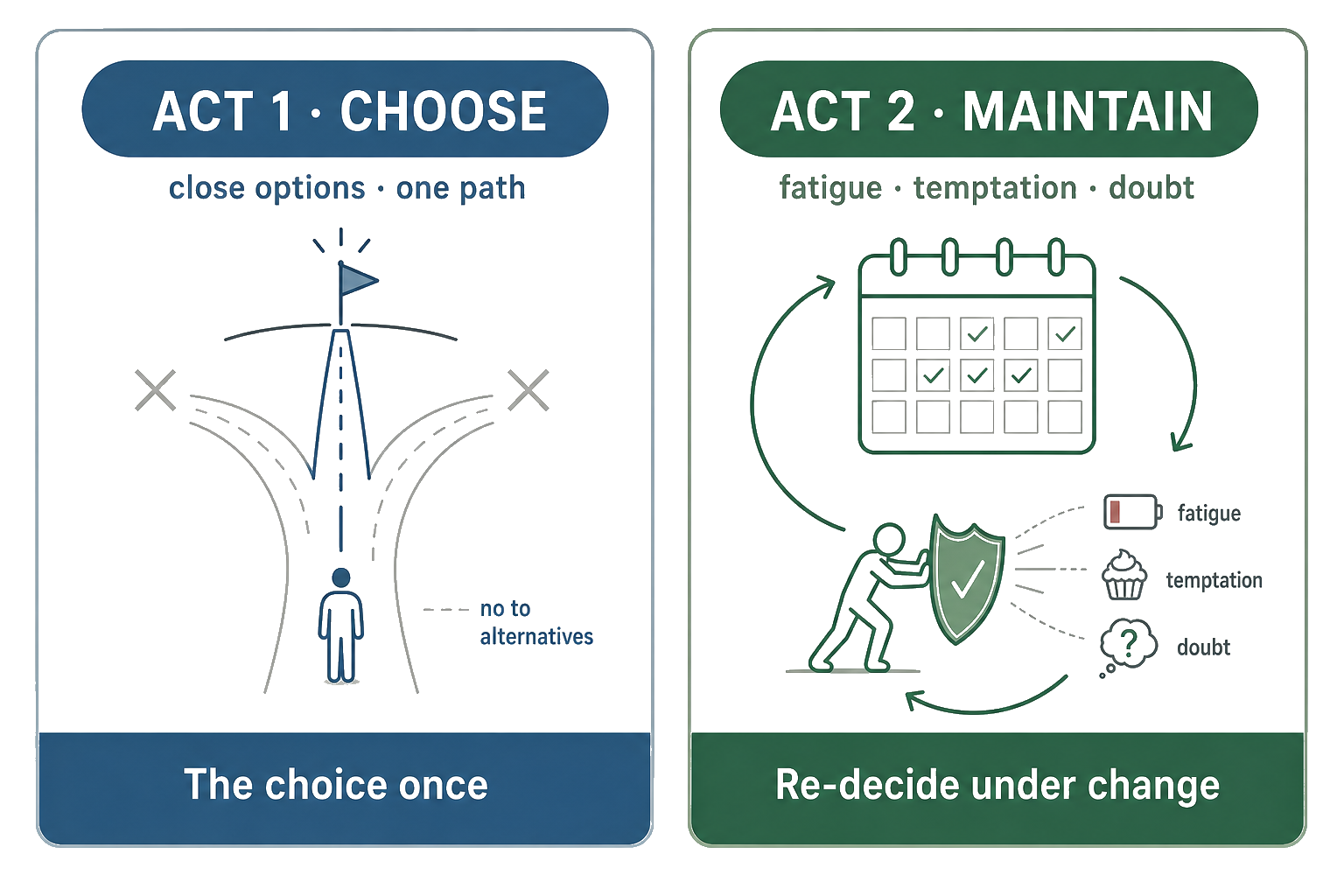
Choose once versus re-decide under change — most failures are act two, not act one. Pair Long Effort · ADR.
Maintenance is a distinct, recurring decision made under changed conditions — usually under fatigue, temptation, or doubt. Most failed resolutions are not failures of the first act but of the second: the choice was made once and never re-made. Logging the choice, its context, and its expected impact (an architecture-decision-record discipline) supports the second act by making the original reasoning retrievable.
Applications
- Treating follow-through as its own scheduled decision, not an assumed consequence of the choice.
- Using implementation intentions and commitment devices to defend the maintenance phase.
- Reviewing a decision against its recorded context instead of a rewritten memory.
Sources
Cite
- Gollwitzer, P. M. (1999). Implementation intentions. American Psychologist, 54(7), 493–503.
- James, W. (1890). The Principles of Psychology (Vol. 2, “Will”). Henry Holt.
- Thaler, R. H., & Sunstein, C. R. (2008). Nudge. Penguin Books.
Related doctrine
Architecture Decision Record (ADR)
Long Effort