Definition
The sunk cost fallacy is the tendency to persist with a course of action because of money, time, or effort already spent and unrecoverable, even when continuing is no longer the best choice.
Origin
Hal Arkes and Catherine Blumer (1985) documented the “sunk cost effect” across a series of experiments, showing that prior investment increases the tendency to continue. It is closely tied to loss aversion in prospect theory (Kahneman & Tversky): abandoning an investment forces the spent resource to be felt as a loss, which people work to avoid.
Mechanism
A rational decision weighs only future costs and benefits; past costs are gone regardless of the choice.
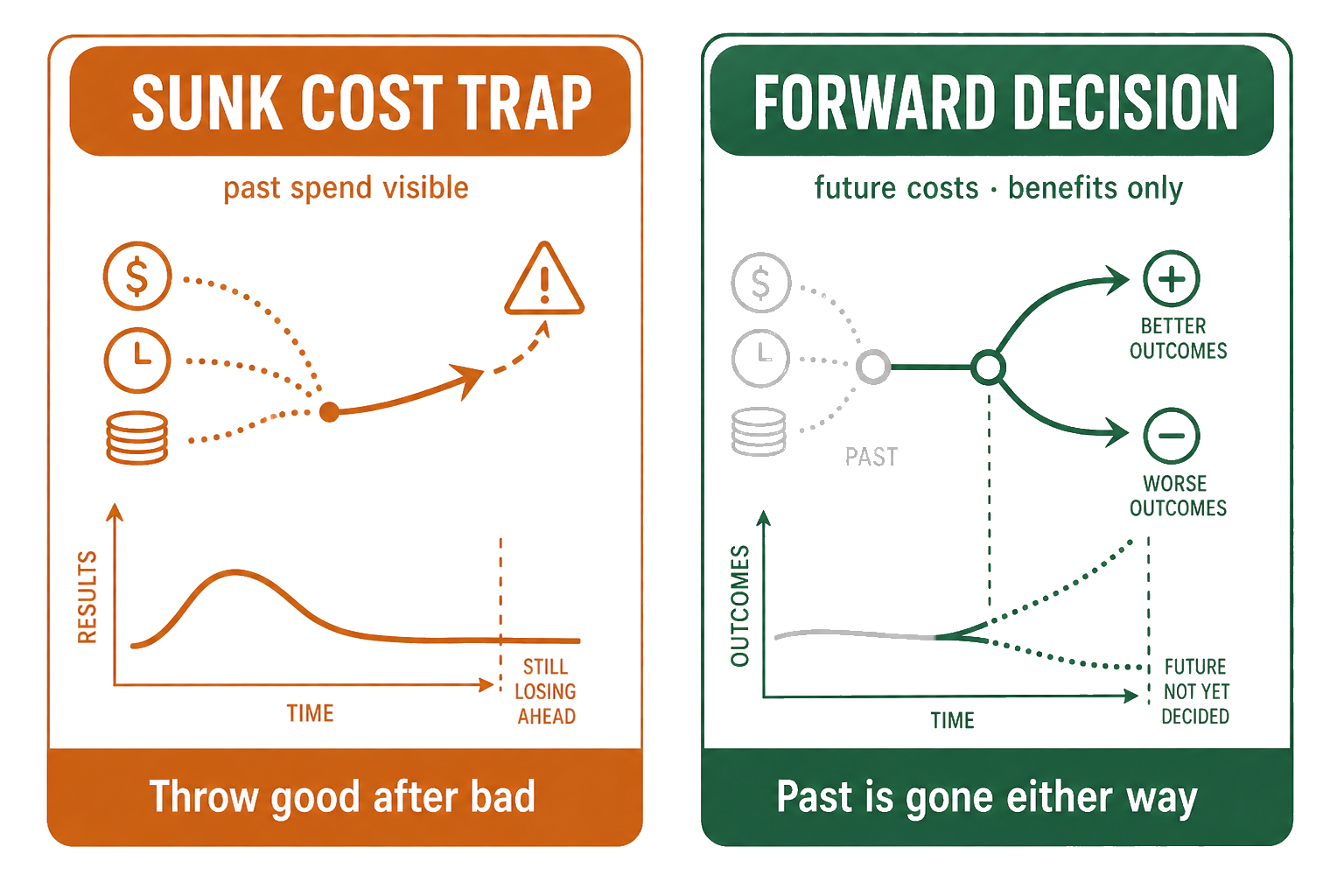
Past spend trap versus forward-only decision. Pair Long Effort · IKEA effect.
The fallacy appears when the salience of what has already been spent distorts that calculus, so commitment grows with investment rather than with prospect. A legitimate-looking twin exists: effort already invested can raise valuation through the IKEA effect, and a maintained streak can be worth protecting for identity reasons — but that value must come from future benefit, not from the wish to not have wasted the past.
Applications
- Recognising when persistence is driven by past spend rather than future value.
- Separating a worthwhile maintained commitment (future-justified) from a sunk-cost trap (past-justified).
- Designing review points that evaluate only forward costs and benefits.
Sources
Cite
- Arkes, H. R., & Blumer, C. (1985). The psychology of sunk cost. Organizational Behavior and Human Decision Processes, 35(1), 124–140.
- Kahneman, D., & Tversky, A. (1979). Prospect theory. Econometrica, 47(2), 263–291.