Definition
A parallel reward circuit is a second way the nervous system can register pay while the primary cue — the room, the yes, the number — has not paid yet. It is a spare, not a duplicate of the same bet.
Origin
Prediction-error learning trains you to repeat cues that pay and to drop cues that do not. A life with only one paying cue is a single point of failure: when that cue misses, the whole day reads as unpaid, and cheaper cues (sugar, a scroll, a stop) volunteer. Engineering keeps a spare path so one outage does not become the identity of the system. The same shape applies to reward. Reward prediction error is the miss. This note is the spare you can fire while the miss is still true.
Dopamine governance decides when you take a small hit. A parallel circuit decides what still counts as pay if the hit you wanted does not come.
Mechanism
- Name the primary cue whose pay you are waiting on.
- Name one spare that can complete without that cue: a bout of effort, a cold shock, a sentence said out loud, a finished small rep.
- Fire the spare at the moment the unpaid thought is visible, before the argument about whether you deserve it.
- Keep the spare off the primary scoreboard. A run does not fill the room. It keeps the day from being only the empty room.
- One spare, rehearsed, beats a menu of spares you negotiate.
Epistemic boundary. Redundancy is a reliability idea. The reward literature describes learning from omitted reward; it does not prescribe a second hobby. The claim here is structural: an unpaid primary cue will recruit a default spare if you have not named one. No single journal article is the spare itself.
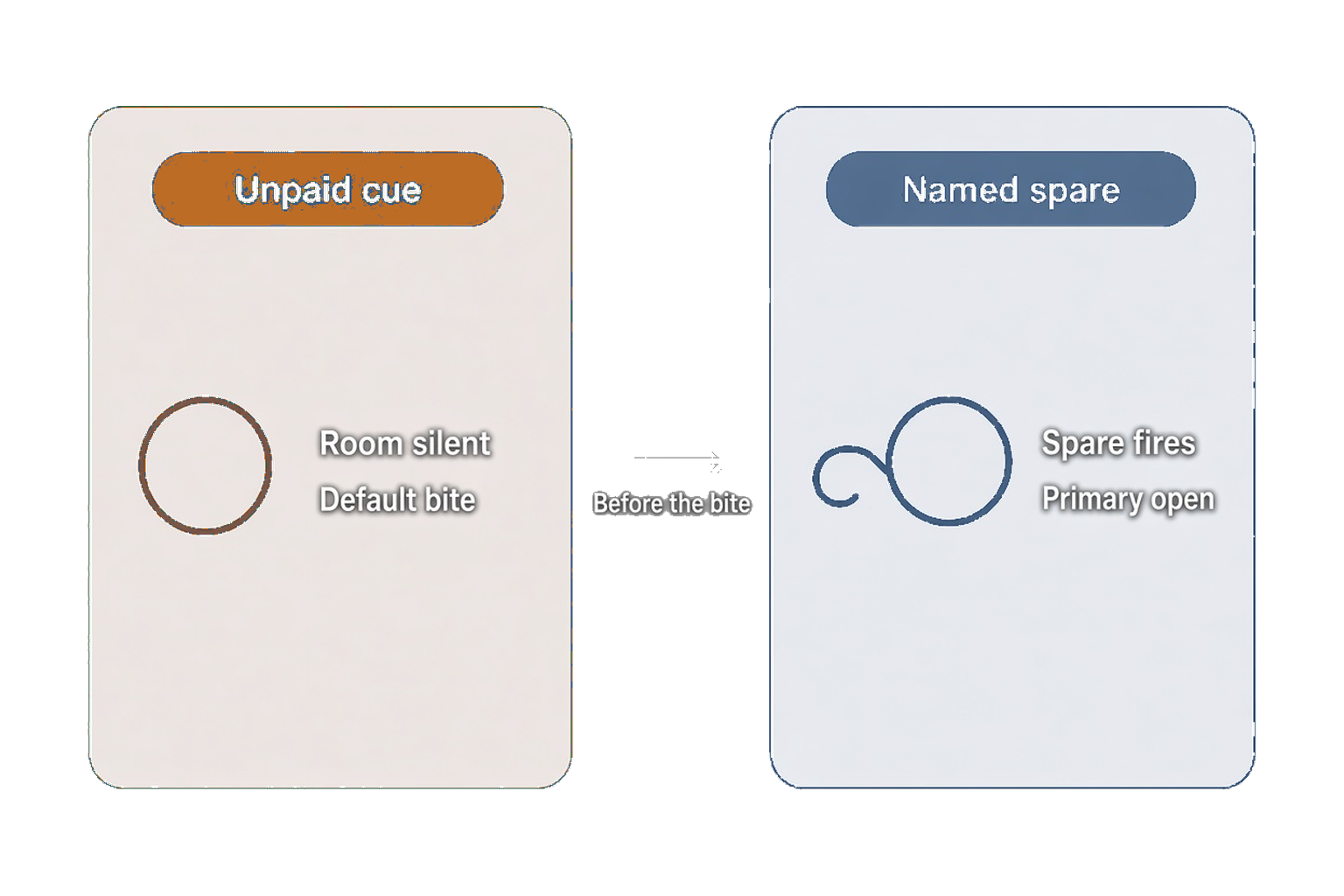
An unpaid cue recruits a default bite unless a named spare fires first.
Applications
- Before a week of likely refusals, write the spare you can run without leaving the building.
- If the default spare is food or a feed, that is data about the missing named spare, not a character verdict.
- Do not retire the primary goal because the spare worked. The spare is what lets you stay.
Failure modes
- Collector trap: a list of healthy rewards and no cue that fires one of them.
- Overclaim trap: treating the spare as proof the primary goal no longer matters, or as a detox.
- Test today: in the next unpaid hour, run one named spare before the default bite.
Sources
Cite
- Schultz, W. (2016). Dopamine reward prediction-error signalling. Nature Reviews Neuroscience, 17(3), 183–195.
- Schultz, W., Dayan, P., & Montague, P. R. (1997). A neural substrate of prediction and reward. Science, 275(5306), 1593–1599.