Definition
A reward prediction error is the difference between the reward a nervous system expected and the reward that arrived. A negative error teaches the cue to stop. That teaching is not a verdict on the whole project.
Origin
Midbrain dopamine neurons do not simply report pleasure. They report whether the outcome beat, matched, or missed the prediction already in play. Wolfram Schultz’s line of work made that teaching signal measurable: a cue that predicts reward starts to drive the response, and a fully predicted reward stops driving it. The omission is the lesson.
Dopamine baseline is the set point those hits are judged against. Dopamine governance is what you do with small hits once you can see them. This note is the miss itself: outcome below prediction, and the advice the miss tends to give, which is to leave the tree.
Mechanism
- A prediction is spent before the event. The picture of a full room, a yes, a number, is already a reward draft.
- The outcome is scored against that draft, not against the year and not against your values.
- A negative error teaches abandonment of the cue. No fruit on this branch, try another tree. That is efficient when the tree is dead.
- The same lesson fires on a living tree you have already chosen. Belief and a missing pay then occupy the same hour. The signal is scrambled, not absent.
- A spare pay has to be designed if you intend to stay. Waiting for the original cue to pay again leaves the error in charge.
Epistemic boundary. The electrophysiology is about phasic dopamine and learned cues in animals and, by extension, human reward learning. It does not by itself say which personal projects you should keep. The transferable claim is the score: a miss teaches the cue. Whether you obey that teaching is a separate decision.
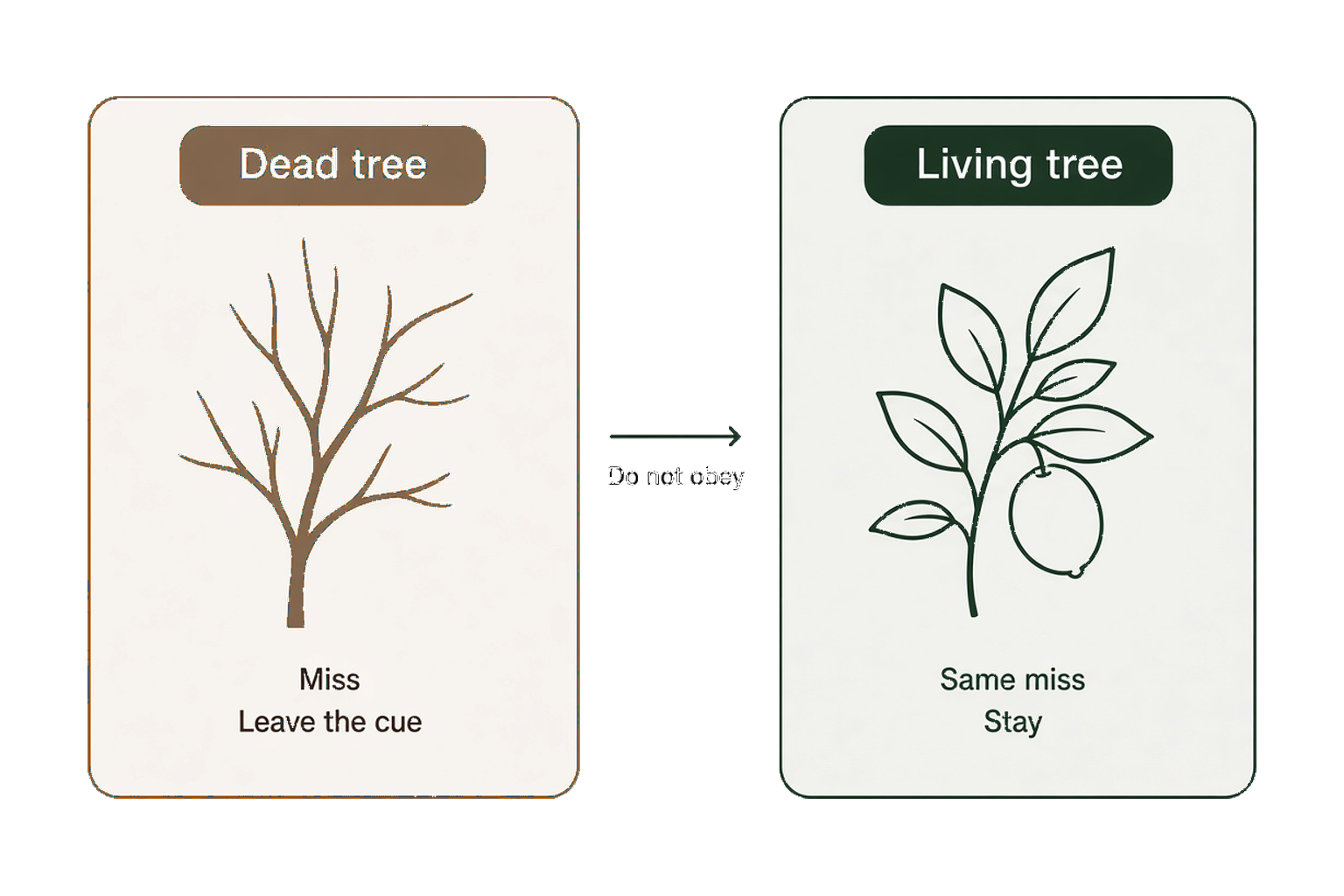
A miss on a dead tree is a reason to leave. The same miss on a living tree is not.
Applications
- After a thin result, write the sentence the error is selling you before you treat it as strategy.
- Separate a dead tree (the cue truly does not pay) from a tree you still mean to climb (the error is early).
- Do not ask a yearly reason to cancel a phasic miss. They are different clocks.
Failure modes
- Collector trap: logging every miss and never deciding which tree is still yours.
- Overclaim trap: treating a single omitted reward as proof the project is false, or treating the literature as a moral order to quit.
- Test today: name the prediction you had already spent, and the outcome that missed it, in one line each.
Sources
Cite
- Schultz, W. (2016). Dopamine reward prediction-error signalling. Nature Reviews Neuroscience, 17(3), 183–195.
- Schultz, W., Dayan, P., & Montague, P. R. (1997). A neural substrate of prediction and reward. Science, 275(5306), 1593–1599.