Definition
Dopamine governance is how you manage small reward hits — scroll, snack, novelty drive — so your baseline shifts and you can stay in productive discomfort without constant micro-escape.
Origin
Dopamine baseline maps habitual stimulation level; governance adds agency — noticing the micro-hit, reversing the car, staying in repetitive silence until focus lengthens.
Mechanism literature emphasises prediction error and cue-driven learning (Schultz 2016) — governance is operational, not detox mythology.
Mechanism
When interception fires (I want my little dopamine hit), you can feed it or train through it. Raising tolerance is not white-knuckling forever — it is choosing fewer, deliberate rewards so the same work block feels sufficient.
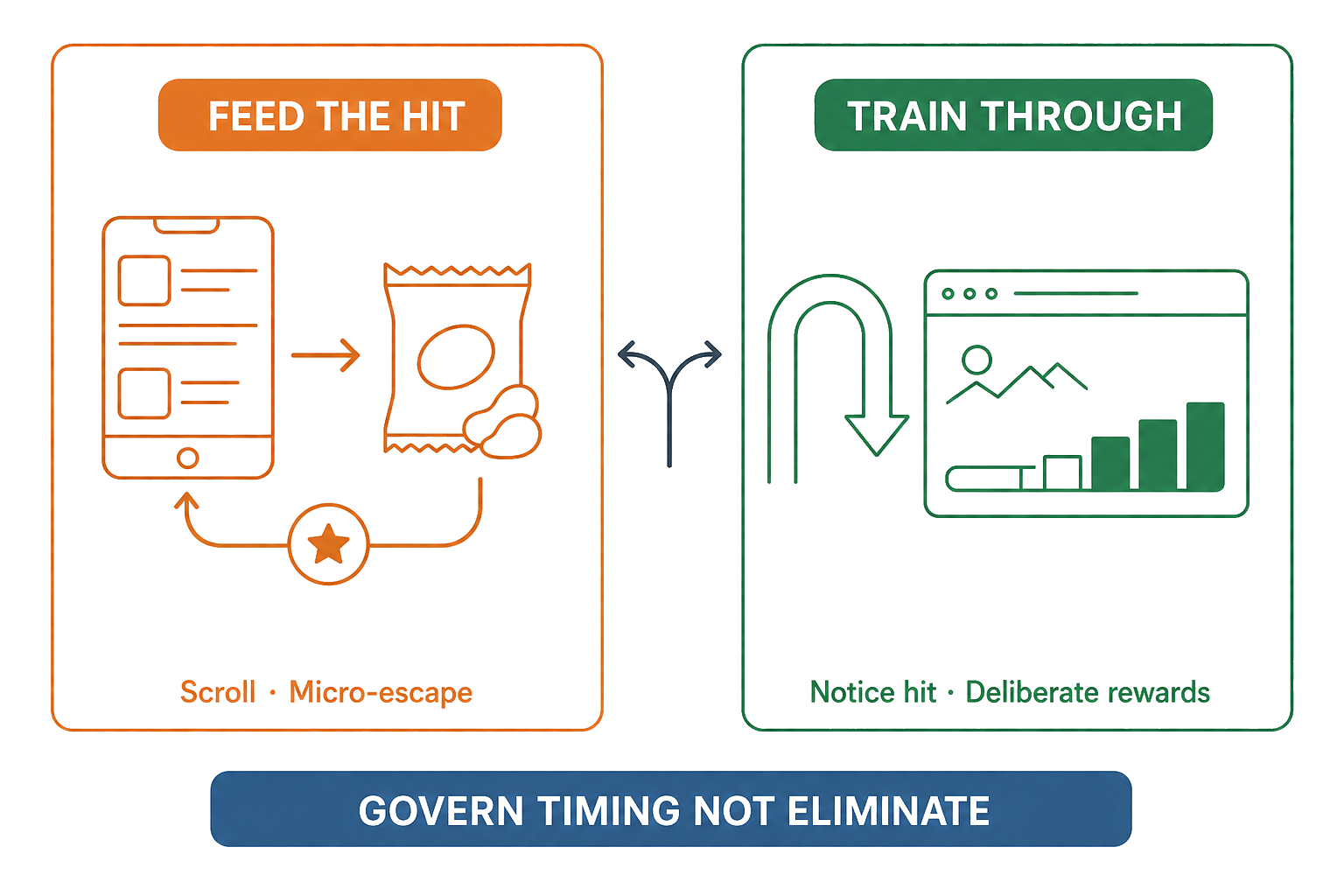
Feed the hit vs train through — govern timing, not elimination mythology. Curated domain trail: Focus.
Pairs with Dispersion (scatter as reward) and Flight strategies (avoidance as reward).
Applications
- First five minutes of deep work: govern before the first hit.
- Gym and sport: progressive load mirrors baseline training (Long Effort).
- Hourly journal: count flee moves that were dopamine purchases.
Failure modes
- Detox mythology — treating governance as elimination instead of deliberate timing of reward.
- White-knuckle forever — no planned micro-rewards; baseline training collapses into binge–restrict cycles.
- Confusing governance with shame — moralising hits instead of naming and choosing (Flight strategies).
Related doctrine
Sources
Cite
- Schultz, W. (2016). Dopamine reward prediction-error signalling: a two-component response. Nature Reviews Neuroscience, 17(3), 183–195.
- Nutt, D., Lingford-Hughes, A., & Erritzøe, D. (2015). Dopamine theory of addiction: 40 years of highs and lows. Nature Reviews Neuroscience, 16(5), 305–312.