Definition
Wanting and liking are dissociable brain processes: “wanting” is the dopamine-driven motivation to pursue a reward, while “liking” is the distinct, opioid-mediated pleasure of actually experiencing it.
Origin
The distinction was established by neuroscientists Kent Berridge and Terry Robinson, whose “incentive salience” research showed that dopamine drives the pursuit of rewards more than the pleasure of them. It was popularised for general readers in The Molecule of More (Daniel Lieberman & Michael Long), which frames dopamine as the chemistry of the future and the possible — anticipation, craving, “more” — set against the here-and-now chemicals (such as endorphins and oxytocin) that govern present enjoyment.
Mechanism
Dopamine fires for the prediction and pursuit of reward, not its consumption. So the desire that pulls you toward a thing (wanting) is generated by a different system than the satisfaction you feel having it (liking).
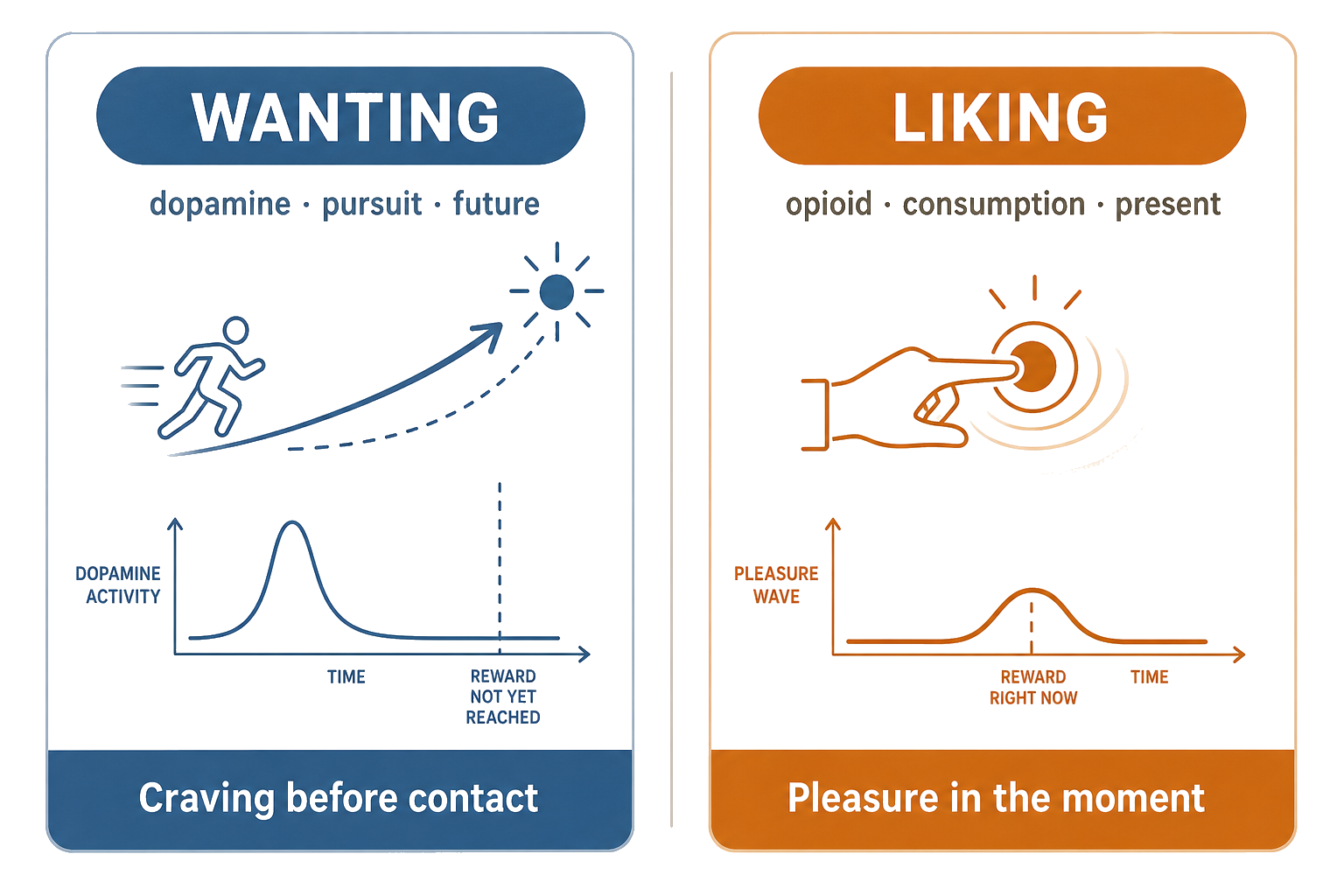
Pursuit (dopamine) versus consumption (liking) — craving is not the same chemistry as enjoyment. Pair The Molecule of More · Dopamine baseline.
This explains a common pattern: intense craving followed by muted enjoyment — desire does not equal enjoyment. The same split illuminates the love and addiction overlap: early passionate love is dopaminergic — future-oriented, novelty-seeking, craving — while durable companionate love runs on present-moment chemistry; addiction is wanting amplified and decoupled from liking, where pursuit persists even as pleasure fades.
Applications
- Reading your own craving: separating I want this from will I actually enjoy this? before acting.
- Understanding why acquisition rarely satisfies for long, and designing for present-moment reward instead.
- Recognising the dopaminergic signature of new infatuation, novelty-seeking, and compulsive pursuit.
Sources
Cite
- Berridge, K. C., & Robinson, T. E. (1998). What is the role of dopamine in reward: Hedonic impact, reward learning, or incentive salience?. Brain Research Reviews, 28(3), 309–369.
- Berridge, K. C., Robinson, T. E., & Aldridge, J. W. (2009). Dissecting components of reward: ‘Liking’, ‘wanting’, and learning. Current Opinion in Pharmacology, 9(1), 65–73.
- Lieberman, D. Z., & Long, M. E. (2018). The molecule of more. BenBella Books.