Definition
Dispersion is attention scatter — leaving the declared tunnel for surfing, side tabs, or low-stakes stimulation before the deep-work loop starts.
Origin
Task-switching and interruption research document recovery costs when focus breaks (Flow literature complements this at the state level). Club use names the first five minutes as the gate where dispersion wins or loses.
Mechanism
You can enter a music-backed tunnel and hold — or drift to one quick look that purchases relief. Dopamine governance names the micro-reward; Long Effort names staying through the opening discomfort until the loop locks.
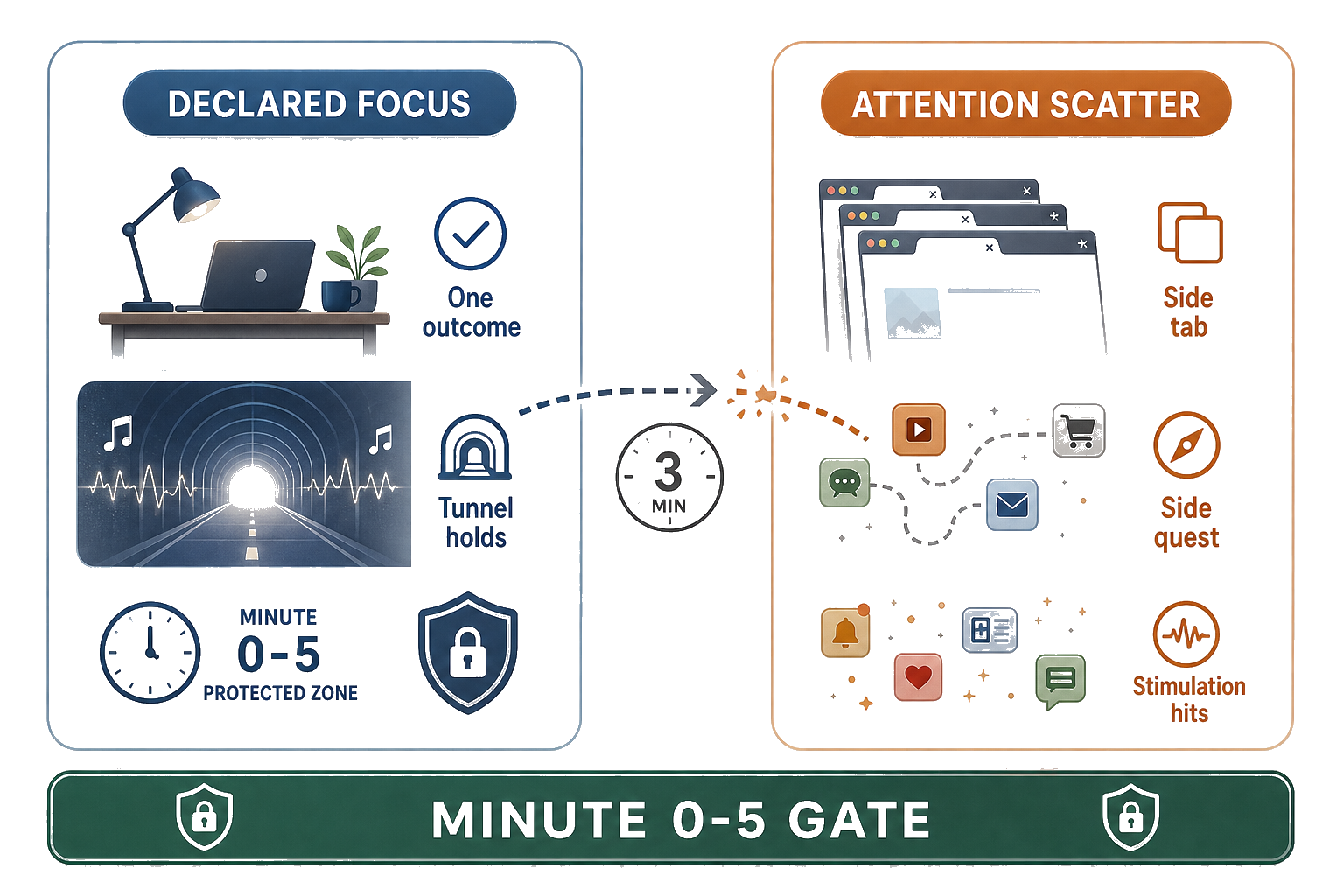
Declared tunnel vs side-tab scatter — the gate is minute zero–five, not hour three. Curated domain trail: Focus.
Journaling dispersion episodes (trigger · body · exit move) turns scatter into trainable data.
Failure modes
- Blaming willpower alone — scatter often starts in minute zero–five before discipline is even in play.
- Research masquerading as focus — side tabs that feel like work but never touch the declared outcome.
- Ignoring recovery cost — switching without logging resumption tax (Couffe 2017).
Applications
- Morning blocks (90-90-1 / 45-91): protect minute zero–five before opening browsers.
- Knowledge work: one declared outcome per block; dispersion often masquerades as research.
- Pair with Flight strategies when scatter is avoidance.
Related doctrine
Sources
Cite
- Couffe, C., & Michael, G. A. (2017). Failures due to interruptions or distractions: A review and a new framework. The American Journal of Psychology, 130(2), 163–181.
- Kiesel, A., Steinhauser, M., Wendt, M., Falkenstein, M., Jost, K., Philipp, A. M., & Koch, I. (2010). Control and interference in task switching—A review. Psychological Bulletin, 136(5), 849–874.