Definition
Flow is a state of full, effortless absorption in an activity, in which attention is completely invested in the task at hand, action and awareness merge, and the sense of time and self recedes.
Origin
The concept was formalised by the psychologist Mihály Csikszentmihalyi, who interviewed artists, athletes, surgeons, and chess players and found a recurring description of an “optimal experience” they pursued for its own sake. He named it flow after the metaphor participants used — being carried along as if by a current. It became the founding construct of the positive-psychology research on intrinsic motivation and engagement.
Mechanism
Flow arises at the balance point between challenge and skill: a task too easy produces boredom, too hard produces anxiety, and the narrow channel between them produces flow.
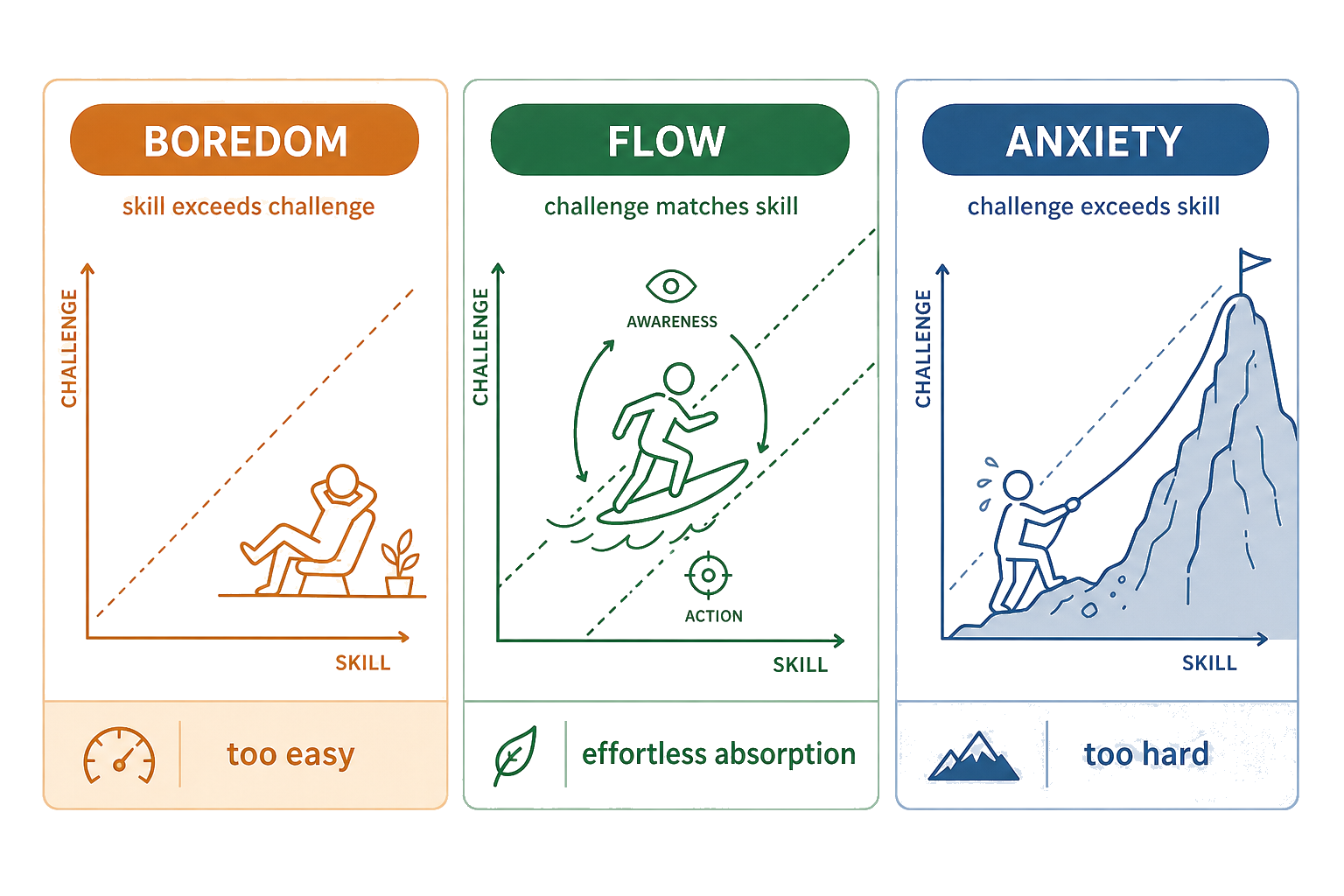
Boredom · flow · anxiety — challenge tracks skill. Pair Efficiency vs Effectivity · Flow. The conditions that reliably trigger it are a clear goal, immediate feedback, and a difficulty calibrated just beyond current ability. Once engaged, attention is fully allocated to the task, which suppresses self-monitoring (the inner critic quietens) and the metabolic cost of divided attention drops — so the same result is reached with less felt effort. This is why flow is the efficiency counterpart to brute persistence: the outcome is the same, the energy spent is far lower.
Applications
- Designing work so that difficulty tracks rising skill, rather than fixing an unchanging bar.
- Reaching a result “with the current of the river” instead of against it — protecting energy and motivation over long projects.
- Diagnosing chronic friction: persistent anxiety signals a challenge-too-high mismatch; persistent boredom signals challenge-too-low.
Sources
Cite
- Csikszentmihalyi, M. (1990). Flow: The psychology of optimal experience. Harper & Row.
- Nakamura, J., & Csikszentmihalyi, M. (2002). The concept of flow. In Handbook of Positive Psychology (pp. 89–105). Oxford University Press.
- Csikszentmihalyi, M., & LeFevre, J. (1989). Optimal experience in work and leisure. Journal of Personality and Social Psychology, 56(5), 815–822.
Related doctrine
Efficiency vs Effectivity
Deliberate Practice