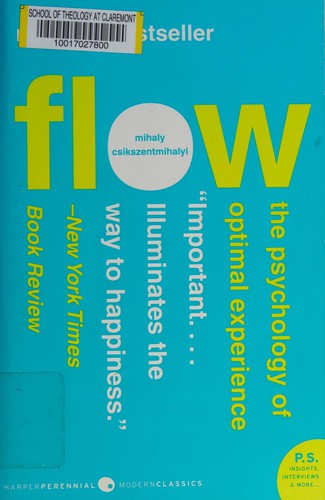
 | Flow — deep task immersion where self-consciousness drops — emerges when challenge matches skill. The channel is designed, not hoped for. Mihaly Csikszentmihalyi First published 1990 - Reprint (1991) · Harper Perennial · ISBN 9780060920434 |
|---|
Key principles
- Flow channel — Optimal experience sits where perceived challenge and skill are both high and roughly matched; mismatch yields boredom or anxiety.
- Autotelic activity — The doing itself becomes the reward — external prizes are weak drivers compared to intrinsic structure of the task.
- Clear goals + immediate feedback — Attention locks when you know the next move and whether it landed — ambiguity breaks the state.
- Loss of self-consciousness — Ego noise drops when action and awareness merge — rumination is anti-flow.
- Challenge calibration — Raise difficulty in small steps as skill rises; static tasks decay into routine or overwhelm.
Core science
The culmination of decades of empirical research on autotelic experiences — states of deep, focused task immersion where the ego dissolves.
Application
Provides an engineering formula — balancing challenge level against skill level — to systematically induce hyper-productivity and high life satisfaction. Open Behavioral change canon on the Atlas shelf for the mechanism map. Curated domain trail: Deliberate Practice · minute-zero scatter: Focus.