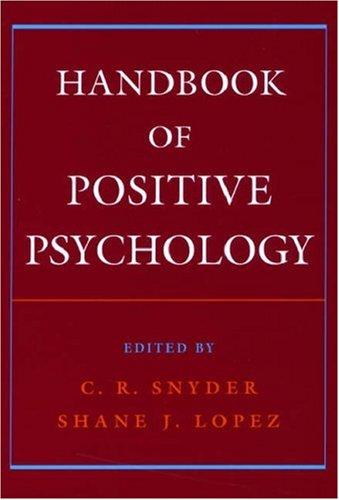
 | The reference shelf for what makes life work — the edited survey of strengths, well-being, and optimal experience, home to Nakamura and Csikszentmihalyi’s canonical chapter on flow. Snyder, C. R., & Lopez, S. J. (Eds.) (2002) · Oxford University Press · ISBN 0195135334 |
|---|
Key principles
- Field mandate — turn psychology’s lens from repairing pathology to studying what makes life worth living.
- Three pillars — positive subjective experience, positive individual traits, positive institutions.
- Character strengths — the push toward a classification of strengths and virtues (precursor to the VIA framework).
- Flow chapter — Nakamura and Csikszentmihalyi’s canonical account of optimal experience — the anchor cited from this volume.
- Subjective well-being — the hedonic measurement tradition (life satisfaction, affect balance) surveyed as a science.
- Hope and optimism — exemplar constructs (hope theory, learned optimism) showing the agentic side of the field.
Core science
An edited survey, not a single argument: Snyder and Lopez assemble the founding constructs of positive psychology — well-being, strengths, flow, hope, resilience — each chapter written by the construct’s primary researchers. Its authority is curatorial, codifying a field at its inception rather than advancing one thesis.
Application
The container reference for the flow chapter and the broader strengths literature. Open it for the canonical overview behind the optimal-experience model. Flow