Definition
The Johari window is a model of self-awareness that divides what can be known about a person into four panes, formed by crossing two axes: known versus unknown to self, and known versus unknown to others.
Origin
The model was created in 1955 by two American psychologists, Joseph Luft and Harrington Ingham — the name “Johari” is a contraction of their first names. It was developed as a tool for understanding interpersonal awareness and group dynamics, and is still widely used in coaching, therapy, and team development.
Mechanism
The two axes produce four panes:
- Open — known to self and to others (what you show and acknowledge).
- Hidden — known to self, unknown to others (what you conceal).
- Blind spot — unknown to self, known to others (what others see in you that you cannot).
- Unknown — unknown to self and to others (latent patterns, undiscovered capacities).
Growth is the movement of area between panes: disclosure shrinks the Hidden pane, feedback shrinks the Blind spot, and reflection or new experience opens the Unknown. The decisive leverage sits in the fourth pane — the more you make conscious of what you did not know you did not know, the more governance you gain over the patterns that were silently shaping your results.
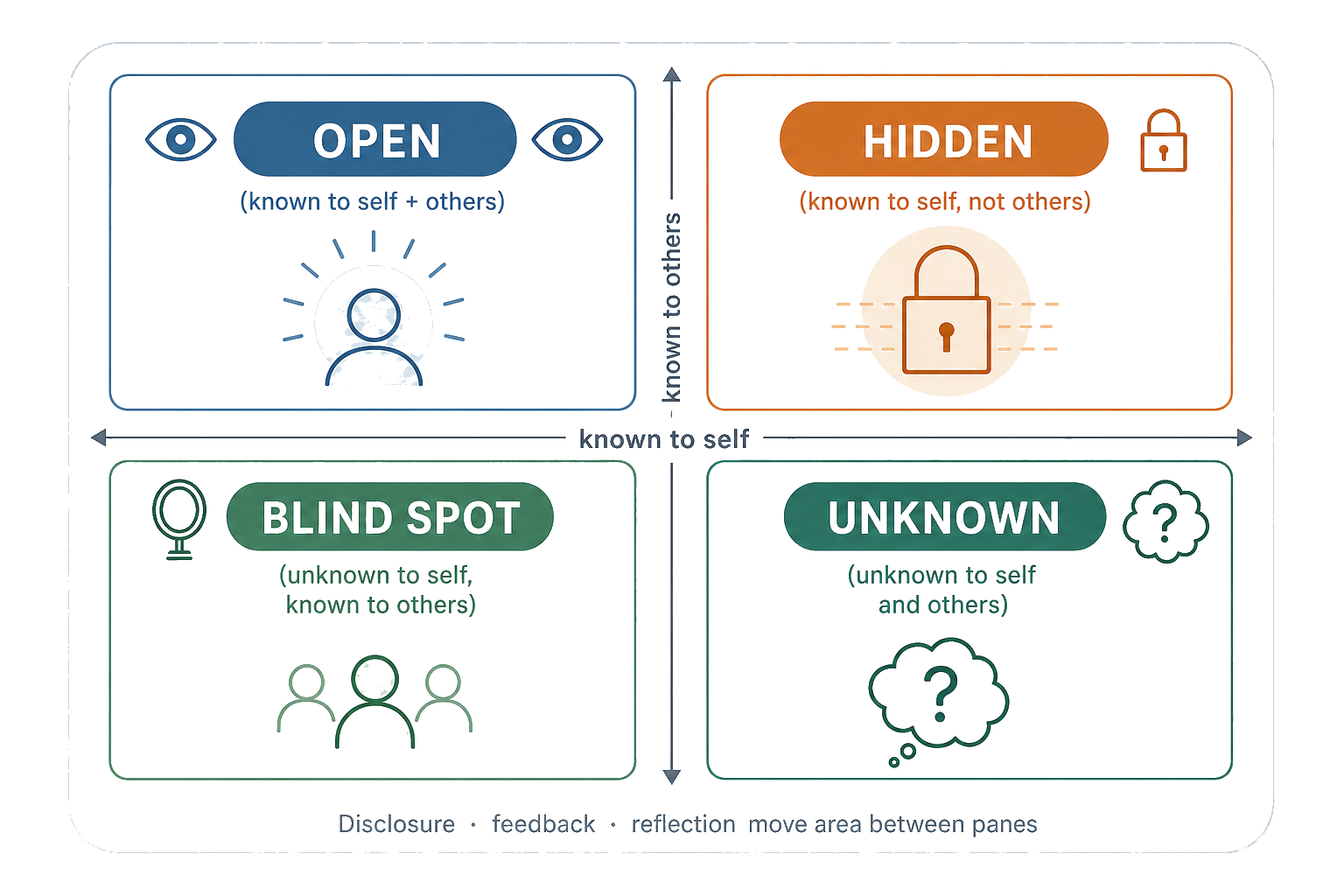
Four panes — disclosure shrinks Hidden, feedback shrinks Blind spot. Pair Quality of Questions · Of Human Interaction.
Applications
- Mapping where to seek feedback (Blind spot) versus where to risk disclosure (Hidden).
- Framing self-inquiry: the unknown-unknown pane is why structured questions and outside perspective expand self-knowledge faster than introspection alone.
- Locating a recurring failure pattern that the person cannot yet name but others can observe.
Sources
Cite
- Luft, J., & Ingham, H. (1955). The Johari window, a graphic model of interpersonal awareness. Proceedings of the Western Training Laboratory in Group Development. UCLA.
- Luft, J. (1969). Of human interaction: The Johari model. Mayfield.
- Vazire (2010) — self–other knowledge asymmetry — empirical evidence that blind spots are real and trait-specific.
Related doctrine
Quality of Questions · Inner Tribunal