Working definition
The inner tribunal is the court inside you that condemns early — it biases what you call realistic and whether you give yourself permission to go for the ambition.
How it works
When Branka asks what is realistic? on 2026-06-29, Yann refuses a generic answer and points at who judges. The Johari window maps the cartography: what you know of yourself, what you do not, what others see, what neither side has opened yet. The criteria for realistic may come from a part that fears, a part that believes it already knows you, or a part whose existence you have not yet discovered.
The inner tribunal is the mechanism that runs the verdict — this is realistic / this is not — often before calendar evidence or lead measures speak. That verdict skews permission before strategy is tested. The psychology of realistic as a shield — fear, tribe voice, dissonance, past failure — lives in Realistic; the operational move here is naming who sits on the bench.
Pair with Identity Gap when the tribunal’s sentence does not match the evidence stack; with Quality of Questions to ask realistic by whose criteria?
Signature
Yann on 2026-06-29: with this inner tribunal that will condemn me, I bias my perception of what I consider realistic — the work is not harder planning first; it is identifying the judge before you negotiate cadence (efficiency vs forced effectivity).
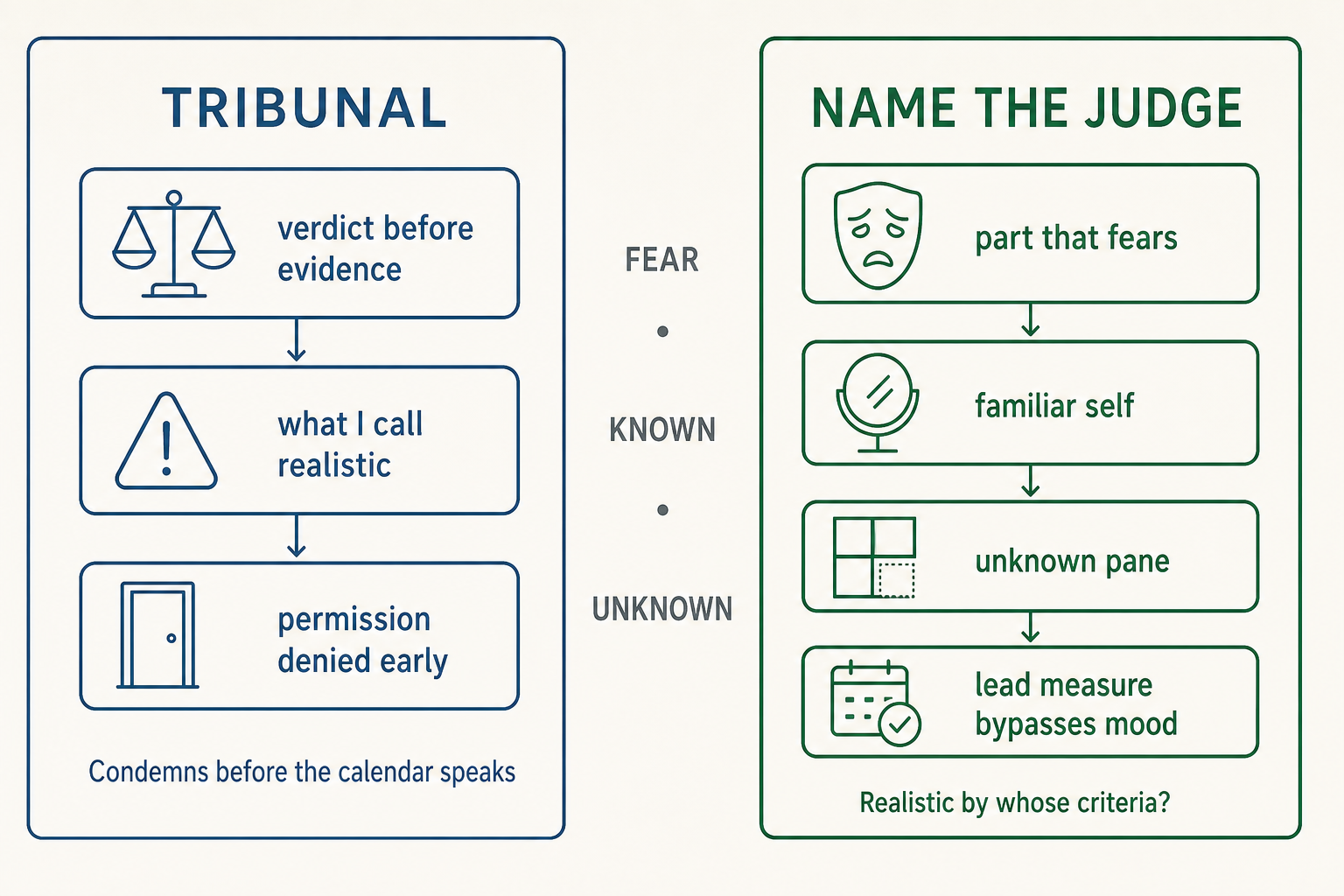
The tribunal condemns before evidence — name who judges · then one lead measure the calendar can show. Branka room stays in prose above. Your move: Your move this week.
Your move this week
- Write one ambition or cadence line you are questioning.
- Finish: What I call realistic is judged by … — name the part (fear · familiar self · unknown pane).
- Add one lead measure that bypasses the tribunal’s mood — evidence the calendar can show.