Definition
The inner child is the part of the psyche that carries the feelings, unmet needs, and survival strategies of early life, continuing to shape adult emotion and behaviour.
Origin
Carl Jung described the “child” as an archetype expressing both early wounding and future potential. The clinical popularisation came through John Bradshaw (1990), who linked unmet childhood needs to adult dysfunction and proposed “reparenting.” Internal Family Systems (Richard Schwartz) reframes such parts as protective sub-personalities — often young, often holding burdens — that can be approached with curiosity rather than suppressed.
Mechanism
When a present situation rhymes with an early one, the corresponding part activates and supplies an outsized emotional charge and a familiar protective reflex.
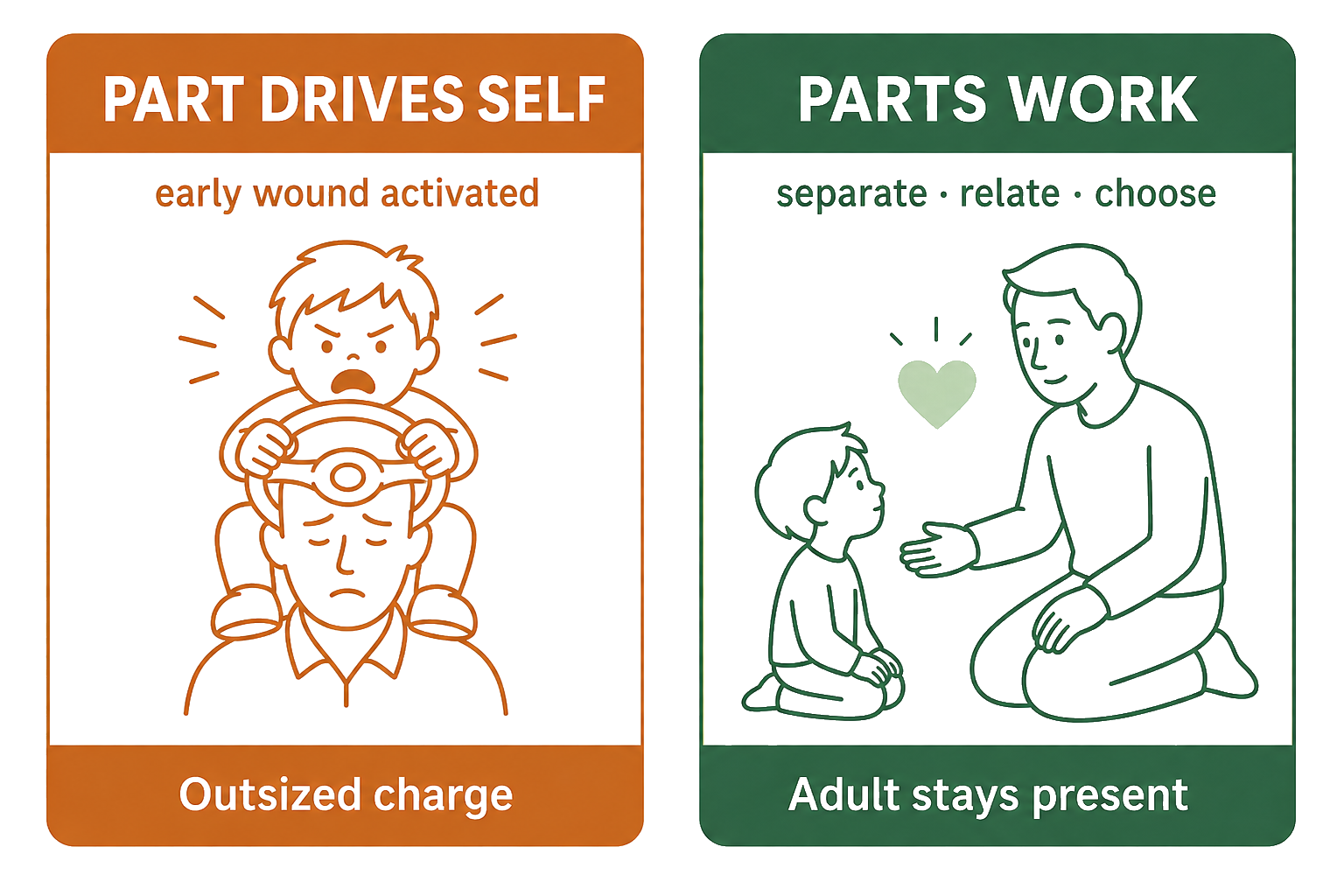
Part drives self versus adult meets part — separation restores choice. Pair Master of Opposites · IFS.
Treating the reaction as a part with a need — rather than as the whole self — allows the adult self to stay present, meet the need, and choose a response instead of being driven by it. This is the core move of “parts work”: separation from the part, then relationship with it.
Applications
- Naming a disproportionate reaction as a part lowers its grip and restores choice.
- Reparenting practices (acknowledgement, reassurance, met need) reduce reactivity over time.
- Integrating opposing parts — the fearful and the capable — supports a fuller self-image.
Sources
Cite
- Jung, C. G. (1951). The psychology of the child archetype. In The Archetypes and the Collective Unconscious. Princeton University Press.
- Bradshaw, J. (1990). Homecoming. Bantam.
- Schwartz, R. C. (1995). Internal Family Systems Therapy. Guilford Press.