Definition
Don’t break the chain is a visible streak that raises the cost of skipping a day — useful while the mark still serves the behaviour, toxic when the mark becomes the reason you act.
Origin
Identity-based habit systems treat a streak as environment design: a calendar, a darkening bar, a chain of X’s that makes “just today” expensive (Clear, 2018). Habit-formation work shows automaticity rising with repetition in the same context — a long chain is cheaper than a short one to keep (Lally et al., 2010). Measurement research adds the other face: when a measure becomes the target, it stops being a good measure (Strathern, 1997). Club language keeps both faces.
Mechanism
- Short chain. Two days does not hurt to break. The vote is cheap. The behaviour is still a decision.
- Long chain. Thirty days, forty days, two years. Breaking hurts. The next rep is cheaper than the identity hit of a gap. Visual darkening (a week recap that fills) is the cue.
- Inverted chain. The streak is now the target. The bath needs a chrono. The record steals the pleasure. Goodhart’s Law has eaten the instrument.
Adjacent, not the same: Microdoing adds a link to an imperfect system. Don’t break the chain is what a running system uses to stay running. micro dosing is a skill rep, not a streak.
Epistemic boundary: this note does not claim that longer streaks are healthier, or that every behaviour should be streaked. It claims that a visible chain that serves the behaviour and a chain that has become the behaviour are different relations to the same mark.
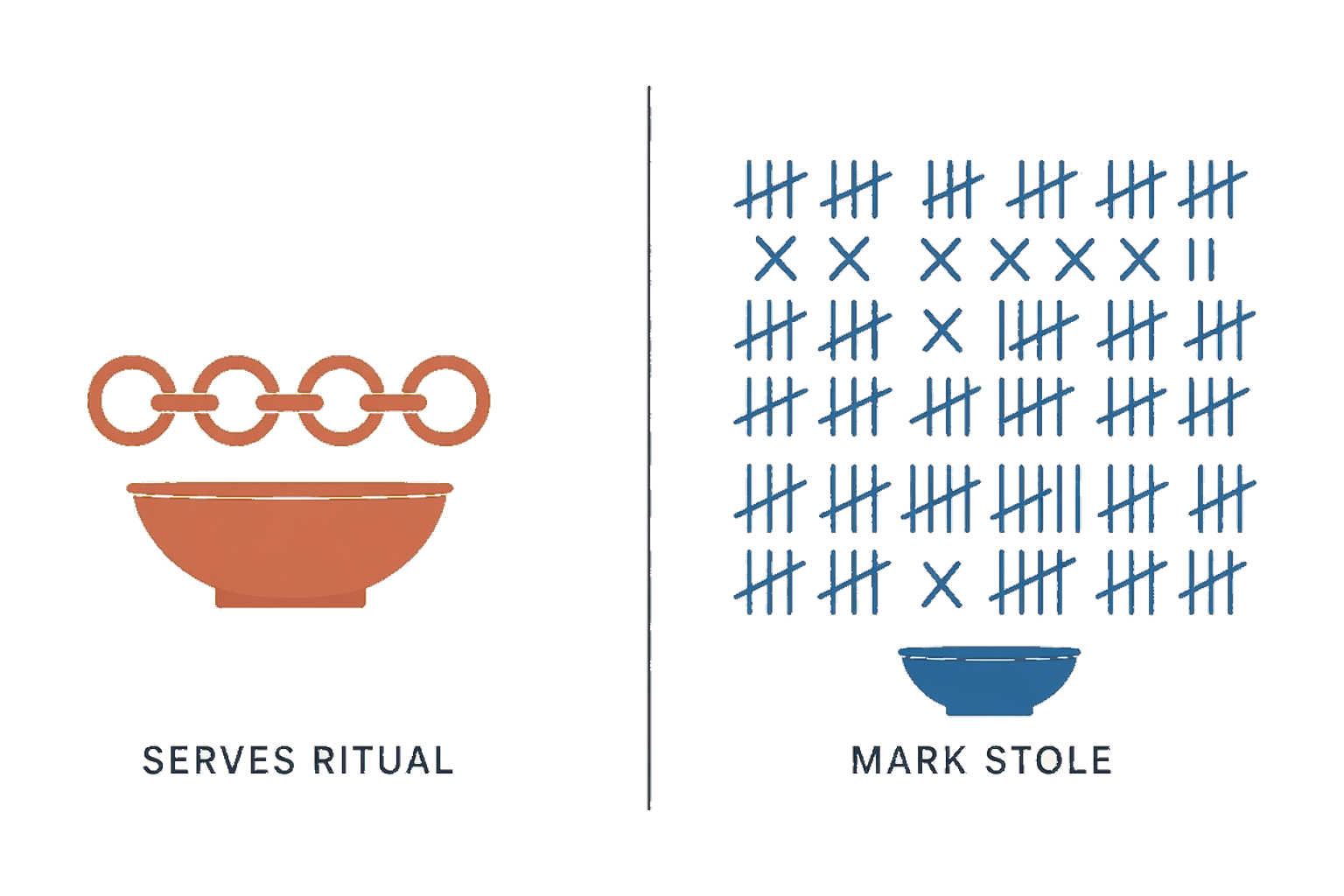
Serves ritual vs mark stole — the streak is not the bath.
Applications
- When a habit app darkens a week, ask whether the darkening still serves the ritual or has become the ritual.
- Pair with Goodhart’s Law when a watch, a record, or a scoreboard stole the pleasure of the thing being measured.
- Pair with Environment cue sculpting when the chain should live on a tile, not only on a dashboard.
Failure modes
- Collector trap: more streaks, more habits, so the chain looks serious.
- Overclaim trap: two years of X’s presented as proof the behaviour is still alive.
- Test today: name one streak. Write whether breaking it would cost identity or would cost the thing you actually wanted (calm, pleasure, skill). Drop the mark if it stole the bath.
Sources
Cite
- Clear, J. (2018). Atomic Habits. Avery
- Lally, P., van Jaarsveld, C. H. M., Potts, H. W. W., & Wardle, J. (2010). How are habits formed: Modelling habit formation in the real world. European Journal of Social Psychology, 40(6), 998–1009
- Strathern, M. (1997). ‘Improving ratings’: audit in the British University system. European Review, 5(3), 305–321