Definition
Confirmation bias is the tendency to seek, notice, and remember evidence that keeps a current story true — so a belief about who you are allowed to face becomes a filter, not a finding.
Origin
Wason’s selection-task work showed people test rules by looking for confirming instances rather than for the case that would break the rule. Nickerson’s review (1998) gathered the family: biased search, biased interpretation, and biased memory, across hypotheses that range from laboratory cards to life stories. Attentional neighbours sit beside it: once a rule is installed, the system that decides what gets noticed will keep feeding the rule. Club language uses the ordinary name. Adjacent, not the same: Reticular Activating System is the noticing hardware; confirmation bias is the story-protection on top of the noticing. Saboteur mechanics is the part that uses the bias to keep a protective layer alive.
Mechanism
A story such as I attract beginners or directors will see that I have never run a company does not wait for a verdict from the room. It selects the room, reads the pause, and files the result as proof.
- Search. You call, invite, or notice the profiles that already fit the story. Counter-examples stay unscheduled.
- Interpretation. The same silence is they know I am not enough rather than they are thinking. Projection and reception cannot be told apart from inside the story.
- Memory. Hits are kept. Misses (a guest who found value, a manager room that already transferred certainty) are filed as exceptions.
The hidden payoff is coherence. If the story is true, you do not have to risk a good projection. A prior pain — imagined a good outcome, then it failed — can install the rule: do not project good, and you cannot be disappointed. The bias then protects the rule.
Epistemic boundary: this note does not claim that every pattern you notice is imaginary, or that social feedback never carries real status cues. It claims that a story used as a filter and a contact observed as data are different relations to the same room. Crossref confirmed Nickerson (1998) and Wason (1968); the lab selection task is a narrow paradigm — the life-story application is the review’s family, not a new experiment claimed here.
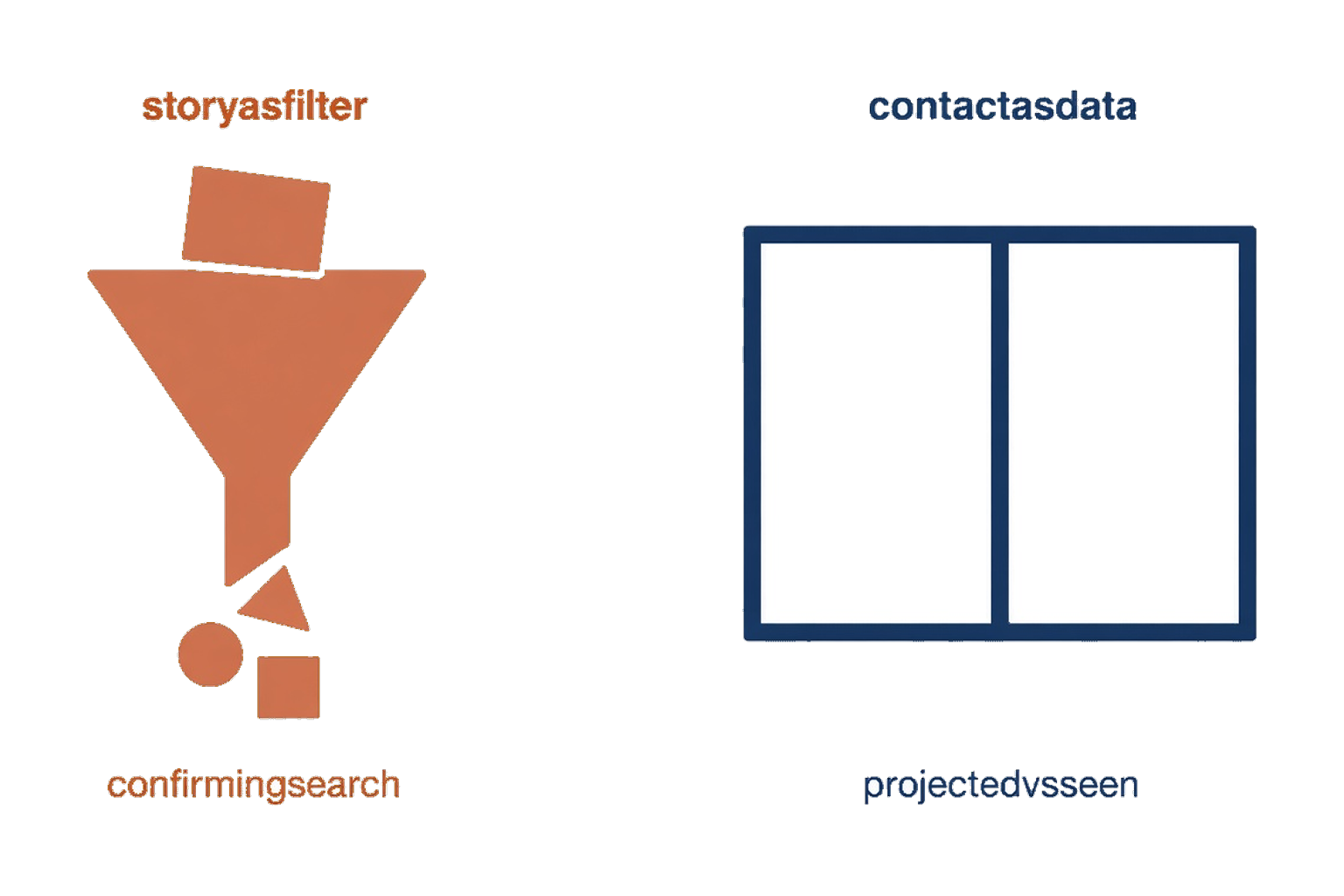
Story as filter vs contact as data — the filter is not a finding.
Applications
- When you cannot tell whether they sent the verdict or you sent it, write what you projected before you write what they did.
- When a room always confirms not enough, ask which profiles you never schedule.
- Pair with Failure Strategy when the no is a chain that the bias then stamps as evidence.
Failure modes
- Collector trap: more confirming anecdotes instead of one disconfirming contact this week.
- Overclaim trap: treating every social cue as bias, including a real mismatch of skill.
- Test today: after one contact, write two columns — what I projected, what I actually saw — before the story closes.
Sources
Cite
- Nickerson, R. S. (1998). Confirmation bias: A ubiquitous phenomenon in many guises. Review of General Psychology, 2(2), 175–220
- Wason, P. C. (1968). Reasoning about a rule. Quarterly Journal of Experimental Psychology, 20(3), 273–281