Definition
Identity decoupling is the gesture of treating the global I as an assembled engine — parts pulled into space, still in assembly order — so the piece that shrinks, protects, or votes no can be pointed at without replacing the whole machine.
Origin
Narrative-identity work treats the self as an internalized, evolving life story that integrates a reconstructed past and an imagined future (McAdams & McLean, 2013). Identity-complexity research (Linville) adds that a self with differentiable facets absorbs a blow in one facet without collapsing the others. Technical illustration already has the drawing: an exploded view of an engine, fasteners released, parts drifted along their axes so a mechanic can see what belongs where. Club language identity decoupling applies that drawing to the I that claims to be one block. Adjacent, not the same: Exploded-view thinking is the pedagogic decomposition of a harvested pattern (a win, a weekend, a failure loop). Decoupling is the same gesture applied to the identity that is running the pattern. Identity Shift is the death of a layer after the parts are visible — not the drawing itself.
Mechanism
A global identity says: I am not the person who can sit with directors; I am the person who is legitimate with managers; I am the person who made himself small on the first site. Those sentences travel as one verdict. Decoupling pulls them apart.
- The assembly. Roles, chapters, and protective parts are fastened into a single I. A threat in one chapter (elders, captains, a dream) shuts the whole engine down.
- The explode. Name the pieces: the manager who already has evidence; the beginner who attracts beginners; the boy on the site who knew nothing; the voice that says calm down after a big picture. Each piece has a job. Each piece has a hidden payoff.
- The reassembly. You do not throw the engine away. You see which fastener is doing the shrinking, and you can choose a different part to speak from — the certainty you already inhabit — without first becoming a new person.
The Failure Strategy question (how do you go about continuing not to succeed?) is a decoupling tool: it forces the chain of thoughts into named steps. The saboteur voice is one part, not the author.
Epistemic boundary: this note does not claim a clinical parts protocol, and it does not license diagnosing anyone from a metaphor. It claims that a self treated as one verdict and a self treated as assembled parts are different relations to the same shrinking. Crossref confirmed McAdams and McLean (2013) and Linville (1987); identity complexity is a buffer finding from one lab tradition, not a license to treat every mood as a module.
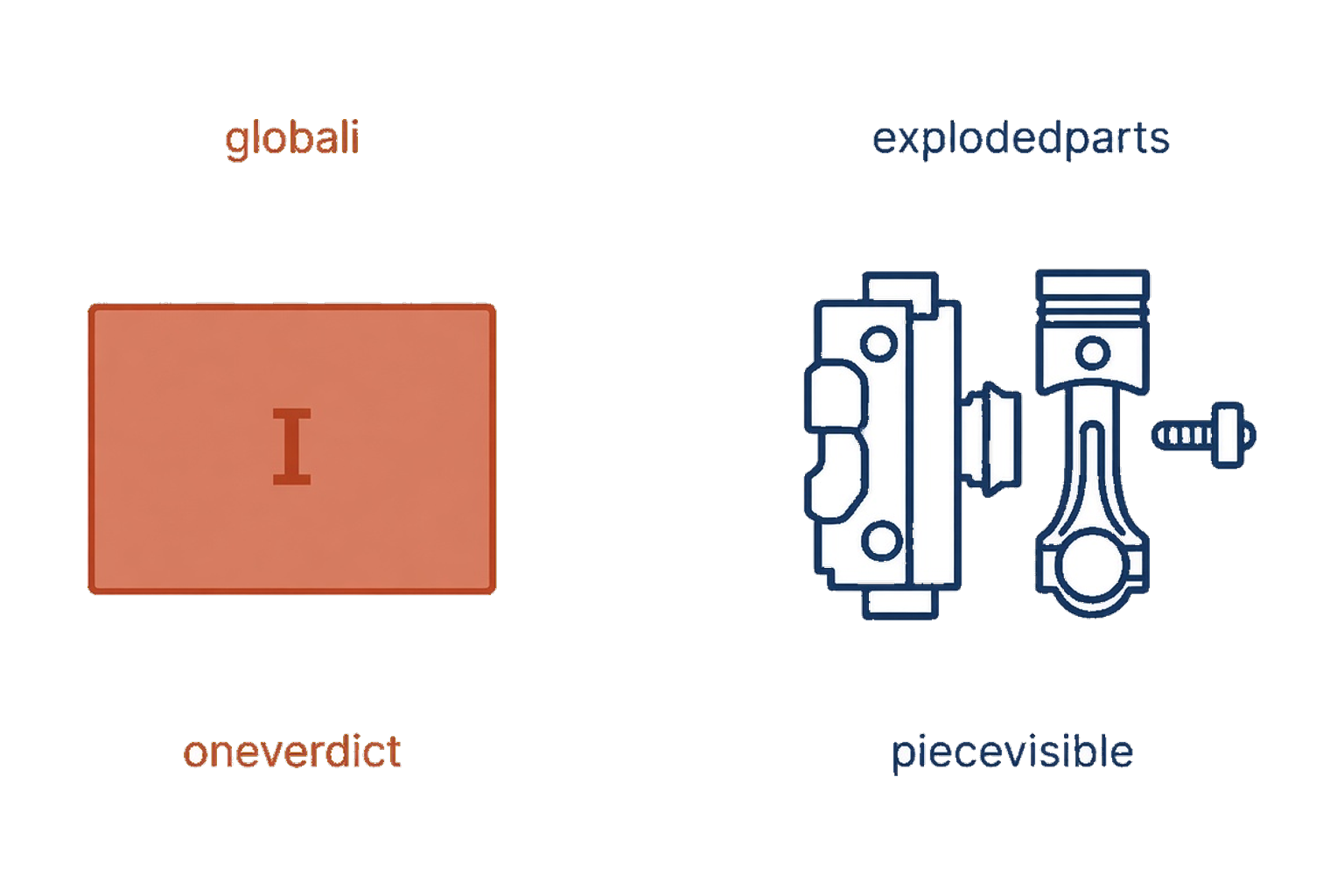
Sealed I vs exploded parts — the verdict is not the engine.
Applications
- When a dream and a calm-down voice arrive in the same second, name which part spoke — do not let the second voice author the identity.
- When legitimacy is easy in one role and collapses in another, explode the two roles before you invent a third self.
- Pair with Failure Strategy when the no is a chain, not a weather.
Failure modes
- Collector trap: naming more parts instead of watching one chain this week.
- Overclaim trap: treating every mood as a permanent identity module.
- Test today: write the steps of one how I continue not to authorize the big picture chain — three links, then which part fastened them.
Sources
Cite
- McAdams, D. P., & McLean, K. C. (2013). Narrative identity. Current Directions in Psychological Science, 22(3), 233–238
- Linville, P. W. (1987). Self-complexity as a cognitive buffer against stress-related illness and depression. Journal of Personality and Social Psychology, 52(4), 663–676