Definition
An exploded view shows a whole as named parts held in spatial relation — close enough to reassemble, far enough that each piece can be pointed at and taught.
Origin
Exploded-view drawing is a standard of technical illustration: an engine, a joint, a device is drawn as if the fasteners released and the parts drifted along their assembly axes. The point is not decoration. The point is that a person who must service the machine can see what belongs where without destroying the object. Larkin and Simon (1987) measured the cognitive neighbour: a diagram helps when it makes the needed relations explicit and searchable — not because pictures are inherently clearer. Chi and colleagues (1989) added the learning step: students who explain the example to themselves outperform those who only reread it. Club language exploded view borrows the engineering form for a harvested pattern — a victory, a failure loop, a weekend that worked.
Mechanism
A pretty poster collapses the machine back into one image. An exploded view forces named parts + order. Generating the drawing (or prompting it) is cheap; appropriating it is the learning step — you must say what each part does and how it refits. That is retrieval plus teach-back, not consumption. If a model draws the poster and you never reassemble the parts in speech, the file is a souvenir.
Epistemic boundary: this is pedagogic method, not a tested clinical protocol. Larkin and Simon compared sentential vs diagrammatic representations on physics-style problems; they do not license every generated poster. Chi et al. studied students learning from worked examples — the gain is from producing the explanation, not from owning a cleaner image. Do not claim that drawing an exploded view causes mastery — claim that it makes the missing part visible.
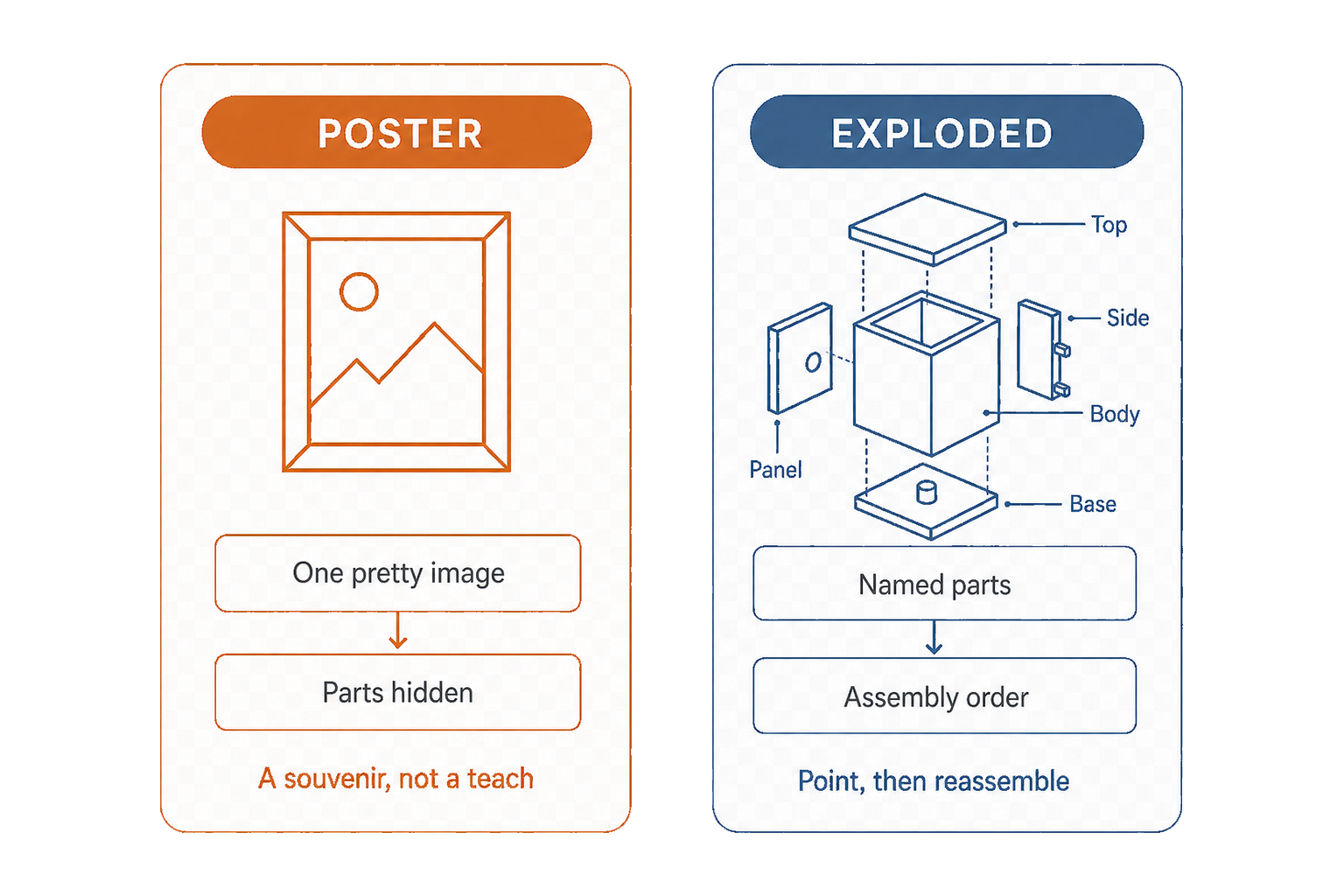
Poster vs exploded — one image hides the parts; named pieces in assembly order can be taught.
Applications
- When a win stays as a feeling, pull it into parts (condition · move · consequence · what you will repeat).
- Pair with Active Recall: screen-share the exploded view and teach it; the room adds the missing washer.
- Pair with Dedicated AI project only after you can name the parts — the prompt is “explode this pattern,” not “make me a nice image.”
Failure modes
- Collector trap: generating posters instead of teaching one exploded view once.
- Overclaim trap: treating a generated image as understanding.
- Test today: name five parts of one recent win, in assembly order, without looking at the file.
Sources
Cite
- Larkin, J. H., & Simon, H. A. (1987). Why a diagram is (sometimes) worth ten thousand words. Cognitive Science, 11(1), 65–100
- Chi, M. T. H., Bassok, M., Lewis, M. W., Reimann, P., & Glaser, R. (1989). Self-explanations. Cognitive Science, 13(2), 145–182